Mazda CX-70
Race to it: the motor racing museum in Bathurst
By Jane Johnston
I’m racing a Mazda CX-70 Azami on Mt Panorama… I’m on the final straight with no other car in sight but know that legendary race cars are not far away. I’ve outpaced them all and tear along at 300 km/hr, the CX-70’s voracious 3.3L inline-6 turbo kicked into full power…
Well, that was a dream. But I truly drive it the next day. This iconic track is a looping public road for anyone to drive, any day except when an event is scheduled.
The CX-70 easily handles The Esses that swing tightly down the mountain and all the rest. I keep to the 60 km/h limit, and that feels fast enough to me around those curves now.
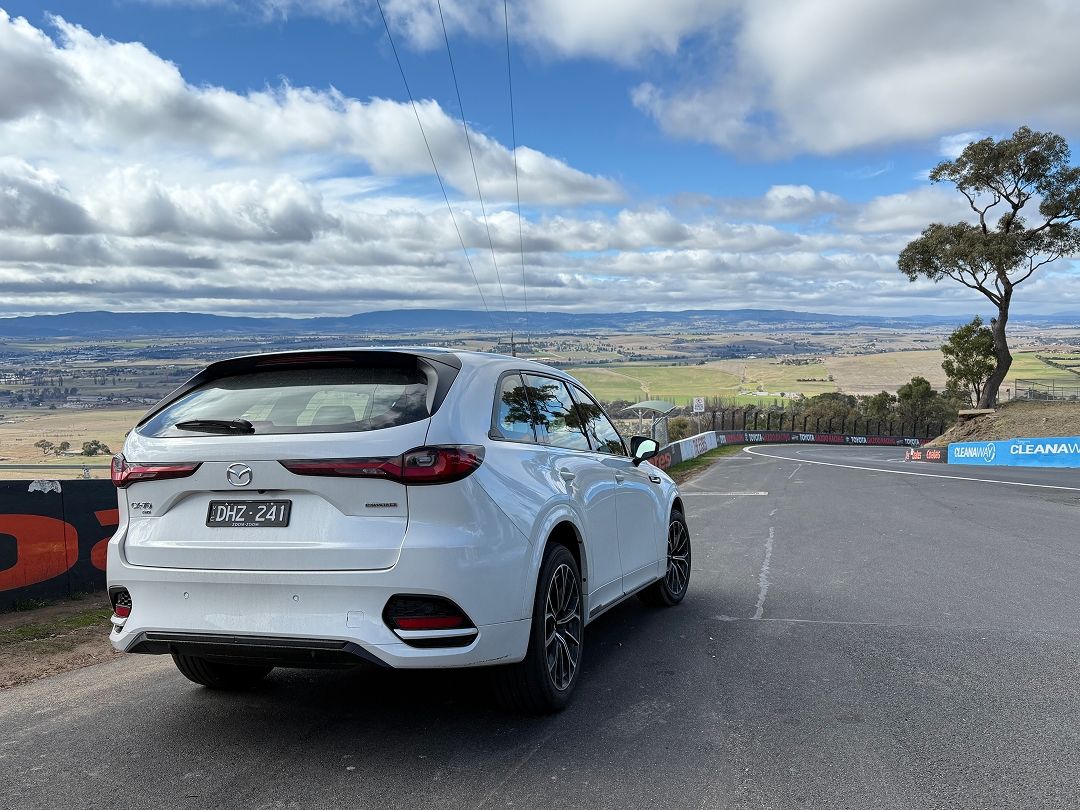
CX-70 Azami at the top of the Mt Panorama racetrack
I’m awed by the daring and skill of the drivers who race here, and by the truly panoramic views from the top of Mt Panorama, named Wahluu in the Indigenous Wiradjuri language.
And those legendary cars are in front of me, as I make a no-screech pull into the National Motor Racing Museum by Murray’s Corner of the track to meet Brad Owen. He’s the Museum Co-ordinator and a self-described motorhead, who is also an expert in Australian motorsport.
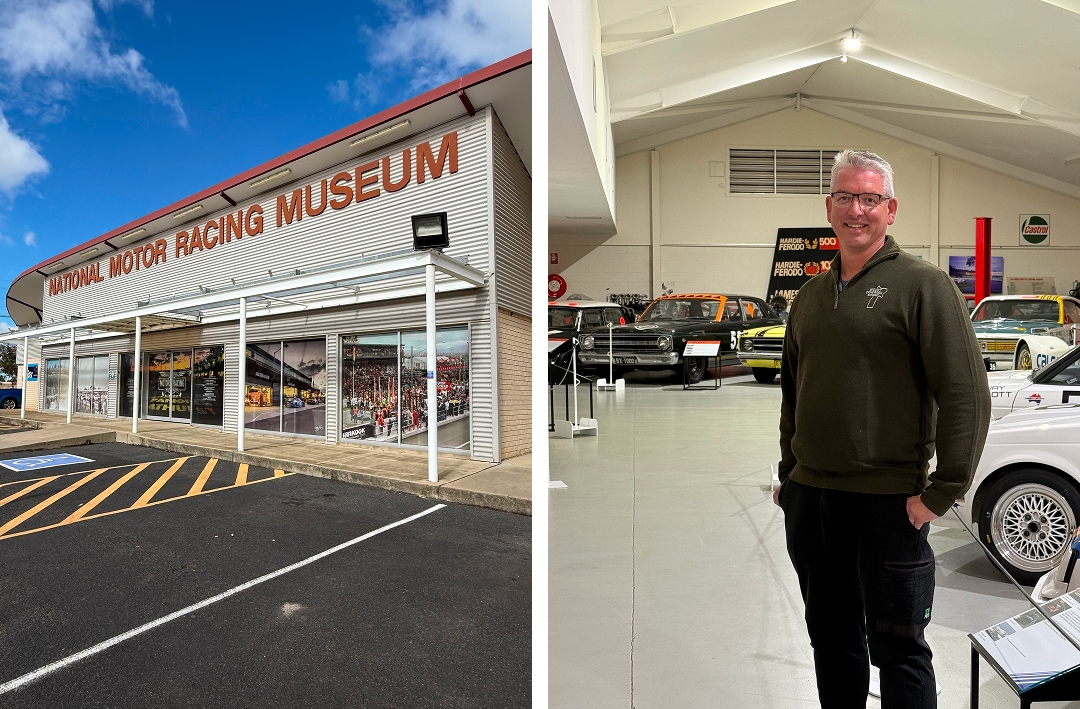
National Motor Racing Museum, Museums Bathurst. Brad Owen, Museum Co-ordinator
We step inside, and before us is an array of over one hundred race vehicles, counting the cars, and the three-wheeled bikes with sidecars, and the motorbikes. The range of different manufacturers, models and eras on view is wide, and it covers various types of racing. In cars, that means open wheel (formula), Grand Touring, touring car and rally racing.
Most are covered in vibrant sponsorship graphics, and there’s immense visual energy in the mix of riotous colours and shapes. I am wowed by that, but also by the superb Australian history of it all.
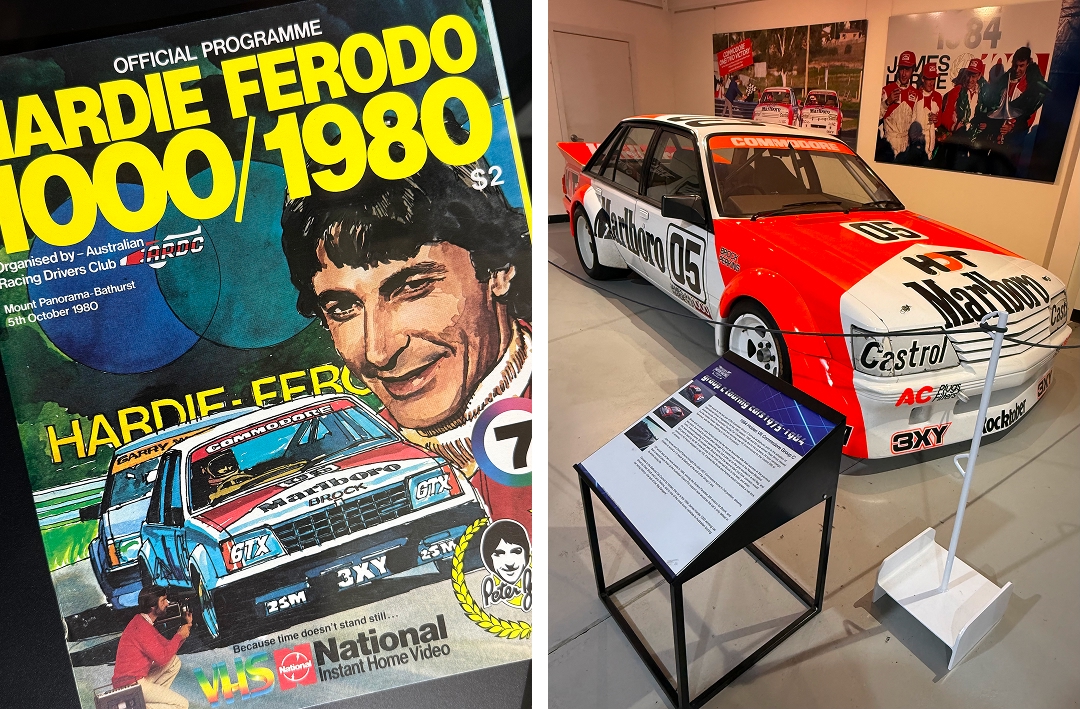
Left: 1980 James Hardie 1000 program front Right: 1984 Holden VK Commodore; last race 1984 James Hardie 1000, win, Peter Brock & Larry Perkins
Brad and I walk and talk among the cars, and soon I notice that some still wear their history – dirt and dings. Brad says, ‘The cars here range from those that are freshly restored and absolutely pristine to a few that haven't really been touched since they finished their last race.’
One such is the Holden VK Commodore with wins that include the James Hardie 1000 at Bathurst in 1984, driven by Peter Brock and Larry Perkins for the Holden Dealer Team. When you see it in person, you fully appreciate how a coat of dirt and a few dings doesn’t dull the looks of this 1980s motorsport classic, resplendent in luminous DayGlo paint. Quite the opposite.
Also here on permanent display is the Ford Falcon FG X, crashed while qualifying in the 2015 Bathurst 1000 by Chaz Mostert, the defending champion. This thoroughly smashed car and the AV presented beside it, powerfully show the dangers of motorsport, and how car and track safety design continuously evolve, as well as how far developed this already was by 2015. Mostert suffered relatively minor injuries (to bones and ligaments) in what was a major accident.
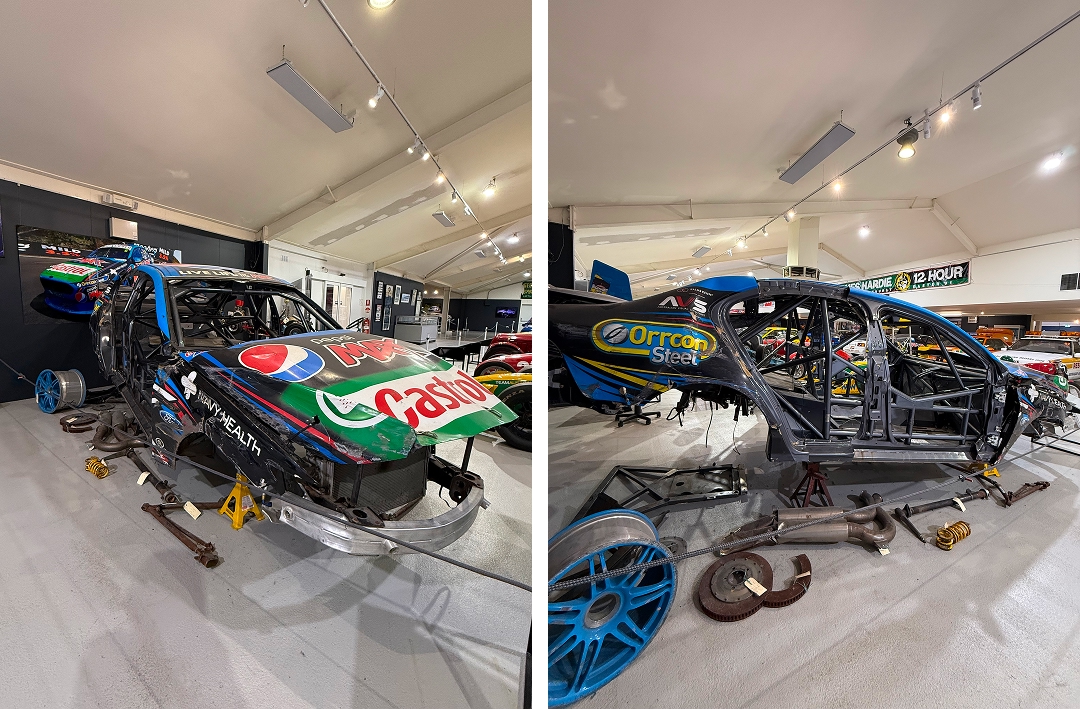
2015 Ford Falcon FG X; last raced 2015 Supercheap Auto Bathurst 1000, crashed in the qualifying round, defending champion Chaz Mostert
The Museum naturally has a strong focus on Bathurst, and on that touring car race so much bigger in popular culture awareness than any other Australian motor race: the Bathurst 1000, with the current full title of Repco Bathurst 1000.
On a ‘motorsports and more’ road trip to Bathurst with history as a theme, this race really interests me.
Brad and I pause beside three cars – a zippy-looking Mini beside two hulking V8s, replicas of the winners from 1966 to 1968, when the race was 500-miles. As Brad talks, I’m struck by how they reflect distinct points in the history of the race and of car design and production.
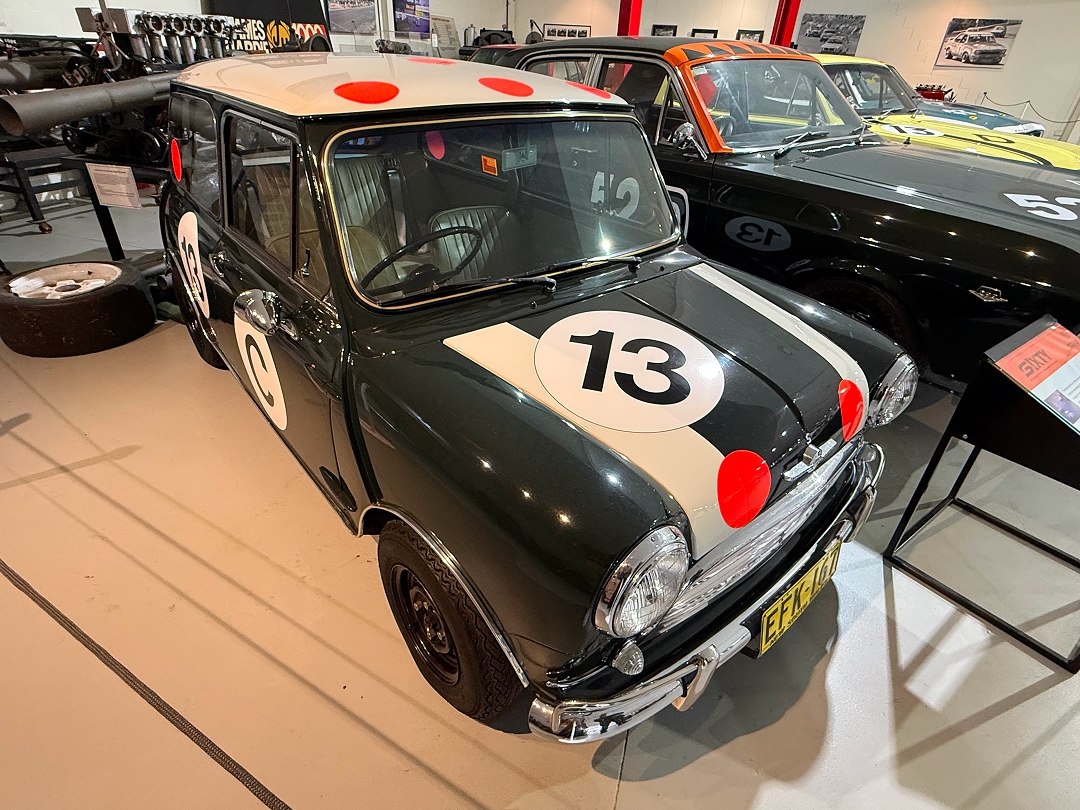
Mini Cooper S; (replica) 1966 Gallaher 500, win, Rauno Aaltonen & Bob Holden; livery restored to that race
Brad says, ‘In the 1966 race, a Mini held the first nine positions in the race. The Mini was absolutely dominant back then, but after Ford released the Falcon GT with a V8 engine the following year, the next time a four-cylinder car won the race after 1966 was 1988, and that was a turbo-charged four-cylinder car.’
Turning to the V8s, he says, ‘This was the first Ford V8 to win the race, 1967, an XR Falcon GT, and here’s the first ever Holden to win, an HK Monaro GTS in 1968.’ He adds that they represent the start of ‘the Ford vs Holden era’ in Australian history and gives a trackside picture of this intense rivalry, mentioning how masses of spectators came to loyally dress in blue for Ford or red for Holden.
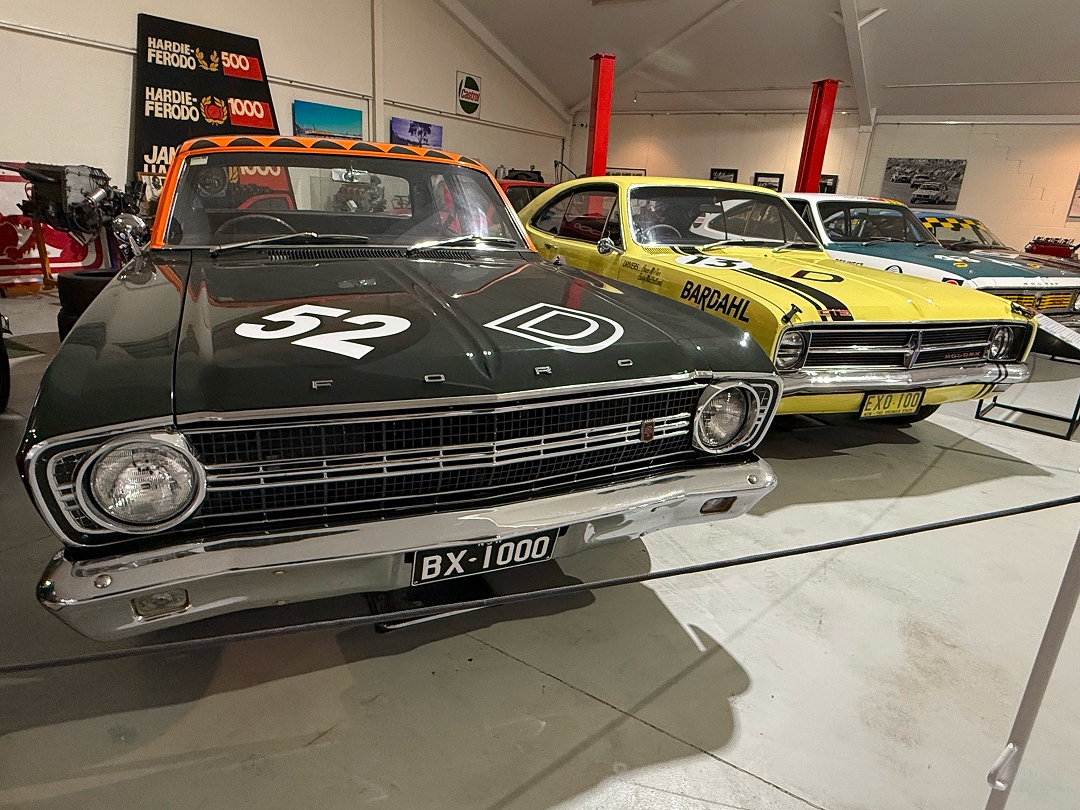
Ford XR Falcon GT; (replica) 1967 Gallaher 500, win, Harry Firth & Fred Gibson; livery restored to that race
The Mini’s dots are a standout, veritably asking to be discussed, and Brad explains that they served to instantly identify the car from a distance. Imagine a race with multiple green minis (as in 1966) to grasp why such markings were important, especially in the pitstop. The Falcon’s triangles around the windscreen, and the Monaro’s stripes had the same purpose.
1967 was the first year that on-car sponsor advertising was allowed, and I hear how the 1968 winning Monaro shows the first time that the Holden Dealer Team specially designed a race ‘livery’ – a car-body graphic design with sponsor advertising.
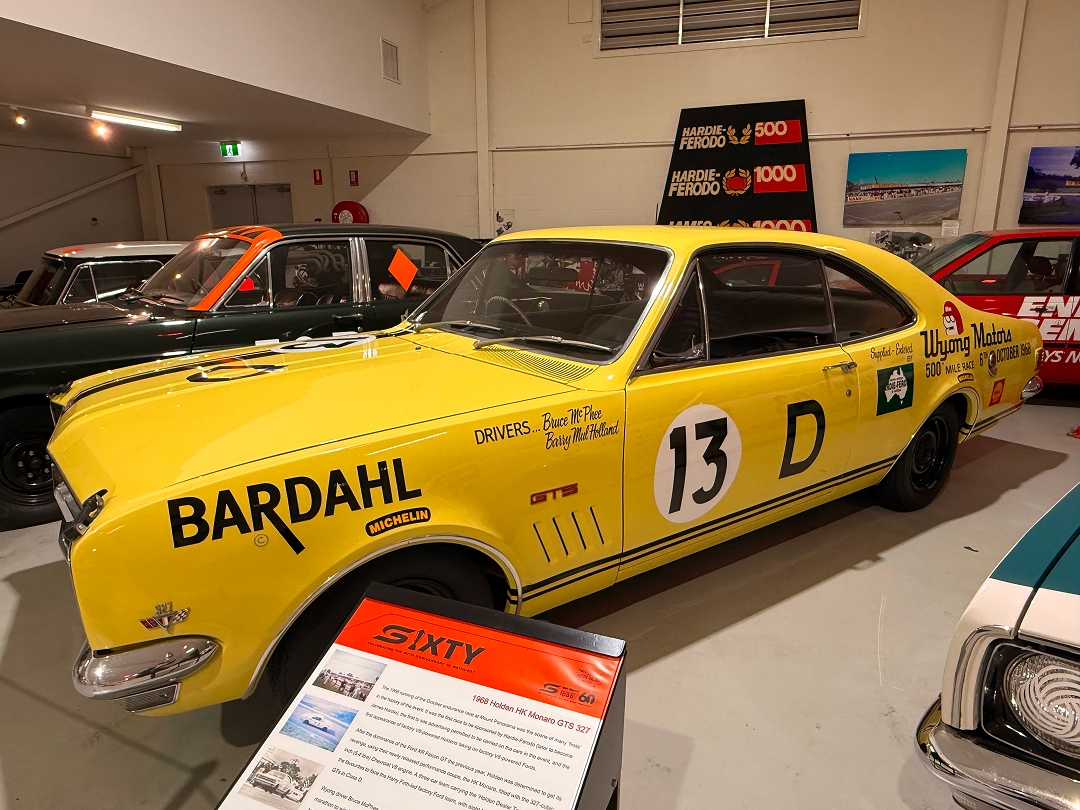
Holden HK Monaro GTS 327; (replica) 1968 Hardie-Ferodo 500, win, Bruce McPhee & Barry Mulholland; livery restored to that race
Looking across the spectacle of sponsorship graphics in the Museum, the advertising is more grab-your-eyes bold and multi-sponsor in the later years, and Brad explains this as because the sport became increasingly expensive.
I’m fascinated, and Brad says, ‘There’s a load of Australian history represented in all these graphics.’ Decades worth, and they do really show how times change, Brad for instance referring to ‘the tobacco era of advertising, now long gone’.
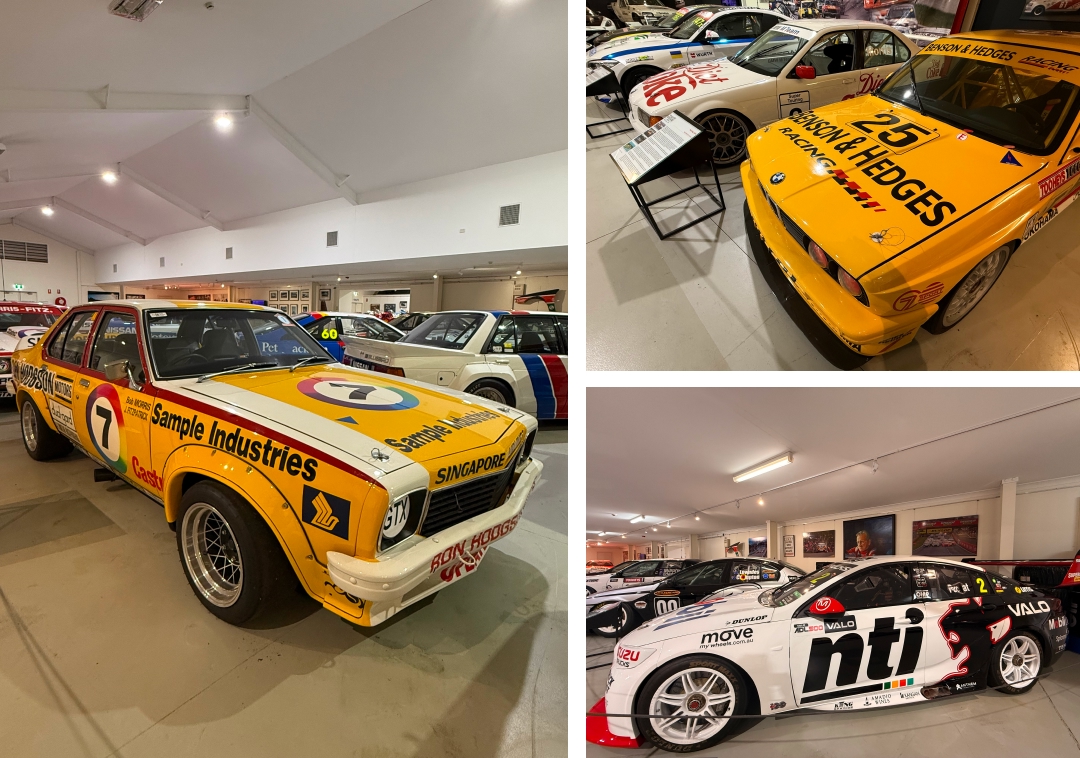
Left: 1974 Holden LH Torana SL/R 5000 L34; races include 1976 Hardie-Ferodo 1000, win, Bob Morris & John Fitzpatrick; livery restored to that race Top right: 1992 BMW M3 Evolution; races include 1992 Tooheys 1000, 4th, Tony Longhurst & Johnny Cecotto; livery restored to that race Bottom right: 2020 Holden ZB Commodore; races include 2022 Adelaide 500, Nick Percat; livery 1990s Holden retro design – last weekend of Holden racing in Supercars
We talk about the ‘production rules’ over the 500-mile (pre-1973) years of the race, which meant that race cars had to be road cars for sale in Australia, with very minimal pre-race modification. ‘That's why I think Bathurst became so iconic’, says Brad, ‘because they were racing cars that you’d actually see on the road.’
Cars from this early era of Bathurst racing often have a strong resonance for Museum visitors, and Brad says that nostalgia accounts for some of that. But it’s also that race cars are considered as supreme in car culture, and I sense this – to be in the presence of these cars is to appreciate their star quality.
‘So, it's not only that visitors say, for instance, my dad had that car, or my favourite racing car driver won in that,’ says Brad. ‘For some visitors, it’s more like, I remember those cars, and this was the ultimate expression of that car.’
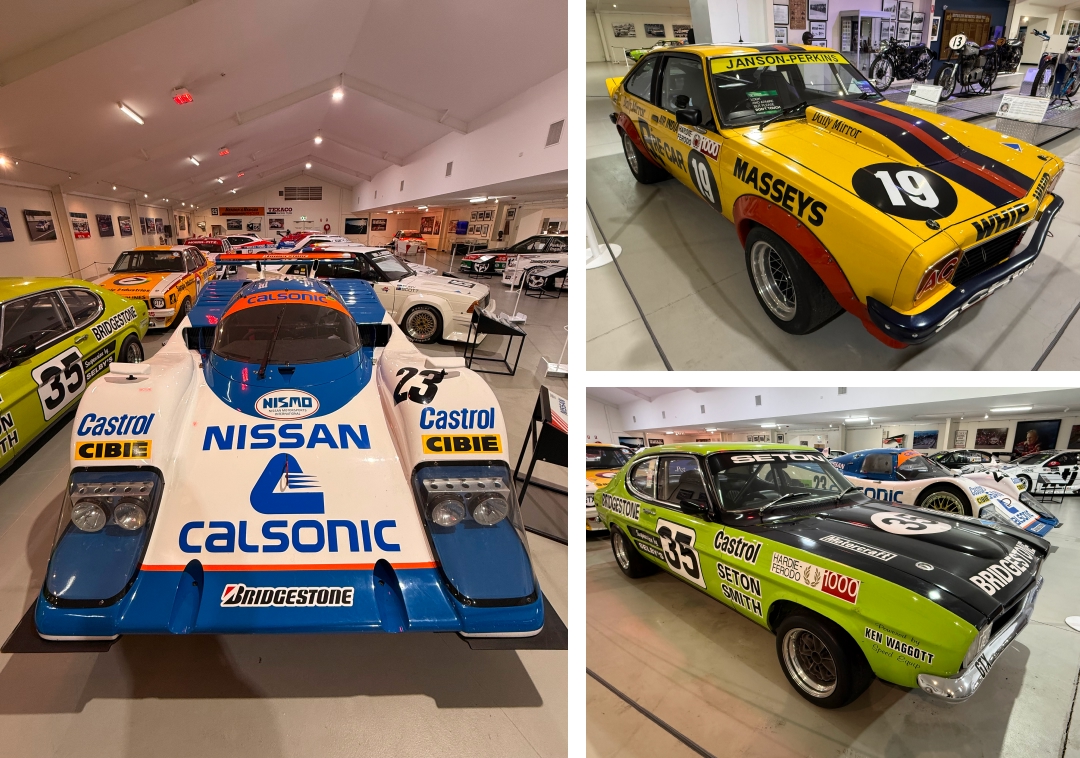
Left: 1988 R88C sportscar by Nissan; races include 1988 Le Mans 24 Hour, Kazuyoshi Hoshino, Taksa Wada and Aguri Suzuki; livery as for that race. Top Right: 1979 Holden LX Torana SS A9X; races include 1979 Hardie-Ferodo 1000, 2nd, Peter Janson & Larry Perkins; livery restored to that race Bottom Right: 1975 Ford Capri V6 Coupe; races include 1975 Hardie-Ferodo 1000, Barry ‘Bo’ Seton & Don Smith, livery restored to that race
Those production rules ended up creating furore.
How? Showroom sales of the winning car began to rise sharply, immediately post-race. ‘By 1967, for a manufacturer, the value of winning the Bathurst race for your sales was already huge, and this sales effect was just getting started,’ says Brad and cites a saying from the times: Win the race on Sunday, sell more cars on Monday.
With that as a financial incentive, some increasingly powerful cars were manufactured for racing and sale. And when in 1972 some manufacturers intended to release very powerful cars, Australia’s ‘Supercar Scare’ erupted.
1973 was a momentous year for the race, extending to 1000 km and adopting a new (Group C) rule set with many changes, including one to quell the Supercar Scare furore. In Brad’s words: ‘Road cars didn't have to be quite so potent, as manufacturers could modify them more for racing’.
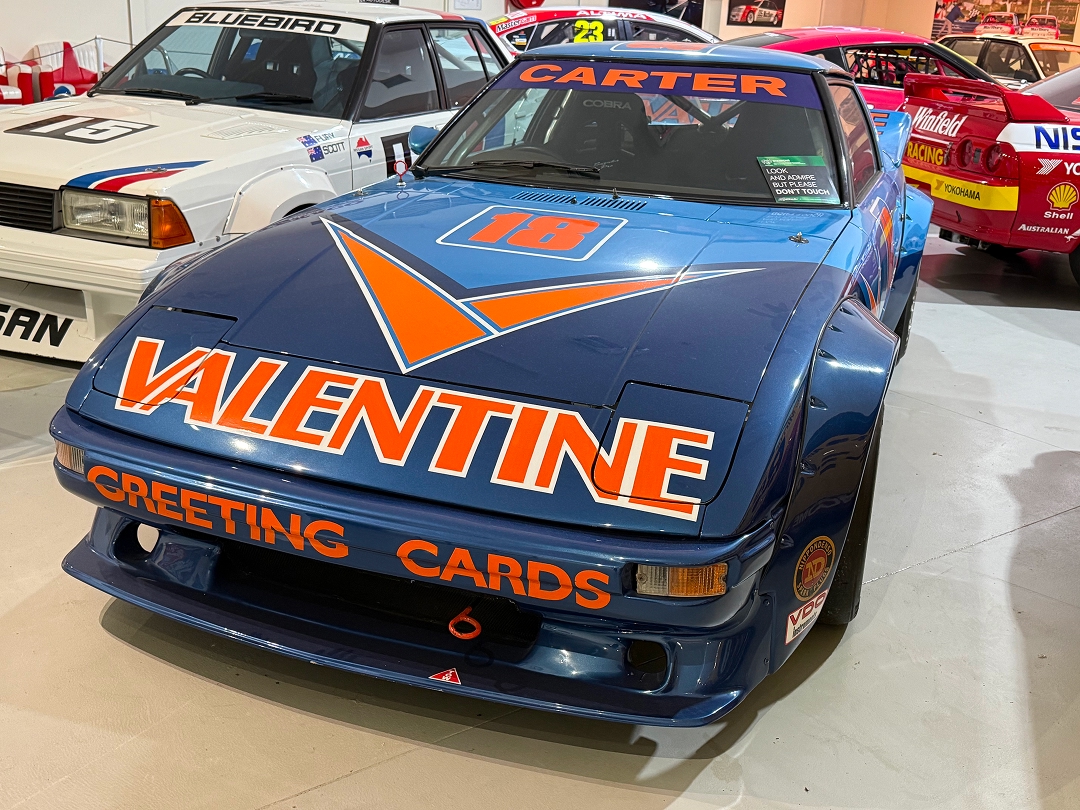
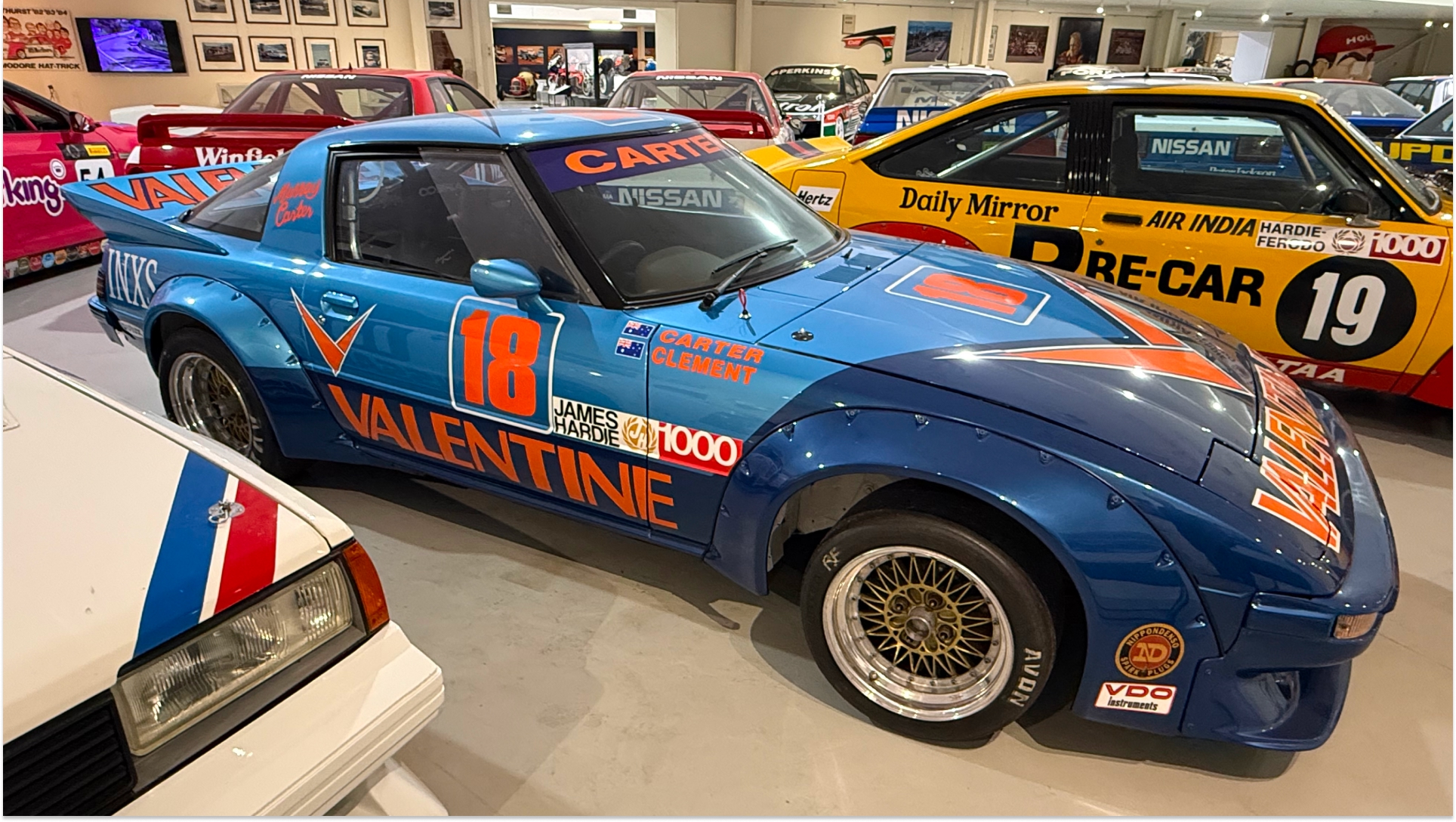
1983 Mazda RX-7; races include 1983 James Hardie 1000, Murray Carter & David Clements; livery restored to that race
To single out just one more car to spotlight here is not a tough decision – it has to be the Mazda RX-7. I recall from my visit to Mazda’s own museum in Hiroshima to understand the design of Mazda’s red paints that this model has a formidable global racing history.
The restored paintwork of this privately owned RX-7 recreates its looks when raced in the 1983 James Hardie 1000 by the privateer Murray Carter. His principal sponsor? Valentine & Sons Ltd., a printing company renowned for postcards and greeting cards.
Carter’s co-driver that year was David Clements, who knew the band members of INXS, then only three album releases into their legendary discography… Yes, that ‘INXS’ on the rear does advertise their music, and this was the first but not last time that this band of musicians (and car lovers) marketed in motor racing.
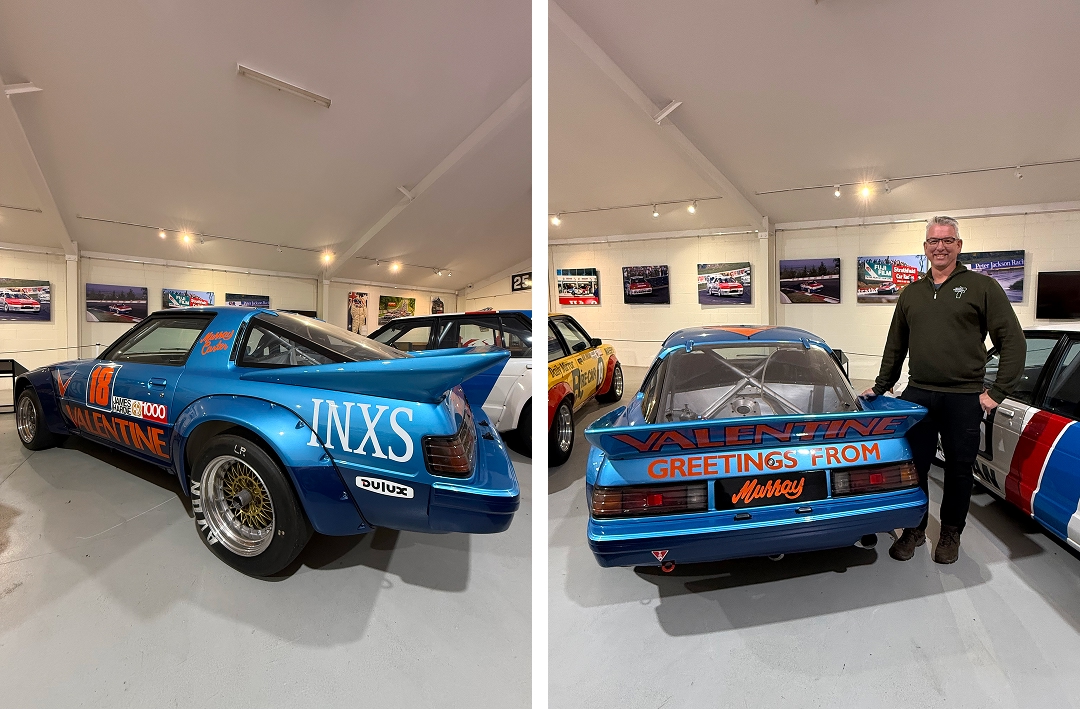
Brad Owen with the same 1983 RX-7 by Mazda
Brad says, ‘Murray Carter had a long career as a Ford driver, and then changed to Mazda in 83–84, because he felt an RX-7 was the right car to hopefully get good results.’ The RX-7 was truly turning the heads of many in Australian motorsport at this time.
And in the Bathurst 1000, they were controversial. The race had never included a two-seater sports car before. More controversial still was the model’s revolutionary Mazda Wankel rotary engine.
Race organisers accepted RX-7s into class racing in time for 1979, and as an outright contender before the 1981 races. But difficult discussions about race class and permissible modifications in the aim to ensure fairness against cars with piston engines occurred from the 1979 get-go and did not stop. Brad likens the difficulties to ‘trying to compare apples and oranges.’
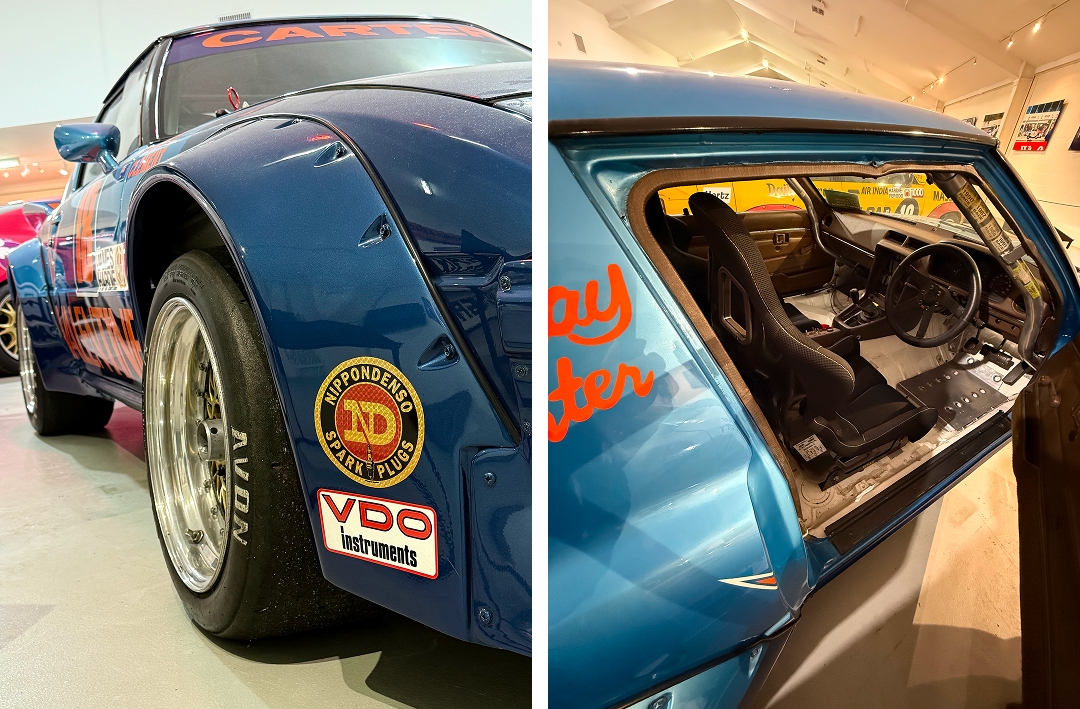
The same 1983 RX-7 by Mazda
I hear how racing classes were decided on engine displacement, as an indicator of engine power. Yet a rotary is more powerful than a piston engine of the same displacement, and lighter in weight. Also, the sorts of modifications relevant to the different engine types aren’t easily comparable. Apples and oranges, for sure.
Brad tells me that legal discussions (race teams with race organisers) always occur on the ‘sidelines’ of motor racing, and they really hotted up in the Bathurst 1000 when it looked like the RX-7s might win not just their classes, but the outright championship. Meanwhile, the famed Australian driver, Alan Moffat, was right alongside Mazda amid the heat, championing the RX-7 in Australian motorsport generally.
Ultimately, the racing drivers of RX-7s reached the level of class podium (2nd or 3rd place) at the Bathurst 1000. And when the (Group C) race rules were swapped for new international (FIA Group A) rules pre-1985, it meant the end of RX-7s in the Bathurst 1000. The RX-7 nameplate had its chance to really prove its mettle and dominate in other iconic races though, such as the Bathurst 12-hour and at Eastern Creek.
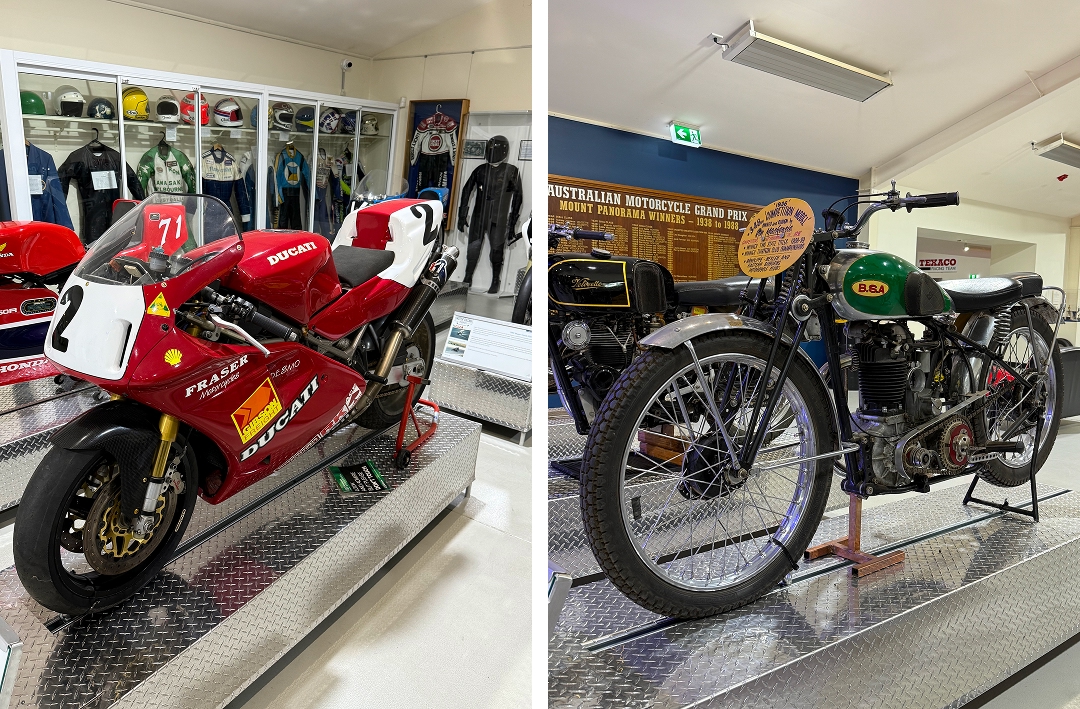
Left: 1993 Ducati 888 Corse Superbike; races include 1994 Australian TT at Mt Panorama, Roy Leslie Right: 1935 BSA 350cc ‘Competition Model’ R19; races include inaugural Easter 1838 race on Mt Panorama, Ron Mackenzie
There are plenty of motor bikes in the Museum, and bikes with sidecars, but these vehicle types haven’t raced at Mt Panorama since around 2000. ‘The sorts of safety measures in place on Mt Panorama now that make it safer for cars are not compatible with two and three-wheeled racing,’ says Brad. ‘And we’ve had some tragic fatalities here, most of them racers on two or three wheels. It got harder and harder to sanction them racing here.’
Motorcycle racing was actually the first motor racing in the Bathurst area, starting 1914, and we talk about the stories of several stellar motor bikes, from modern to historic, including a BSA motorbike raced in the first race at Mt Panorama, Easter Sunday, 1938.
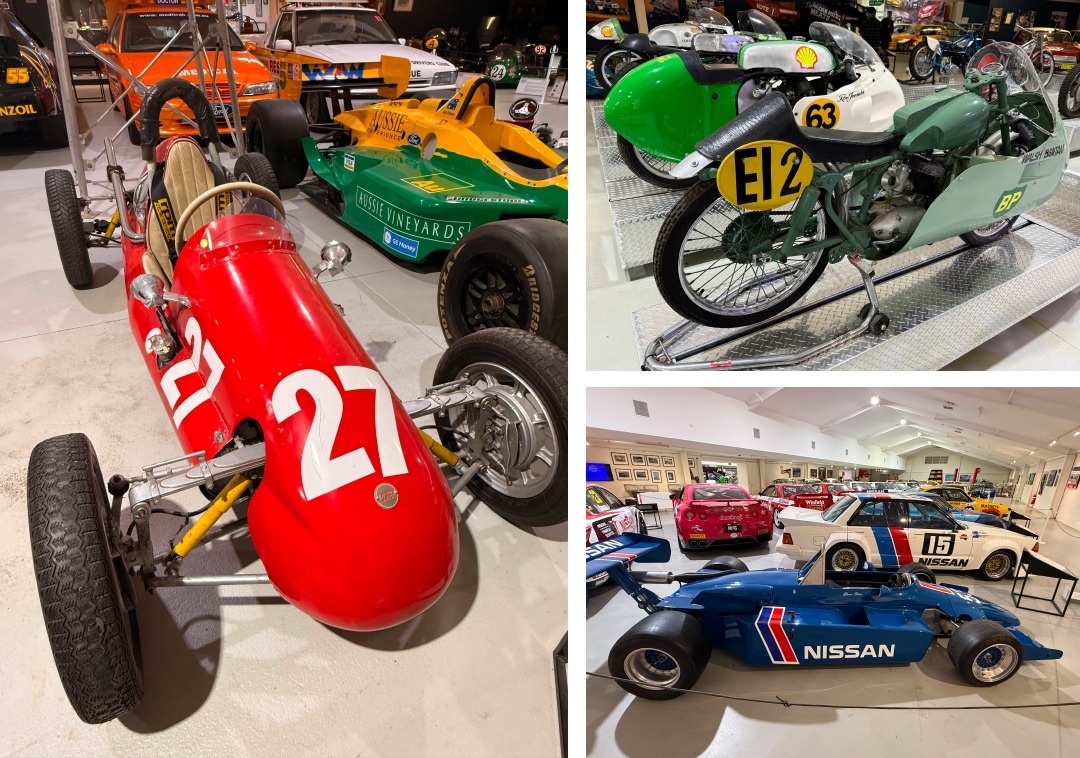
Left: 1951 Cooper MkV Manx Norton; imported from UK early 1950s, raced in various Australian events since Top right: 1965 G50 Matchless engine with Norton frame; races include 1967 Unlimited GP at Bathurst 1967, win, Ron Toombs; 1967 form. Walsh Bantam (BSA bantam built by Eric Walsh); races include Easter 1959 at Mt Panorama, win, Noel Gardiner; in 1959 race form Bottom right: Museum view, Nissan open wheeler for formula racing in foreground
And what else is there to see? A mix of other material that conveys the human aspect of racing, including AV showing a variety of film, sometimes short documentary pieces by V8 Sleuth or Supercars who are media partners for the Museum.
Brad keeps a degree of newness across the Museum. A temporary exhibition will typically make up a portion of the displays, and one about the Bathurst 1000 will run from October 2025 until February 2026.
Moreover, the entire mix of vehicles is in constant change-over. Most are on loan (short or long term) from private individuals or companies. As some cars leave, others arrive, and the Museum’s Facebook announces what’s new.
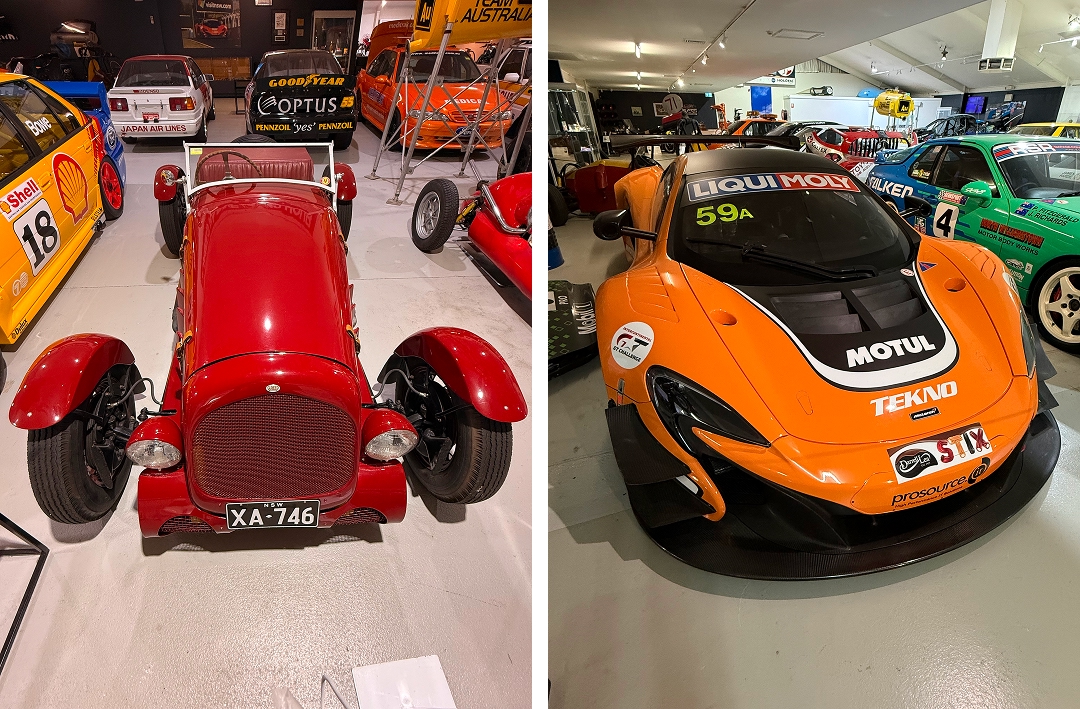
Left: ‘George Reed special’, (replica) 1 of 5 built 1930s-1950s by George Reed of Bathurst; one special won the 1951 Australian Grand Prix Right: 2016 McLaren 650S GT3; races include 2016 Bathurst 12 Hour, win, Shane van Gisbergen, Alvaro Parente & Jonathon Webb
The most exciting AV is best left to last – the ‘immersive room’ with screens that wrap-around, all the better to sense the sounds, sights and thrill of racing. There’s historic race footage from Mt Panorama showing cars that I recognise from the Museum. But film that was shot more recently is mixed in, and it features those same cars ‘racing’ on Mt Panorama. You don’t see the drivers’ faces, but Brad is among them at the wheel of the Mini.
Yes, Brad is a motorhead. And an expert.
And with all that I’ve seen and heard, the idea of another lap (or more) tempts me.
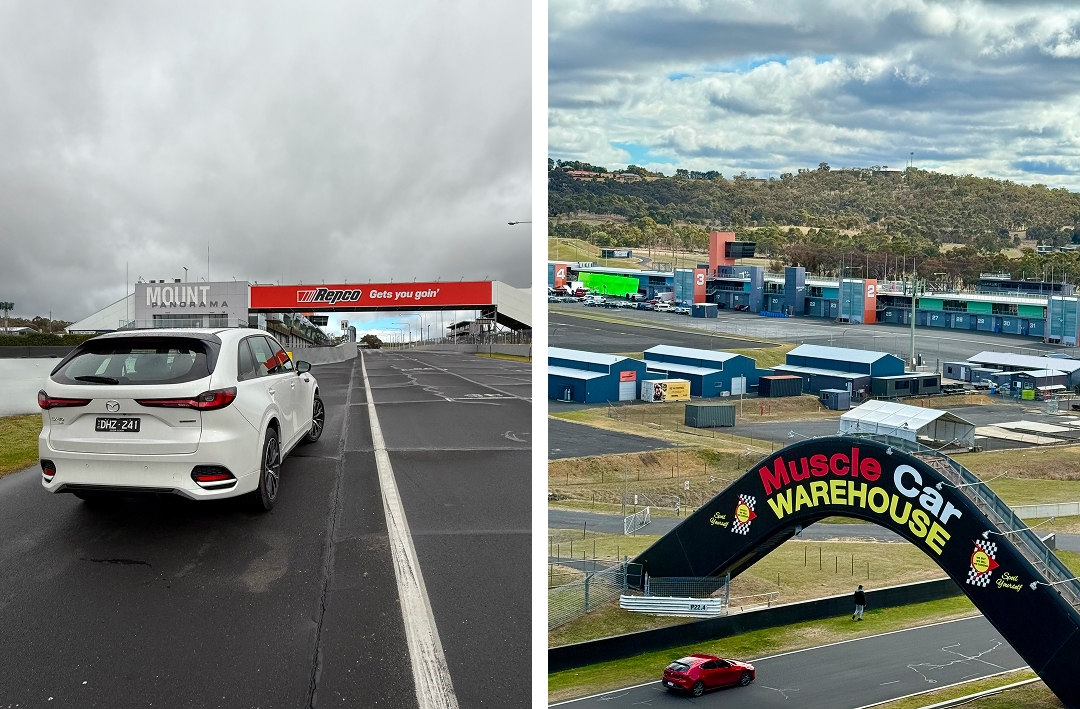
CX-70 at the track start, and view towards Pit Straight from the trackside hotel, Rydges Mt Panorama
I pull the CX-70 back onto the Mt Panorama track and lap the 6.213 km in around seven minutes, a time typical for the everyday driver. The current racing lap records are around 2 minutes.
This time, I’m more conscious of the track. Its narrowness. Its steepness, remarkable among racetracks globally. The strong curves, and the long straights enabling average lap speeds far greater than at any other Australian racetrack.
The recent top recorded speeds are along the Conrod Straight, at around 300 km/h. Unimaginable to me.
Equally hard to imagine, is how it would feel to lap 161 times between two drivers in the Bathurst 1000, next up on 9-12 October 2025. Or an epic 306 times between three drivers, as won the 2025 Meguiar’s 12 Hour. This endurance race in the international GT (Grand Touring) circuit is next up on 13-15 February 2026.
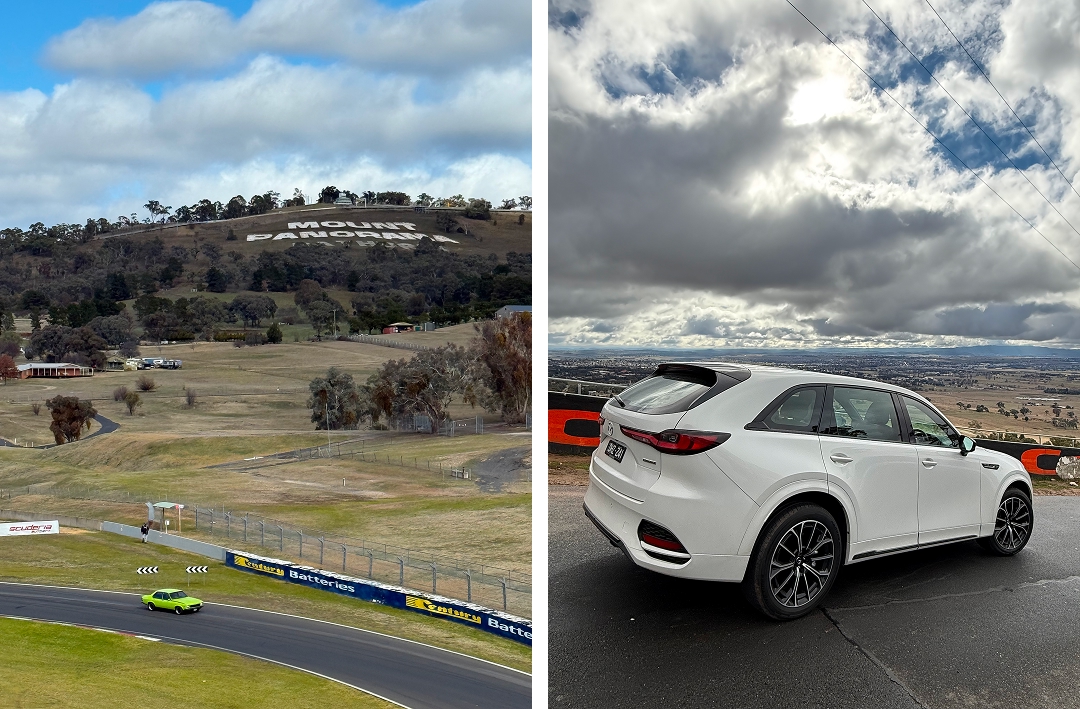
CX-70 at the track top, and view to the track top from the trackside hotel, Rydges Mt Panorama
Soon, I’m pulling into a parking area at the track top to rest and take in the ‘must stop for’ views. The basalt-capped Mount Panorama / Wahluu really does rise high from the vast Bathurst Plain. I’m not surprised to have learnt that the track was built in the 1930s as a ‘scenic road’, in a form that would also suit motor racing.
Driving down and away, I picture race-time crowds. They’re enormous at the Bathurst 1000. The 2024 race attendance figure: 193 219 attendees over 4 days.
On race days, the Museum is within the event footprint. This touches back to its origins as a small, temporary (race-time) and trackside display, first opened at the Bathurst 1000 by Peter Brock in 1988.
If you go to the Museum on a major race day or thereabouts, you’ll find it buzzing with fellow visitors. Whenever you go, you’ll find something unique – the only motor museum in Australia that focuses on motor racing.
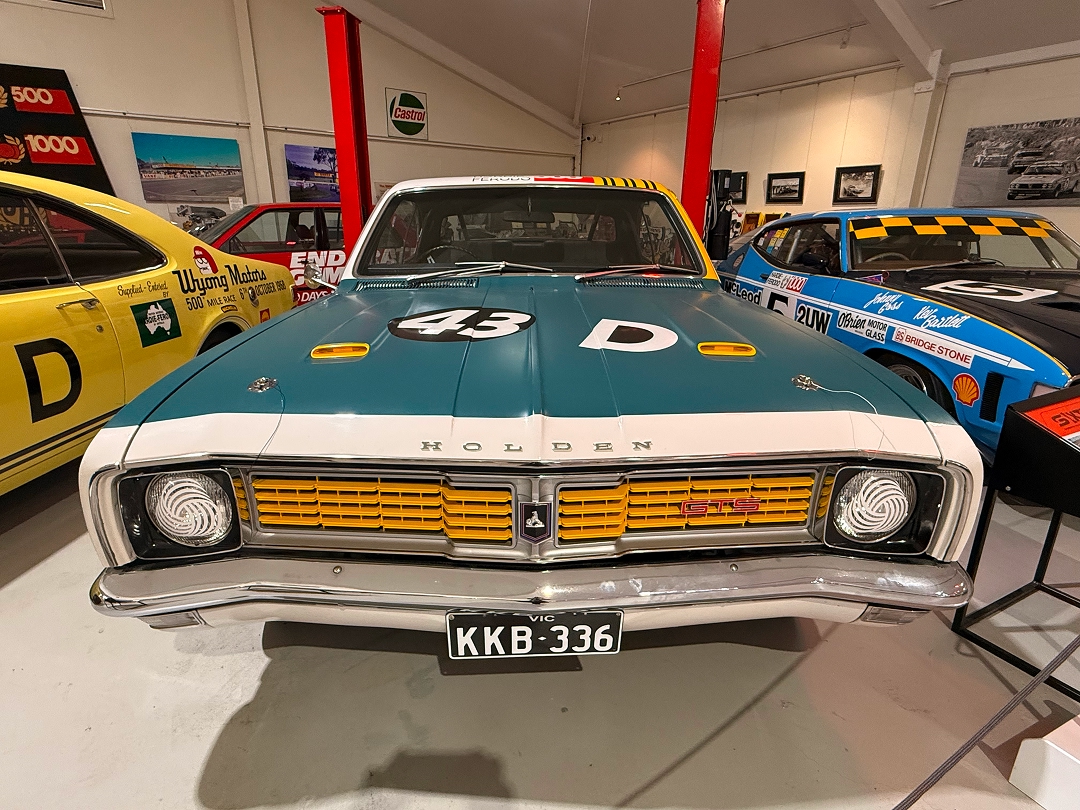
1969 Holden HT Monaro GT 350; races include 1969 Hardie-Ferodo 500, Des West & Peter Brock – first drive of this race for Brock, later ‘King of the Mountain’
Read on for the ‘motorsports and more’ trip to Bathurst
Facebook: NationalMotorRacingMuseum