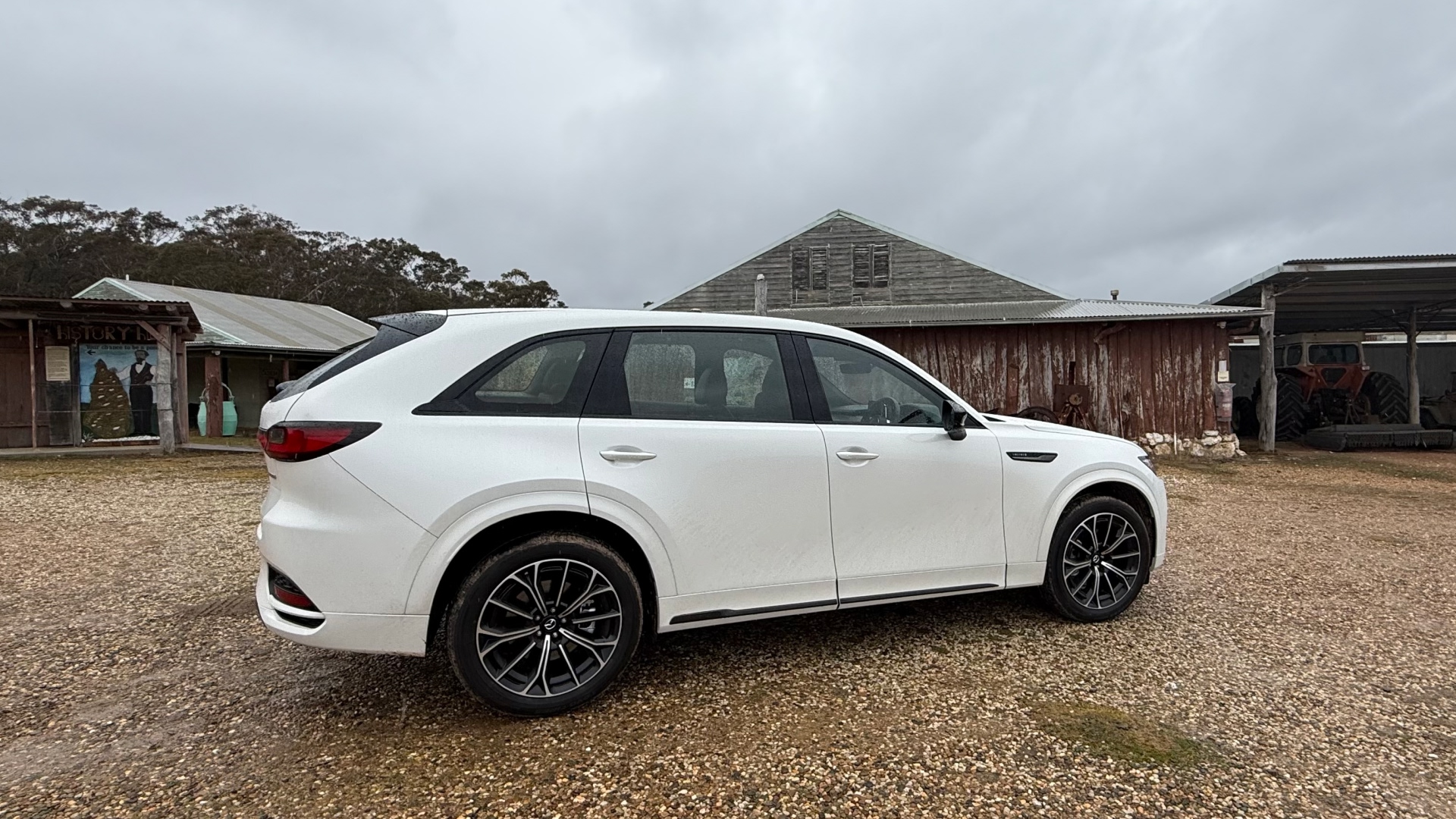
Mazda CX-70
Hill End: Gold and Art, Past and Present
By Jane Johnston
In Hill End, the past feels ever present, and it has fascinating Australian gold rush and art history. But don’t think of Hill End as just a remnant of its past. It’s far from that.
I visit this village as part of a winter road trip in a CX-70 Azami to Bathurst – a NSW city west of the Blue Mountains that’s a destination itself for motorsport and more, and a great base from which to explore the area.
Hill End is one of several villages near Bathurst, and it’s the day trip choice that compels me.
It’s listed by the NSW Government as a Historic Site for the state and nationally significant heritage that’s there. And I’m intrigued that it’s sometimes described as a ‘ghost town’, when it’s home to a rural community of some100 residents, including around twenty artists, all very much alive.
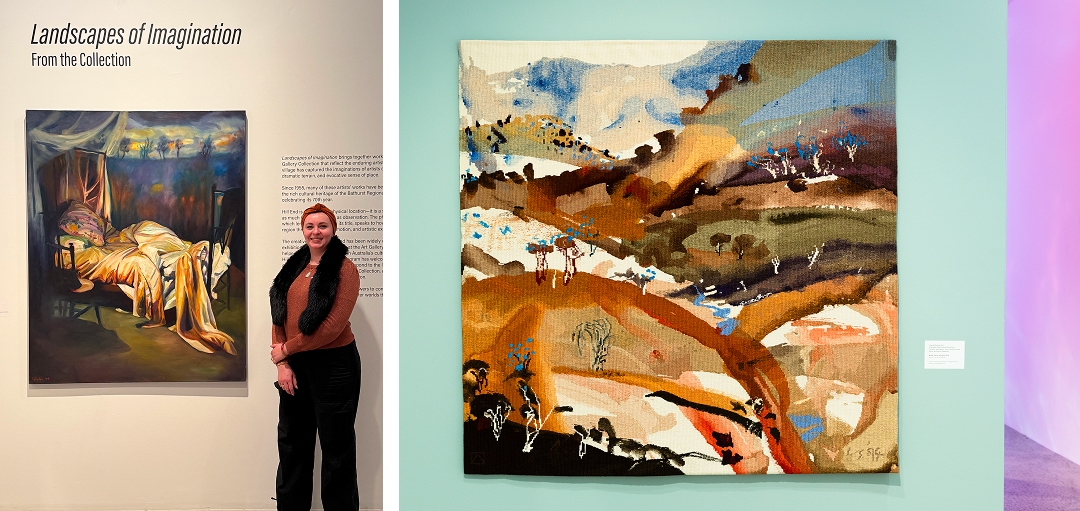
Bathurst Regional Art Gallery, Landscapes of Imagination: From the Collection exhibition, 2025 Left: Camille Gillyboeuf with artwork; Rosemary Valadon, Jean Bellette’s Bed, 2004, oil paint on canvas Right: Luke Sciberras with the Australian Tapestry Workshop, The Bridle Track, 2019, cotton and wool. Image by Silversalt Photography, provided courtesy of BRAG
I was in Hill End the day before too, in a way, visiting the Bathurst Regional Art Gallery (BRAG) to experience Landscapes of Imagination: From the Collection – a temporary exhibition wholly focused on art about Hill End that runs until 9 November 2025.
There’s a wide and intriguing range of imaginative responses to Hill End across the 41 works by 20 artists on display. Camille Gillyboeuf from BRAG curated this exhibition, and she encouraged me to see the artists’ perspectives at the gallery, and then go see Hill End for myself. And I do, with the artworks still fresh in my memory.
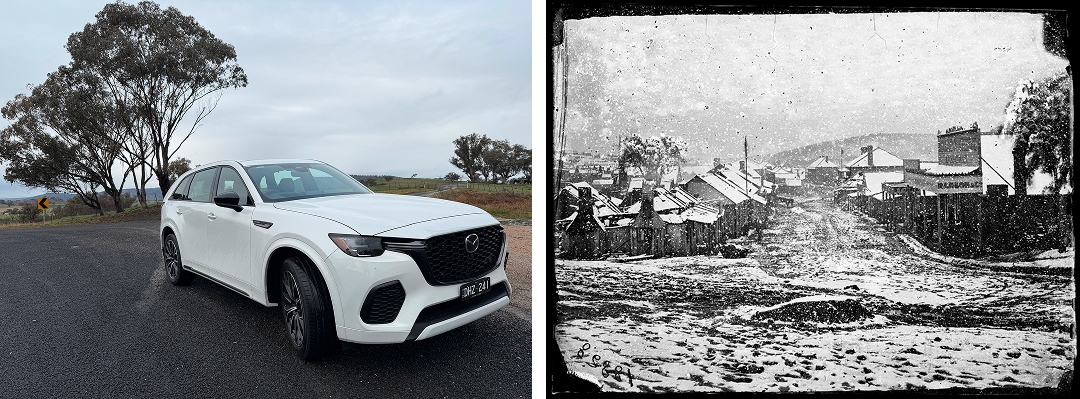
Left: CX-70 on the road to Hill End Right: Snowfall in Hill End, 1872, Call# ON 4/Box 9 /no. 18828; A & A Photographic Co., Holtermann Collection, 1870-1875, Mitchell Library, State Library of New South Wales
I fuel up in Bathurst: coffee for me, diesel for the CX-70. The sky is metallic grey and white, and I’ve checked the forecast – snow isn’t expected today, but it sometimes falls where I’ll be, including in Hill End itself. The village is on the edge of the Central Tablelands, near where they adjoin the vast Bathurst Plain.
I turn on music and turn the CX-70 onto the Turondale Rd and Hill End Rd route which reaches Hill End in around an hour. The alternative ‘Bridle Track’ is a far more adventurous drive better matched to Mazda’s 4WD BT-50 ute.
Light rain mists the scenery, a succession of bushland and farmland, all atmospheric, all wintry. It’s cold and the CX-70 is set accordingly, windows and sunroof shut tight, Nappa leather seat and steering wheel heated. And with the BOSE speakers sounding superb, the auto wipers working perfectly, and the handling feeling keen on the wet road, I really enjoy this ascent to the hills.
Who needs blue skies for a glorious country drive?
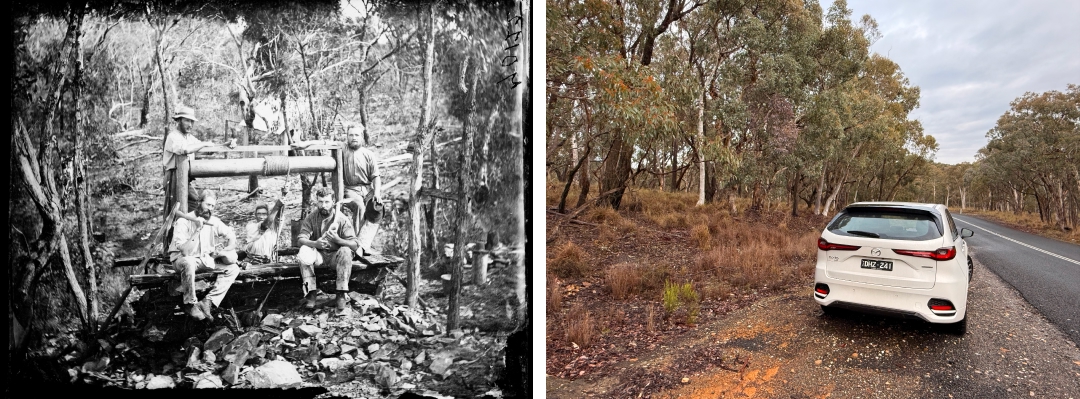
Left: Gold miners and gold mine head, Call# ON 4/Box 10/no. 70122; A & A Photographic Co., Holtermann Collection, 1870-1875, Mitchell Library, State Library of New South Wales Right: CX-70 the road to Hill End
And I think about the history.
A gold rush began across several sites north of Bathurst in the mid-nineteenth century and, in Hill End, it peaked in the early 1870s. It was already bustling when, in 1872, the world’s biggest-ever find of reef gold attracted more people.
Alluvial gold found in rivers and creeks in the 1850s started the rush, but the gold extracted from Hill End was mostly ‘reef’ – gold found amid quartz veins in the ground rock. In search of it, the ground around Hill End was thoroughly mined.
Then, once the viability of continued prospecting began to falter as soon as 1874, decades of abandonment and deconstruction set in. The remaining people and buildings were in a landscape of mine shafts, dug gulleys and mullock heaps, and the weather continued to erode this landscape into scenes of fantastic form and colour.
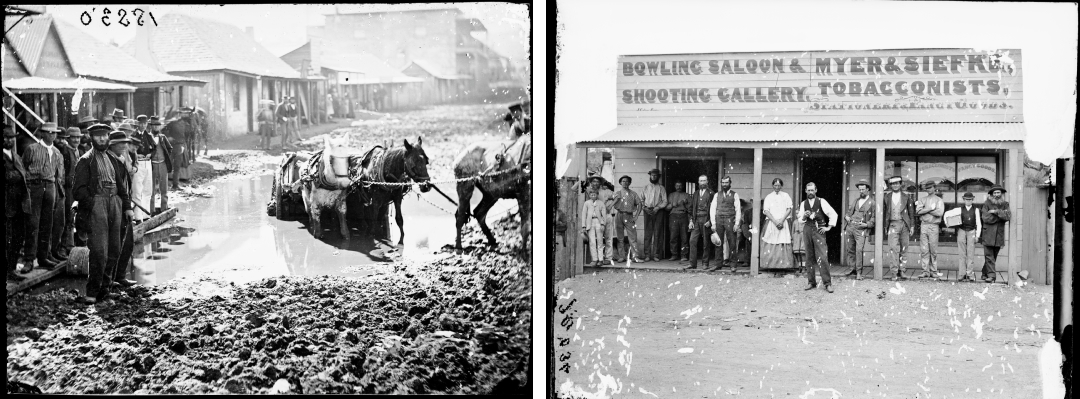
Left: Horse and cart bogged on Clark St, Winter 1872 Call# ON 4/Box 9 /no. 18830 Right: Bowling saloon and shooting gallery (left), tobacconists, stationery & fancy goods store (right), Call# ON 4/Box 9 /no. 70034 All: A & A Photographic Co., Holtermann Collection, 1870-1875, Mitchell Library, State Library of New South Wales
In 1947, the artist Donald Friend was enthused by a newspaper article describing Hill End and nearby Sofala. He convinced his friend and fellow artist Russel Drysdale to take a winter road trip to both places from Sydney to ‘run in’ Russel’s new Riley Tourer.
To make a long-story-short of some important Australian art history, Hill End then became renowned for art as Friend, Drysdale and other modernist artists, all later collectively known as ‘The Hill End Group’, created art there over the 1940s–50s. The others in the group’s core were Margaret Olley, Jeffrey Smart, David Strachan, and Jean Bellette with her husband, Paul Haefliger, an artist and then (1941–1957) the Sydney Morning Herald’s art critic.
Artists drawn to Hill End since, include John Olsen, Brett Whitely and Ben Quilty, just to name three of the best known.
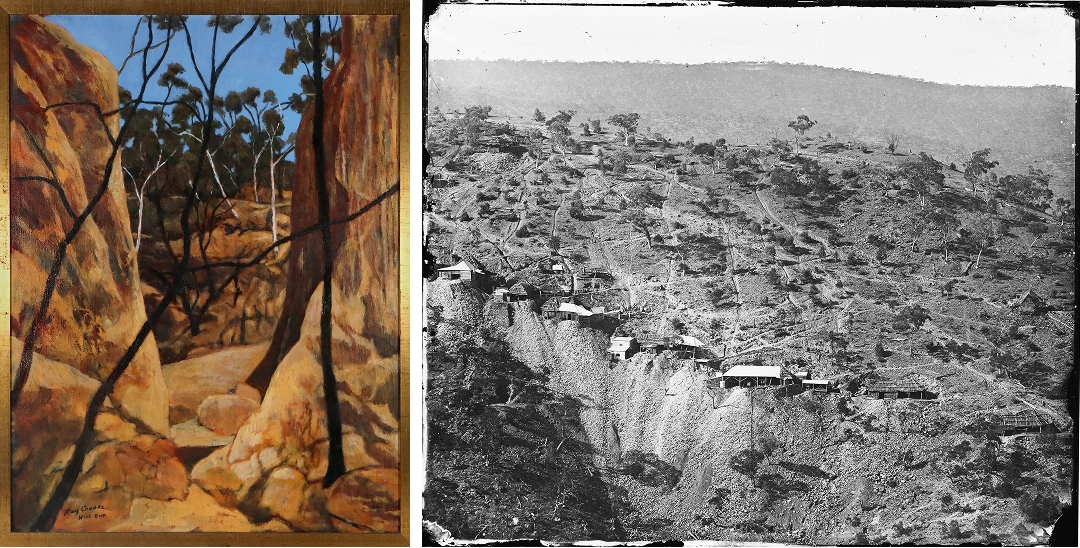
Left: Ray Austin Crooke, Eroded Gully, 2004, oil on canvas. Image courtesy of BRAG Right: Hawkins Hill mines, with the head of the mine established by Bernhardt Otto Holtermann and Louis Beyers being the two-story white building (centre), Call# ON 4/Box 71/no. C; A & A Photographic Co., Holtermann Collection, 1870-1875, Mitchell Library, State Library of New South Wales
What’s still the world’s biggest-ever find of reef gold occurred on 19 October 1872, after a blast underground in the Star of Hope mine. Bernhardt Otto Holtermann, then a major shareholder and a manager of this mine, arranged for the enormous specimen to be brought to the surface intact.
It was absolutely photo-worthy – a 286 kg mass of gold, quartz and slate that became known as ‘The Holtermann Nugget’. Once crushed, it yielded 3,000 ‘troy’ ounces of gold, around 93 kilograms.
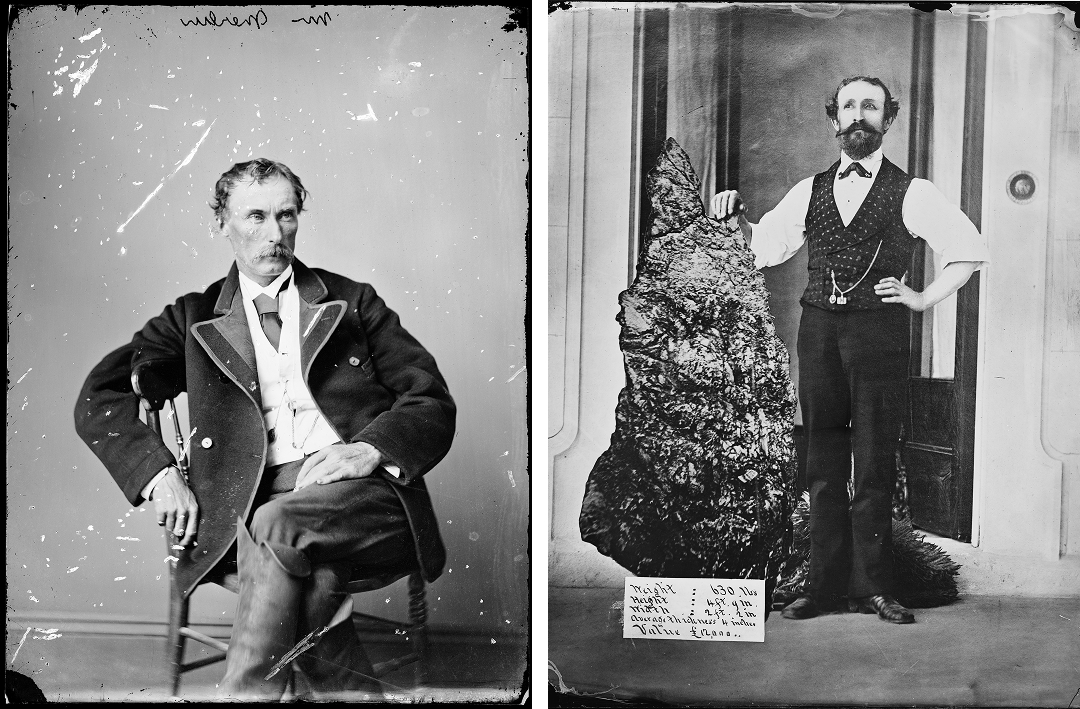
Left: Henry Beaufoy Merlin, Call# ON 4/Box 30/no. 29 Right: Bernhardt Otto Holtermann (apparently) beside the record-large specimen of reef gold, Call# ON 4/Box 71/no. U All: A & A Photographic Co., Holtermann Collection, 1870-1875, Mitchell Library, State Library of New South Wales.
A famous image appears to show Holtermann beside it. It’s actually a montage of multiple photographs, created by Henry Beaufoy Merlin, founder of the A&A (American & Australasian) Photographic Company.
But something much more momentous was already resulting from Holtermann and Merlin having met in Hill End earlier – a phenomenally comprehensive photographic record of some gold rush towns in NSW and VIC, funded by Holtermann, and shot by Merlin and Charles Bayliss, the other photographer in the company.
This record forms the bulk of the around 3500 glass plate negatives called the Holtermann Collection, which is on the UNESCO Australian Memory of the World Register and housed at the State Library of NSW. See some online here and discover more via the library’s catalogue.
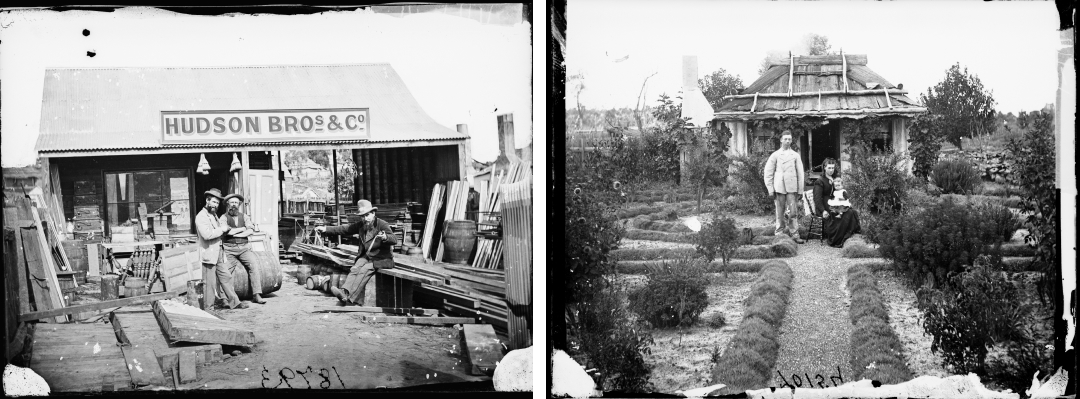
Left: Hudson Brothers Hardware, Call# ON 4/Box 8 /no. 18793 Right: Family in front of cottage with formal garden, ON 4/Box 10/no. 70154 All: A & A Photographic Co., Holtermann Collection, 1870-1875, Mitchell Library, State Library of New South Wales
These photographs are a large part of the existing historic evidence of what was in Hill End in the early 1870s, the peak rush time. To list just some of it: 28 pubs, five banks, an opium den, eight churches, two newspapers, and an oyster bar.
Today, just one pub is operational – The Royal Hotel, established 1872 – and don’t set your heart on finding the opium den or oyster bar, both are long gone.
There are far fewer buildings in Hill End now, and not surprisingly – the early 1870s population was far greater, estimated at 8,000 in Hill End and the adjoining Tambaroora, which today has even fewer residents than Hill End.
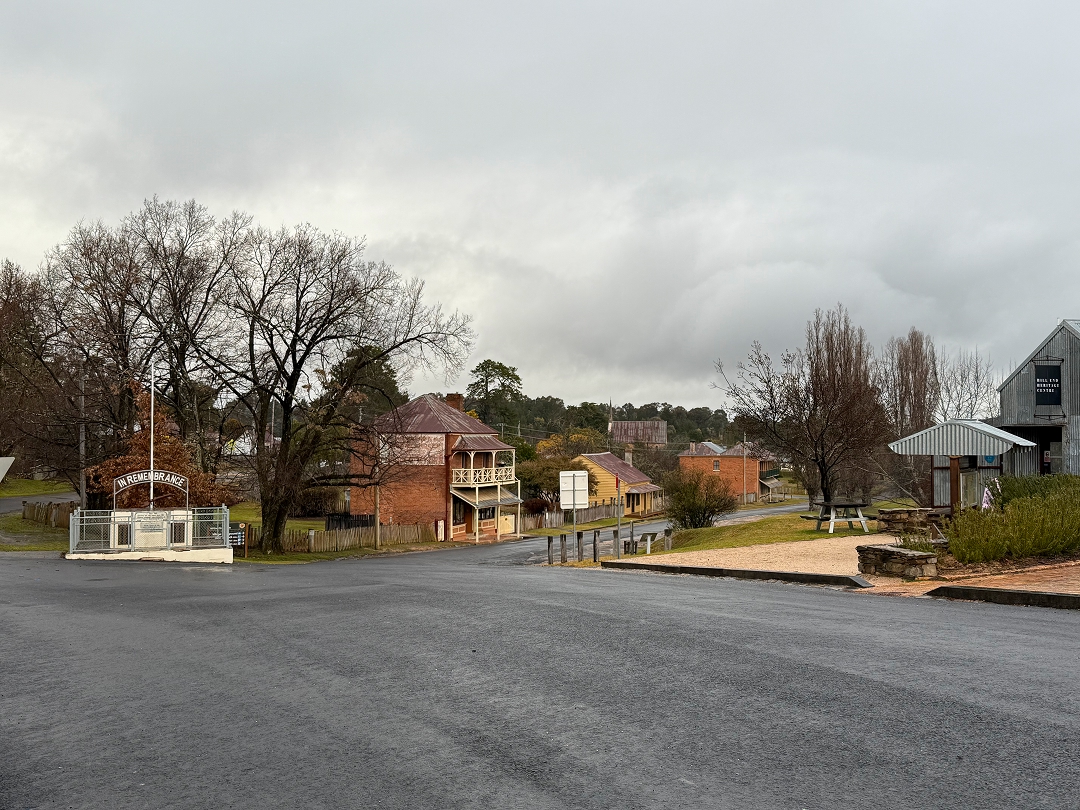
View from Beyers Ave, looking towards Clarke St on the right. Northey’s is the brick two-story building with a veranda
As I drive into Hill End, it’s tranquil – just a few people are visible, moving towards the warmth of a building or car. The quietness makes perfect sense on a winter’s morning.
Yet the near emptiness of the streets imparts a mysterious look and makes it easy for the historic photographs I’ve seen to ‘ghost’ my vision; I look at the streetscapes in front of me, and the historic photographs come readily from memory, suggesting instead a place of greater activity and noise.
A similar effect happens with artworks from the Landscapes of Imagination exhibition at the Bathurst Regional Art Gallery. I park the CX-70 in the village centre, near The Royal Hotel, and glancing down the street, it’s easy to picture the figures from the history-inspired Untitled work of pinhole photography by Tamara Dean and Dean Sewell outside the two-story Northey’s building.
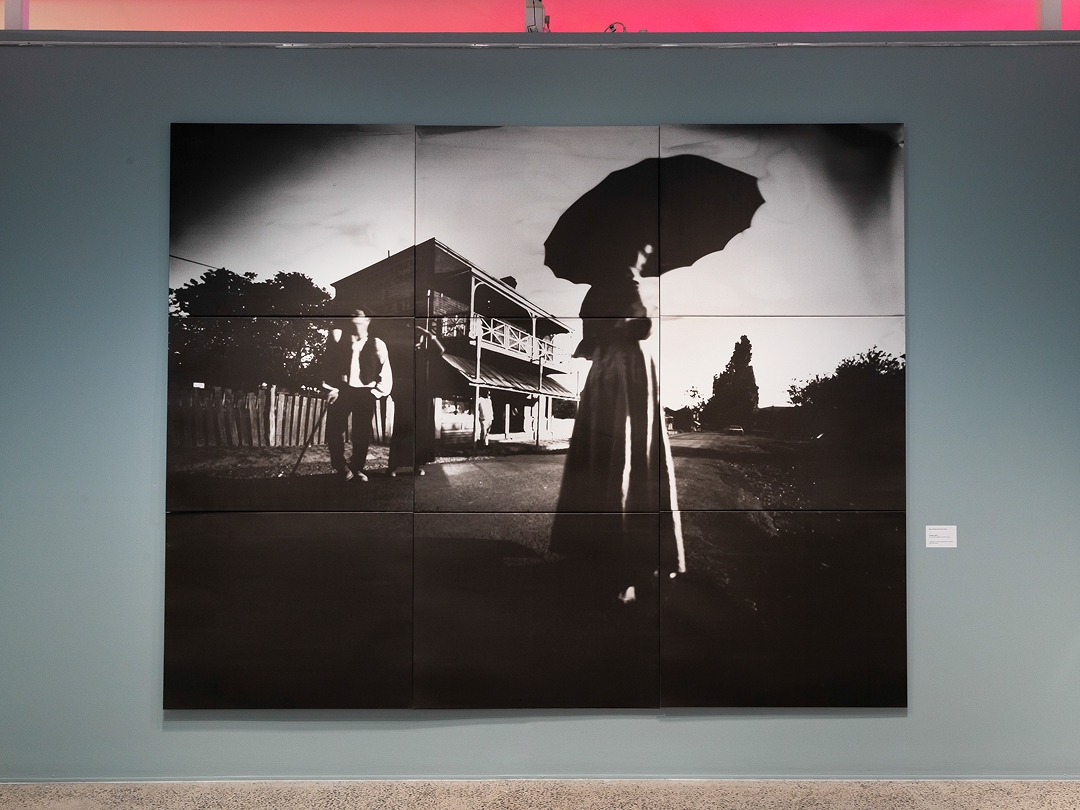
Landscapes of Imagination: From the Collection exhibition, 2025; Tamara Dean and Dean Sewell, Untitled, 2005, pinhole photograph on canvas. Image by Silversalt Photography, provided courtesy of BRAG
I walk to the nearby converted 1950s fire brigade building that’s the Hill End Heritage Centre developed by the NSW National Parks and Wildlife Service (NPWS) – ‘Parks’ as the locals call it. This introduces Hill End’s gold-rush history in a self-guided experience (no staff are based there) with immersive digital and object displays.
The role of Parks in heritage management and presenting Hill End’s history to the public began in 1967 after the NSW government declared Hill End a Historic Site. This declaration came after an upswell of interest in Hill End’s heritage, initiated by the art of The Hill End Group.
Parks owns several historic buildings which are part of community life, including the hall and art gallery, and others which are leased to businesses – The Royal Hotel, The General Store, and Northey’s, which has a gift shop on the ground floor.
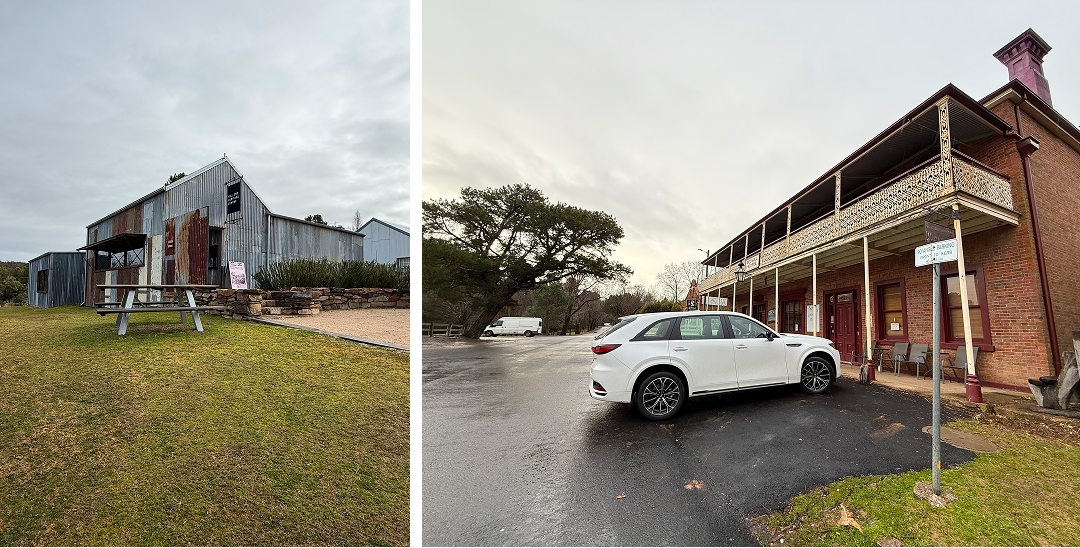
Left: Hill End Heritage Centre Right: The Royal Hotel
And it owns some historic houses including Craigmoor, presented as a house museum of the Marshall family who lived there. You can ‘walk’ through it online.
Before you drive to Hill End, check the Parks website for what’s open and, as a general heads up, more is usually open on weekends. This website also maps a historic walking tour of the village and indicates places of interest in the surrounds, such as sites with mining history, picnic spots, and scenic lookouts.
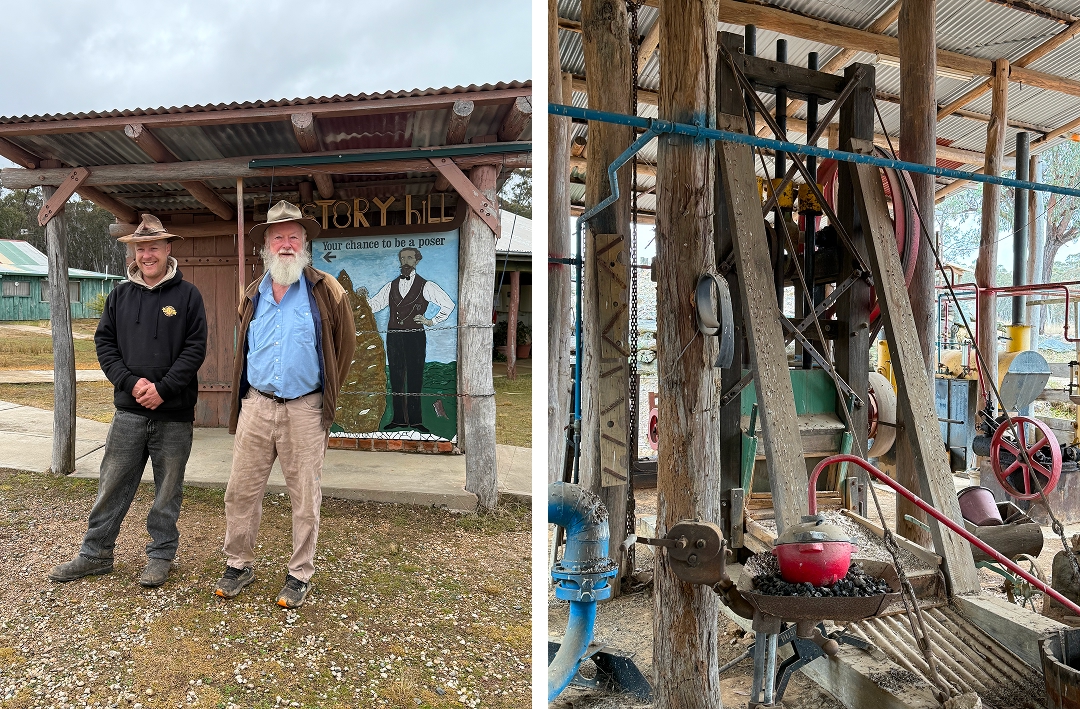
At History Hill with Malcolm and Jhob Drinkwater. Right: example of a stamper battery machine used to crush specimens of reef gold and to separate out the gold from the other rock material
I step back into the Mazda CX-70 and head for History Hill. It’s just outside the village, and I meet Malcolm Drinkwater there, along with his son, Jhob Drinkwater.
Malcolm has created this private museum of several buildings filled with thousands of objects related to the nineteenth century gold rush times. There are objects not only related to finding gold and separating it from the surrounding rock, but all manner of things related to life in the times more generally, sourced from Hill End or elsewhere in the world.
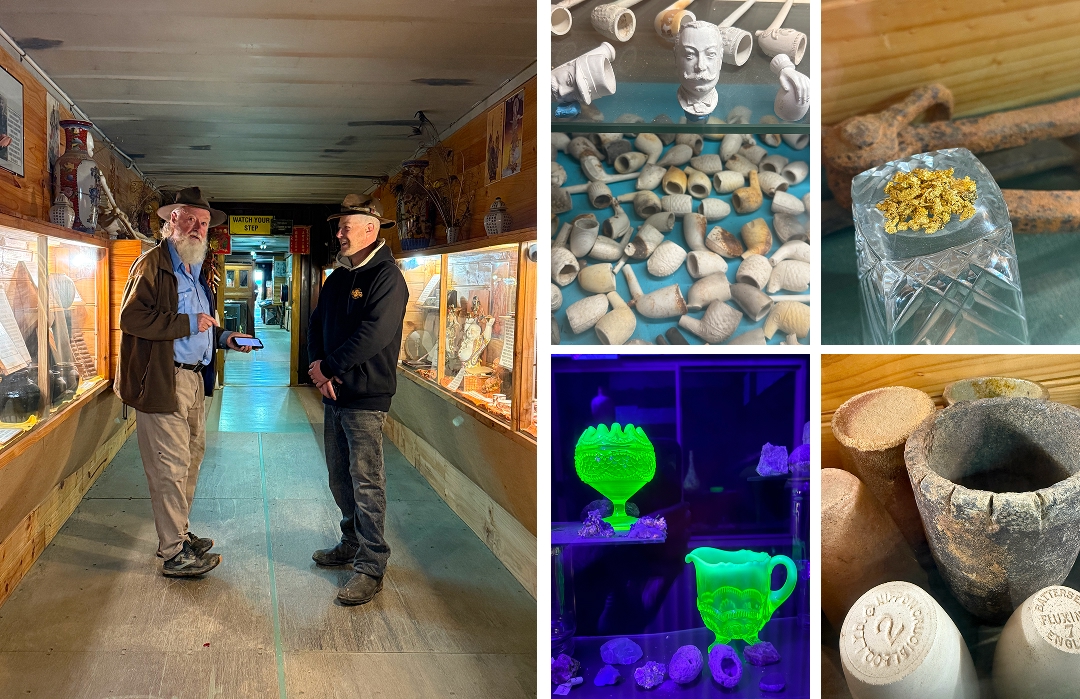
At History Hill with Malcolm & Jhob Drinkwater Middle Top: clay tobacco pipes Top Right: an ounce of gold Lower middle: late 1800s uranium glass, a rosebowl by Northwood Glass Co., a cream jug by Flint Glass Co. Lower right: clay crucibles for melting gold
The great abundance and variety of it all, and not least the photographs, really helps in building a picture of what Hill End would have been like then. And you can gain further insight from books and film docos by Malcolm, or by walking the purpose-built underground mine tunnel that’s onsite, or by joining one of Jhob’s tours of the village or his tours offering experience of panning for alluvial gold.
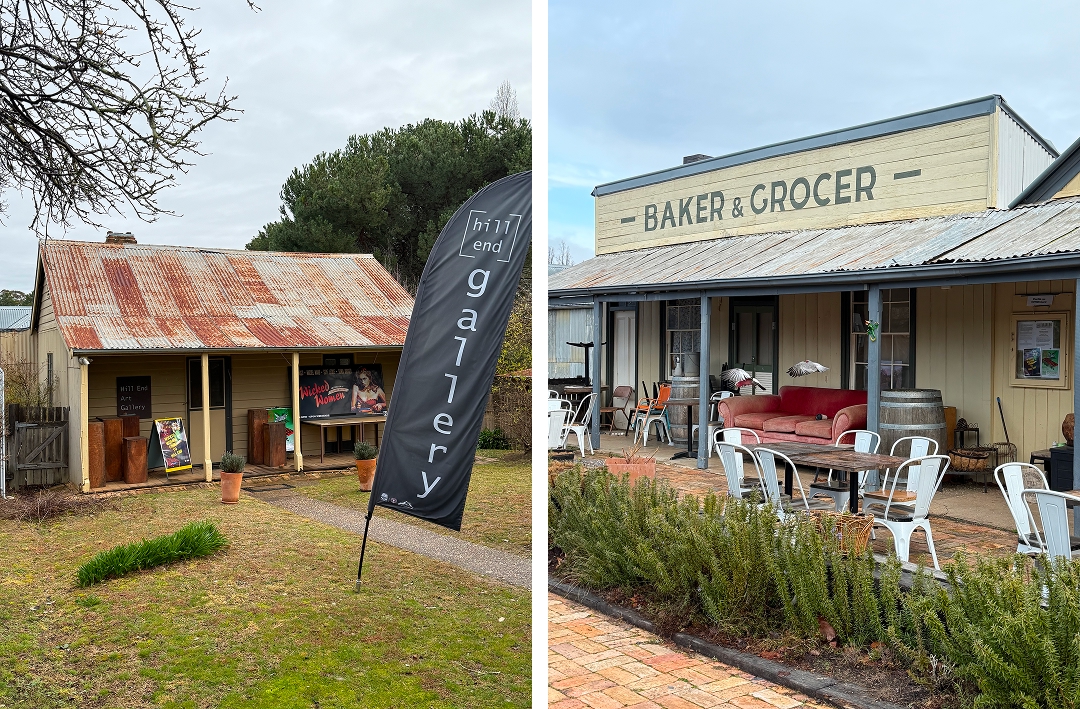
Left: Hill End Art Gallery Right: The General Store. Outside on this winter’s day was for galahs; there were people inside
Back in the village centre, I’m warmly met by the Hill End artists Genevieve Carroll and Bill Moseley. We grab a coffee from The General Store, and go next door to the Hill End Gallery to find it full of Wicked Women – the 2011–2014 series of paintings by Rosemary Valadon on display there until 2 November 2025.
Rosemary joins us and talks about these portraits of actual women, some of them public figures. For instance, that is Rachel Ward. This series was inspired by the graphics of pulp fiction crime novels and film posters from the early to mid-20th century.
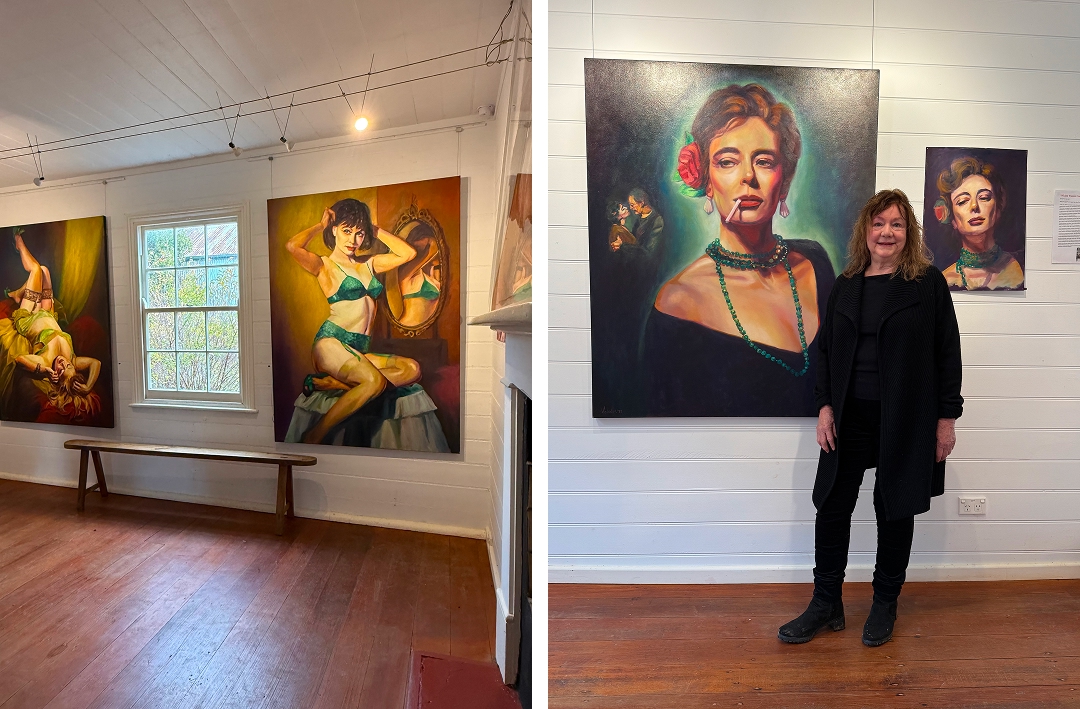
At the Hill End Gallery with Rosemary Valadon. Wicked Women series, 2011–2014, oil on canvas. Rosemary pictured beside Pickup (Rachel Ward & Bryan Brown)
This gallery is run by the Hill End Arts Council Inc., and the Council is now preparing the second biennial Hill End Analogue Festival, to run over 14–16 November 2025.
This festival set across several historic buildings will display art photography by 40 artists on its 2025 theme of ‘Fugitive’. Expect talks, music, workshops and, overall, a celebration of various photographic techniques.
Merlin, Bayliss and Holtermann would be there amid the audience, if they could.
These art experiences are visible via the Culture Maps by Arts Out West, a resource that’s valuable to consult during any travels in central NSW.
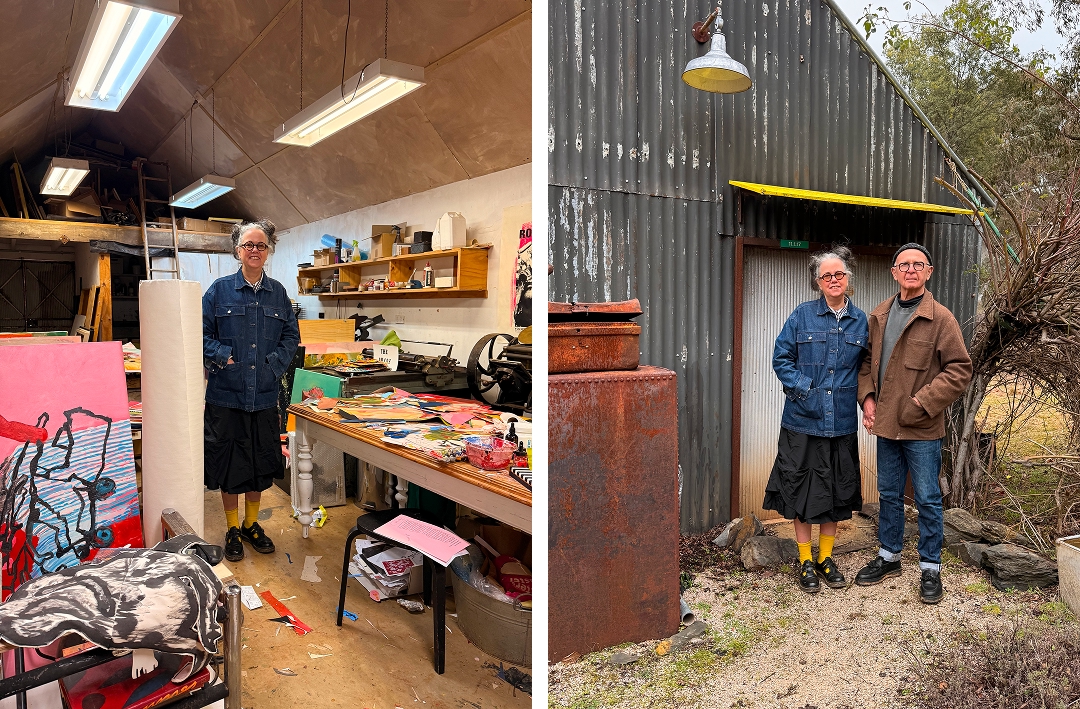
At the studio of artists Genevieve Carroll and Bill Moseley
Next stop is the vibrant studio that Genevieve Carroll and Bill Moseley have shared. Genevieve’s practice includes painting, poetry and multimedia. Bill Moseley is a printmaker, and a photographer interested in traditional processes like wet plate collodion; keep an eye out for his work during the Hill End Analogue Festival.
While their studio is not publicly open to visit, the next studio that I drive to is, though best phone ahead to make a time.
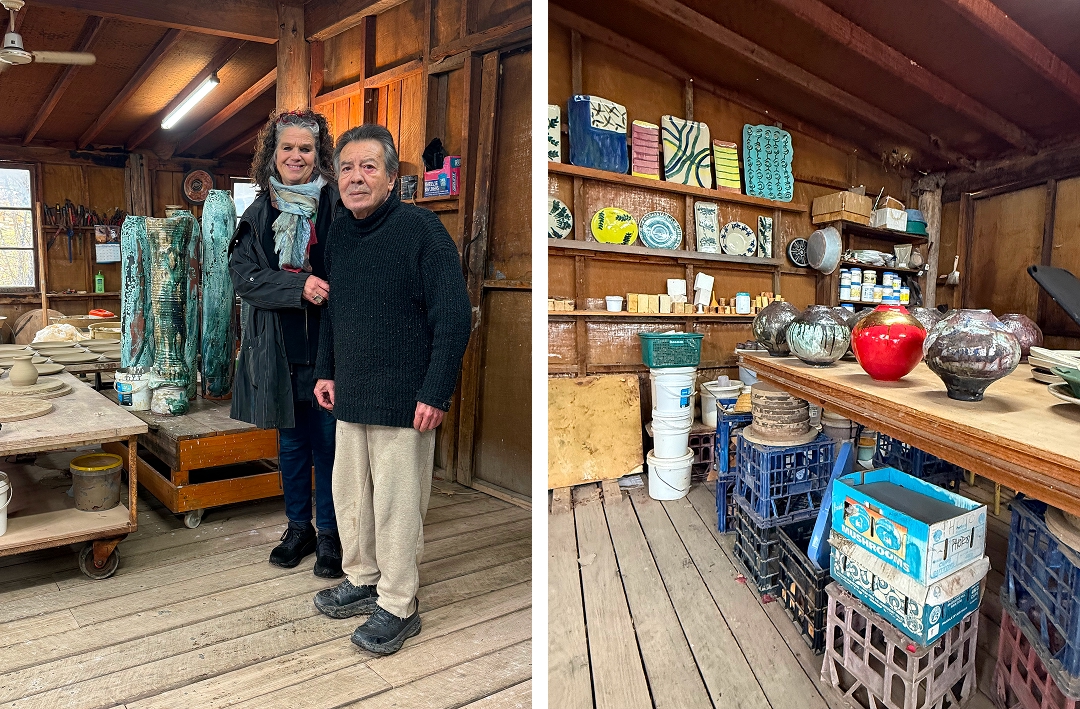
At the La Paloma studio beside Dennington’s Cottage, with the artists Kim Deacon and Lino Alvarez
La Paloma is the studio of the Mexican ceramicist Lino Alvarez. He has a long-established practice and has collaborated with other renowned artists including Gary Shead and John Olsen.
Lino creates the La Paloma ceramics together with his wife, Kim Deacon, who is also a performance artist and a musician – a harpist.
I find the studio kiln-warmed, and a space made welcoming and colourful by the personalities of Kim and Lino and the ceramics in view, some small scale, some large. The earthenware cookware and tableware that’s the signature of La Paloma is amid it all, attracting my eye.
Whether you realise it or not, you may have already dined from the tableware. It’s supplied to restaurants, and customers have included the chefs Rick Stein, Stefano Manfredi and Frank Camorra.
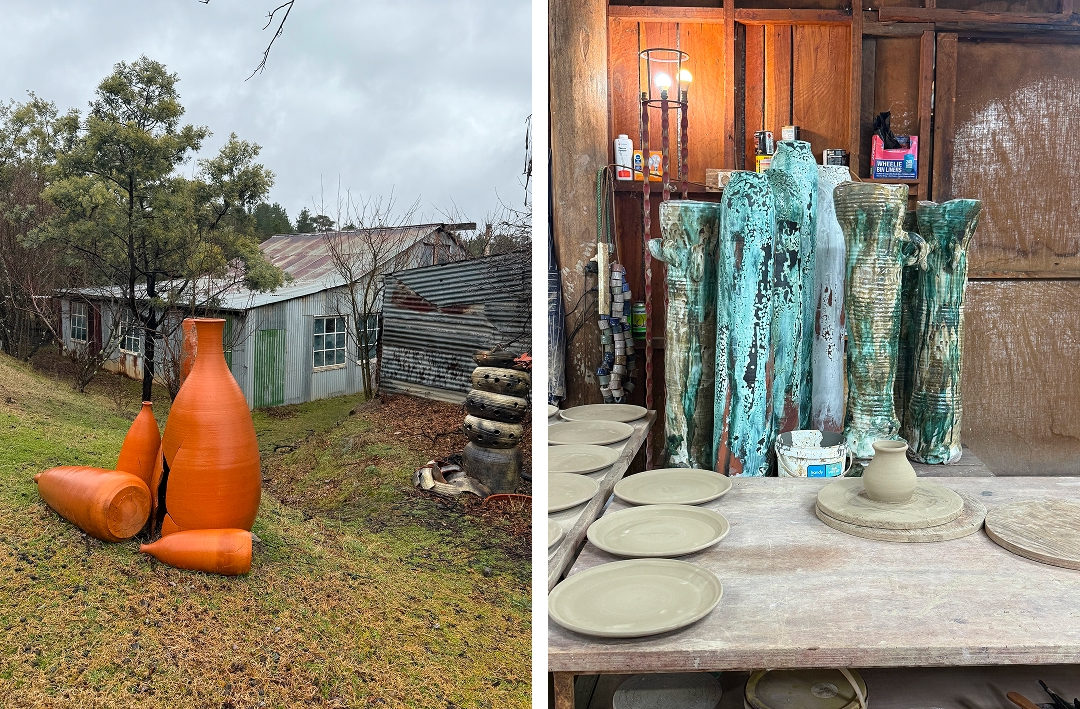
At the La Paloma studio beside Dennington’s Cottage
Visit, and you may obtain some ceramics ‘on the spot’ or discuss an order. I leave with something else – Lino and Kim’s 2017 book, The Hill End Table. I’d seen it earlier, in BRAG’s shop with Gavin Wilson’s 1995 book, The Artists of Hill End. They’re two quintessential books about art and Hill End, and this time I don’t pass up the chance to own and keep learning from The Hill End Table, recipes and all.
All four artists moved to Hill End decades ago – Kim and Lino in the 1990s, and Genevieve and Bill in the 2000s. Each couple gained one of the decades-long leases on historic cottages that Parks was offering then (and no longer does).
And their studios may look old at first glance, but they’re new constructions built to look historic, in a form which the artists pre-negotiated with Parks.
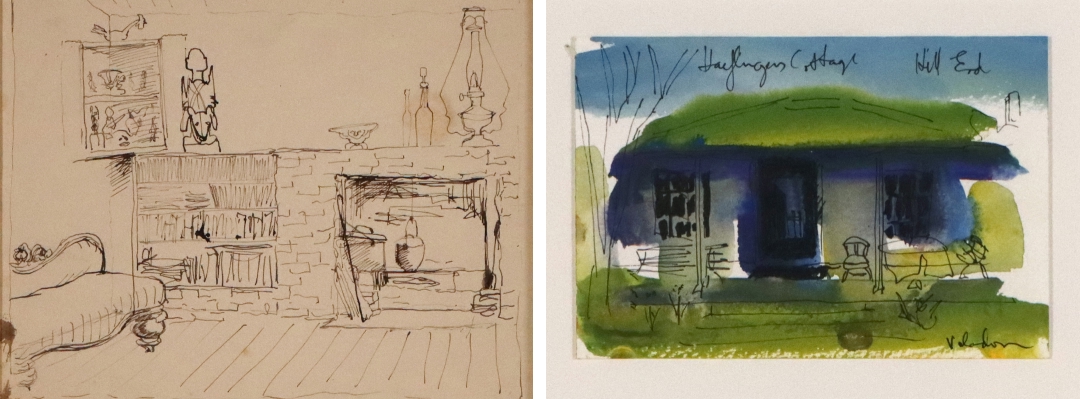
Left: Russell Drysdale, Cottage interior (Hill End studio), 1953, ink on paper. Right: Rosemary Valadon, Haefliger's Cottage, Hill End, 2003, watercolour and ink on paper. Images provided courtesy of Bathurst Regional Art Gallery
Two other historic cottages figure especially large in the story of Hill End’s renown for art: one purchased in 1947 by Donald Friend and his then partner, Donald Murray, and another purchased in 1954 by Jean Bellette and Paul Haefliger.
They were places for The Hill End Group artists to live and to work over the 1940s-50s. Later and most recently, they’ve been sites for Hill End AiR – an artist in residence program administered by Bathurst Regional Art Gallery (BRAG), with Parks (who now owns them) leasing them to BRAG.
The over 350 residencies at ‘Murray’s’ and ‘Haefliger’s’ over 1999–2021, with the program in hiatus since, has brought invaluable benefits including helping to build Hill End’s community of artists. Several former residents live here, including Rosemary Valadon, and the landscape painter Luke Sciberras.
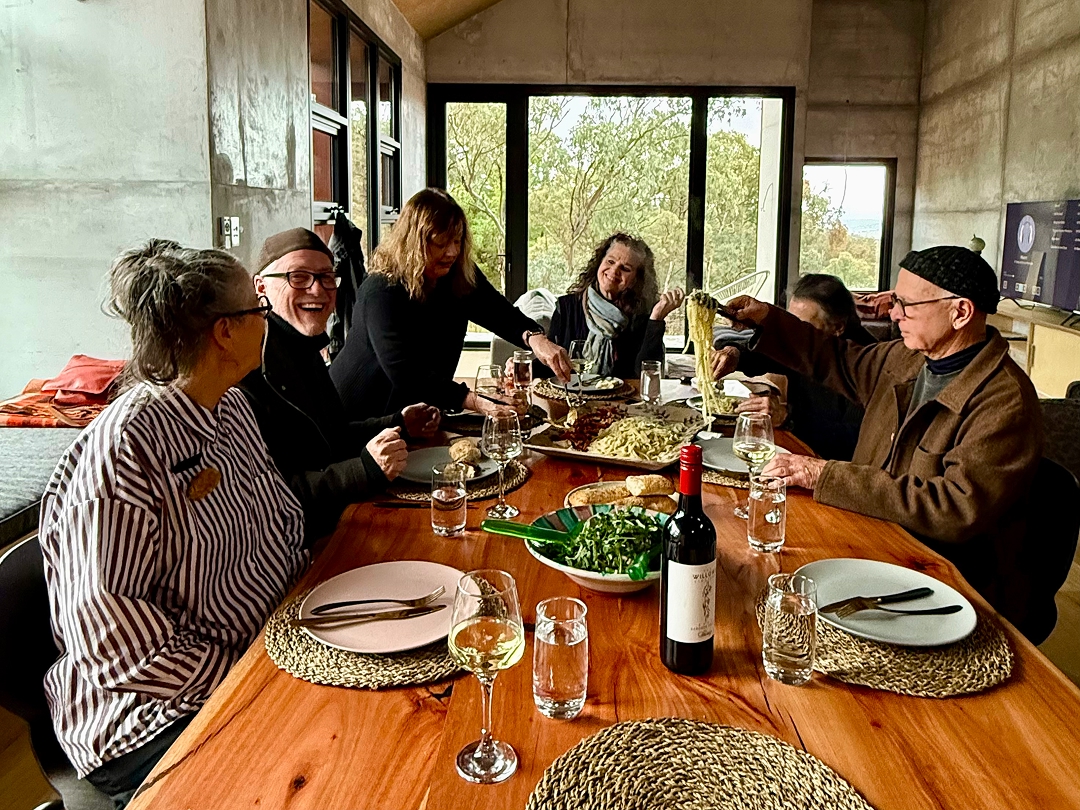
Lunch with the artists (L-R) Genevieve Carroll, Steven Cavanagh, Rosemary Valadon, Kim Deacon, Lino Alvarez and Bill Moseley, at the home of Genevieve & Bill
Genevieve and Bill have recently built a house in a contemporary style, not visible from the street. I’m invited there with Lino, Kim, Rosemary, and Steven Cavanagh, another former Hill End AiR resident and a multimedia artist with a focus on photography.
We share a delicious lunch served from La Paloma tableware, and I’m reminded of the culture that comes across in Lino and Kim’s book The Hill End Table, of food thoughtfully and bountifully prepared and beautifully presented to share around a table. Wine flows, conversation flows.
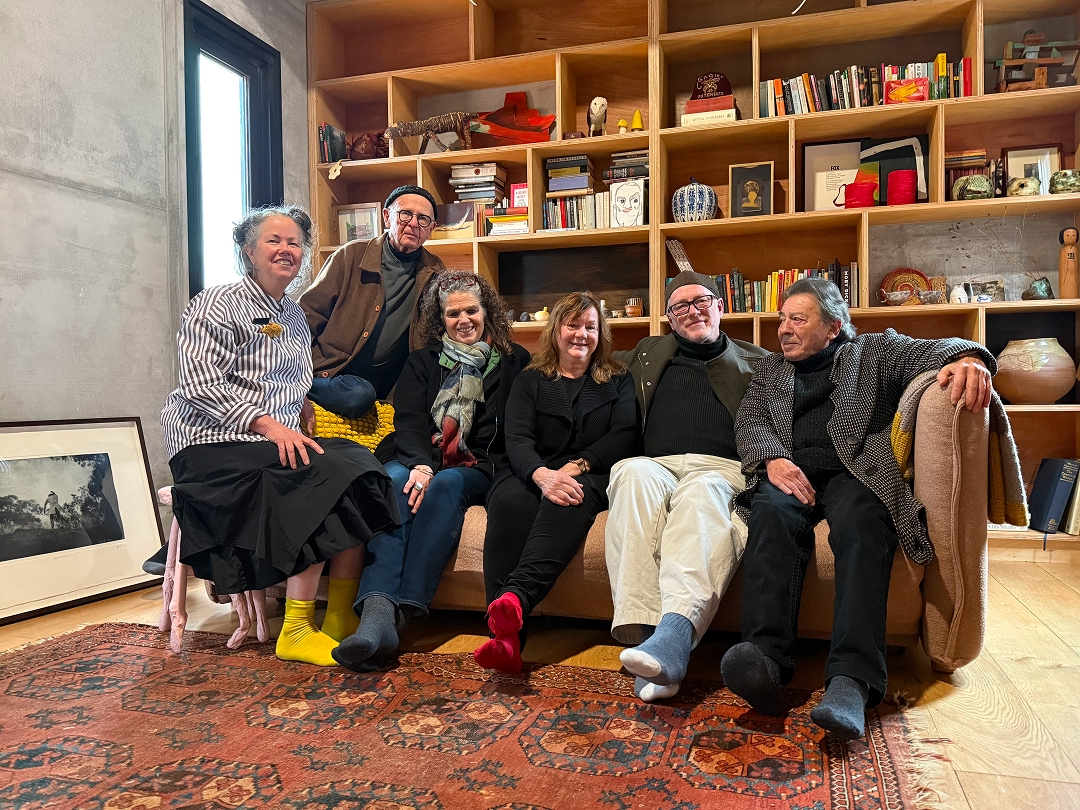
With the artists (L-R) Genevieve Carroll, Bill Moseley, Kim Deacon, Rosemary Valadon, Steven Cavanagh, Lino Alvarez, at the home of Genevieve & Bill
And amid it, they mention some of what influences or directly inspires their art… The forms, colours and evident history of Hill End’s evocative streetscapes and landscapes; the intense summers and winters; the spectacular springs and the autumns when an avenue of nineteenth-century deciduous plantings flame into colour; the contradictory environment, barren and eroded here, lush and verdant there; what historic houses are like to live in; and gold mining – its culture and its above and below ground spaces.
Incidentally, gold mining still occurs nearby. Vertex Minerals Ltd. currently works here.
Lunch over, it is hard to leave the nearby fireside and warm conversation.
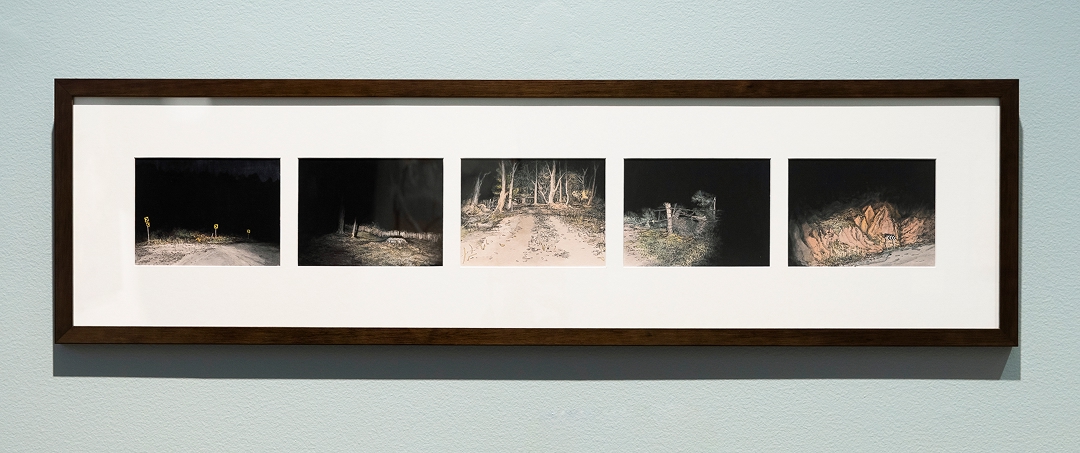
From the Landscapes of Imagination: From the Collection exhibition, 2025; Wendy Murray, The Daily Series, Hill End, 2018, ink and gouache on museum board. Silversalt Photography, image provided courtesy of BRAG
Back in the CX-70, I reflect on the fewer daylight hours of winter as the adaptive LED headlamps act as a reassuring substitute for the disappearing sun.
There’s accommodation in Hill End, including in some of the historic properties owned by Parks. Driving away, I’m already planning a future stay to see more of this remarkable village and over other hours... I think of sunrises, sunsets and nighttime, and other memorable artworks in BRAG’s Landscapes of Imagination exhibition come to mind.
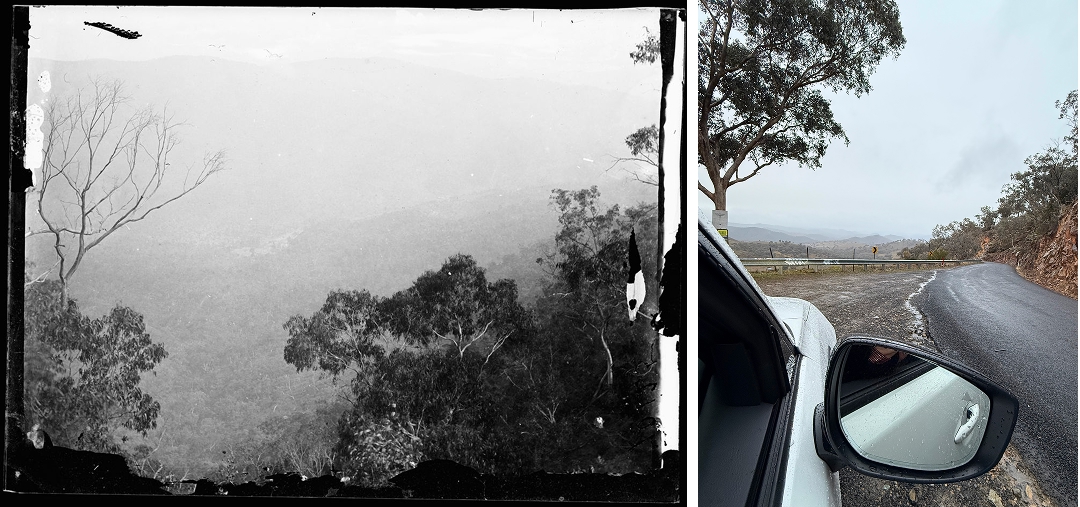
Left: Hill End area view, ON 4/Box 9 /no. 70025; A & A Photographic Co., Holtermann Collection, 1870-1875, Mitchell Library, State Library of New South Wales Right: On the road to Bathurst
On the descent to Bathurst, I watch the light slowly fade across the landscape from the warmth and comfort of the CX-70 – sublime.
I think about a classic ‘ghost town’, entirely abandoned and falling into disrepair. And I think about Hill End as far from that, with its population, and endeavours occurring in art, mining, agriculture and tourism. Also, Parks has a plan in action to manage Hill End’s heritage.
Hill End seems no ghost town to me. It is place with a complex past and present that really gets your eye and imagination working on what once was there, and now is gone.
Drive to Hill End and be fascinated both by what is and isn’t there.
Road trip to Bathurst: Motorsport and more
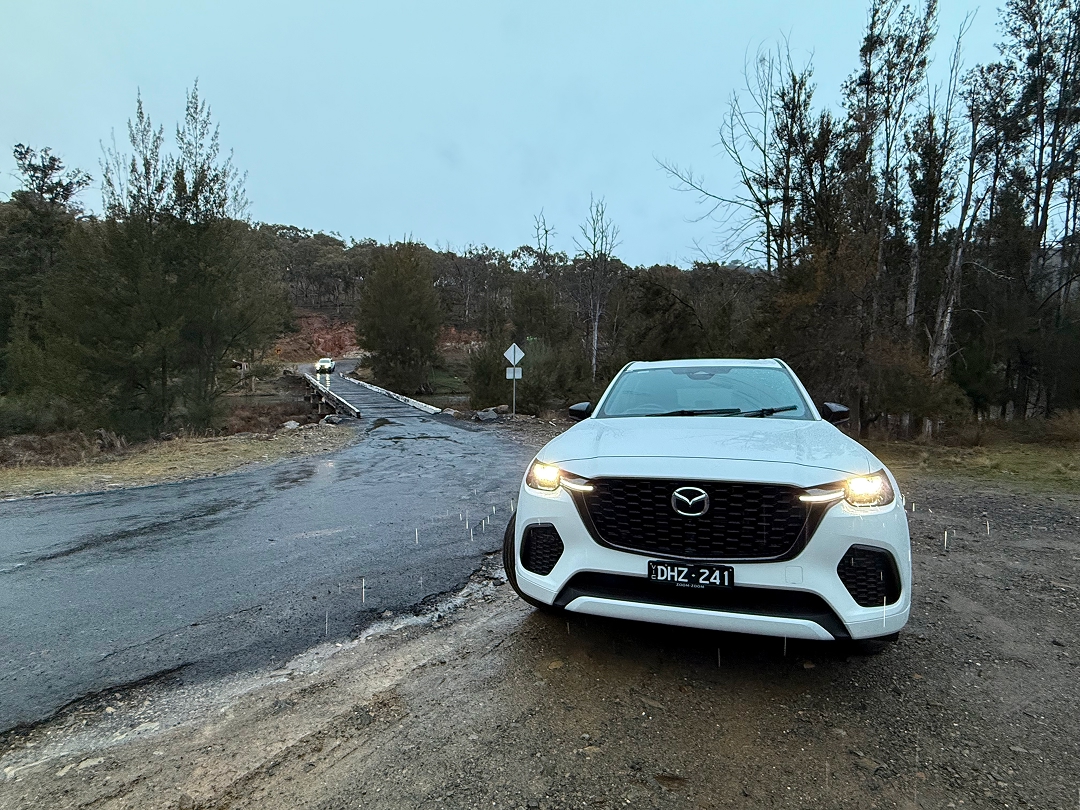
On the road to Bathurst