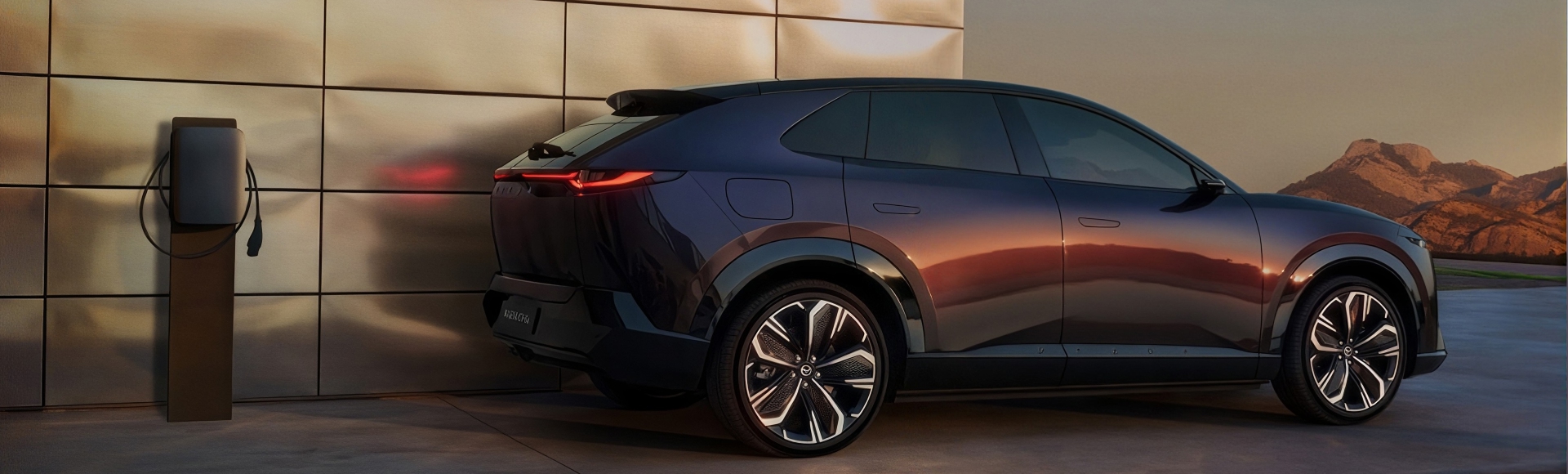
Getting to know the Mazda 6e and Mazda CX-6e
What are the Mazda 6e and Mazda CX-6e?
They are Mazda's all-electric vehicles for Australia. Both are fully battery electric, so there is no petrol engine, no fuel tank and no tailpipe emissions. You charge them at home, at work or at public charging stations.
- Mazda 6e: a sleek, low-slung liftback sedan with long range and a premium, driver-focused cabin. It was named 2026 World Car Design of the Year.
- Mazda CX-6e: a spacious medium SUV for families, with generous rear-seat space, a large boot and a feature-rich, high-tech cabin.
Mazda 6e and Mazda CX-6e
Both models share a 78kWh lithium iron phosphate (LFP) battery and a 190kW / 290Nm rear-wheel-drive electric motor.
What is a battery electric vehicle (BEV)?
A battery electric vehicle runs only on electricity stored in its high-voltage battery, which powers an electric motor that drives the wheels. It differs from a hybrid, which pairs a petrol engine with a small battery, and from a plug-in hybrid, which has a smaller rechargeable battery as well as a petrol engine.
Electric motors are highly efficient. They typically turn around 90% of the battery's energy into movement, compared with well under half for a petrol engine.
What is an electric Mazda like to drive?
An electric motor delivers its full torque the moment you press the accelerator, so acceleration is smooth, quiet and instant, with no gear changes. The battery sits low in the floor, giving a low centre of gravity that helps the car feel stable and planted through corners.
Mazda 6e and Mazda CX-6e
The Mazda 6e and CX-6e are rear-wheel drive, with linear, predictable acceleration and a quiet, wellinsulated cabin. Selectable levels of regenerative braking let you choose how strongly the car slows when you lift off the accelerator, recovering energy for the battery and reducing wear on the brakes.
What technology and comfort features do they have?
Both models are generously equipped as standard, with a premium, high-tech cabin.
Mazda 6e and Mazda CX-6e
Mazda 6e: 14.6-inch touchscreen, 10.2-inch digital instrument cluster, head-up display, 14-speaker Sony sound system, panoramic sunroof with electric sunshade, electrically extendable rear spoiler, heated and ventilated front seats, and wireless Apple CarPlay and Android Auto.
Mazda CX-6e: 26.45-inch 5K dual-split touchscreen, large head-up display, 23-speaker 1,280W sound system, voice and gesture control, panoramic sunroof with electric sunshade, front and rear climate control, digital side and rear-view mirrors (Azami), and Apple CarPlay and Android Auto.
Range
How far can the Mazda 6e and CX-6e travel on one charge?
Most drivers will find several days of normal driving between charges.
| Model | Driving range (WLTP)* | Energy use (combined)* |
|---|---|---|
| Mazda 6e | Up to 560 km | 15.9 kWh/100 km |
| Mazda CX-6e GT | Up to 484 km | 18.9 kWh/100 km |
| Mazda CX-6e Azami | Up to 468 km | 19.4 kWh/100 km |
* Actual driving range may vary depending on factors including accessories fitted, battery age and condition, climate, driving style, use of heating or cooling, traffic conditions and vehicle load.
What does WLTP mean?
WLTP stands for Worldwide Harmonised Light Vehicles Test Procedure. It is a standardised test used to measure a vehicle's energy use and driving range under consistent conditions. WLTP figures are a fair way to compare vehicles, but they are not a prediction of the exact range every driver will achieve.
Is the range enough for everyday driving?
For most Australians, comfortably. The average daily commute is under 40km, so a fully charged Mazda 6e or CX-6e can cover a typical week of commuting before it needs charging. Many owners simply top up at home overnight a few times a week.
What affects real-world range?
The same things that affect fuel use in a petrol car affect energy use in an EV:
- Speed: sustained highway speeds use more energy than urban driving, because air resistance rises
with speed. - Weather: very hot or cold conditions mean more energy is used to cool or warm the cabin and
battery. - Heating and air conditioning: these draw on the battery, so their effect depends on the weather and
the temperature you choose. - Load and accessories: passengers, luggage, roof boxes and towing all increase energy use.
- Terrain and driving style: hills, strong headwinds and hard acceleration use more energy.
In city and stop-start driving, regenerative braking recovers energy, so EVs are often at their most efficient around town.
To get the most from every charge, accelerate smoothly, keep to sensible highway speeds, use regenerative braking, and pre-cool or pre-heat the cabin with the Mazda app while the car is still plugged in.
Charging at home
Can I charge from a normal power point?
Yes, and most owners do most of their charging at home. Around 80% of EV charging in Australia happens at home, usually overnight.
You can charge from a suitable standard Australian 240V power point using a portable EV charging cable. A standard power point supplies about 2.3–2.4kW, adding roughly 10–15km of range per hour. This can suit drivers with shorter daily distances who park overnight. Never use an extension lead or power board, and have an electrician confirm the circuit is suitable for long periods of charging.
Do I need a dedicated home charger?
Not necessarily. Many drivers can replace their daily driving energy from a standard power point. A dedicated wall charger is faster and more convenient, especially if you drive longer distances, and many offer scheduled or smart charging to use cheaper off-peak or solar electricity. A licensed electrician must install it.
Mazda 6e and Mazda CX-6e
You have three easy ways to charge: a portable cable at a standard power point, a dedicated home AC wall charger, and public DC fast charging on the road.
Do I need three-phase power?
No. Most Australian homes have single-phase power, and the Mazda 6e and CX-6e can be charged on it. A 7kW single-phase wall charger will charge from 20% to 80% comfortably overnight.
Three-phase power allows faster AC charging where your home, charger and vehicle are compatible, but it is not needed to own an EV. Upgrading a home to three-phase can be costly, so it is rarely worthwhile just for charging. A licensed electrician can recommend the best option for your home.
Mazda 6e and Mazda CX-6e
The Mazda 6e and CX-6e accept AC charging at up to 11kW on a compatible three-phase charger. On single-phase power, a typical 7kW wall charger is ideal for overnight charging.
How long does it take to charge at home?
It depends on how much energy you need to add and how fast the charger is. As a guide for the Mazda 6e and CX-6e, with their 78kWh battery:
| Charging option | Power | 20% to 80% | 0 to 100% |
|---|---|---|---|
| Standard power point (portable cable) | ~2.3 kW AC | ~20–22 hours | ~34–38 hours |
| Home wall charger (single-phase) | 7.2 kW AC | ~6.5–7 hours | ~10–12 hours |
| Wall charger (three-phase) | 11 kW AC | ~4.5–5 hours | ~8–8.5 hours |
Approximate times. Charging time varies depending on charger capacity, battery and ambient temperature, and other factors.
Is it safe to charge in the rain?
Yes. Charging connectors and the vehicle's charge port are sealed and designed for outdoor use. Power only flows once the car and charger have confirmed a secure connection. You can also take your Mazda EV through a car wash.
Fast charging and road trips
How fast can the Mazda 6e and CX-6e fast charge?
Both models support DC fast charging at up to 194kW. On a suitable fast charger, you can go from:
That is enough time for a coffee and a short break on a road trip. Fast-charging times are quoted to 80% because charging naturally slows as the battery fills, to protect the cells. Any public charger rated at 194kW or more lets your Mazda EV charge at its full speed.
Charging time varies depending on charger capacity, battery and ambient temperature, and other factors.
What is the difference between AC and DC charging?
- AC charging is the slower, everyday charging you use at home, at work and at destination chargers such as shopping centres and hotels. The car converts the AC power into DC to store it in the battery.
- DC fast charging supplies power more directly to the battery at much higher speeds. It is found at public fast-charging stations along major roads and highways.
An easy way to remember it: slow while you sleep, fast while you travel.
The Mazda 6e and CX-6e use the Australian standard plugs: Type 2 for AC charging and CCS2 for DC fast charging, through a single charging port.
Can I take my Mazda EV on a long road trip?
Yes. Australia's public charging network continues to expand, particularly along major highways. A little
planning helps:
- Check your route and the charging stations along the way before you leave.
- Find chargers using your car's navigation, charging-network apps or Mazda's charging-station finder. You can usually pay through an app or by card at the charger.
- Arrive at each charger with a comfortable buffer of around 10–20%.
- Keep a back-up charger in mind in case your first choice is busy.
- In regional and remote areas, plan charging stops in advance. Many hotels and caravan parks also offer overnight AC charging.
A typical rhythm is to drive for two to three hours, then take a short break while the car fast charges.
Mazda 6e and Mazda CX-6e
With up to 560km of WLTP range in the Mazda 6e, and up to 484km in the CX-6e GT, plus 30–80% fast charging in about 15 minutes, both models are well suited to Australian road trips.
What happens if I run low on charge?
Your Mazda EV gives you clear, progressively stronger warnings as the battery gets low, with plenty of notice to find a charger. When a car is stationary or in slow traffic it uses very little energy, so a traffic jam is not a concern. If you ever need help, contact Mazda Roadside Assistance.
Running costs
How much does it cost to charge?
A simple way to estimate it:
Quick formula
Energy added (kWh) × your electricity price per kWh = charging cost
For example, charging the 78kWh battery from 20% to 80% adds about 47kWh. At a typical home rate of 30c per kWh, that is about $14. On a cheaper off-peak rate of 20c per kWh, it is closer to $9. Public DC fast charging usually costs more per kWh than charging at home.
Is an EV cheaper to run than a petrol car?
Usually much cheaper, especially when you charge at home. Here is an illustrative comparison:
| Vehicle / charging method | Cost per 100 km | Cost per year (12,000 km) |
|---|---|---|
| Mazda 6e, home charging at 30c/kWh | ~$4.80 | ~$570 |
| Mazda CX-6e GT, home charging at 30c/kWh | ~$5.70 | ~$680 |
| Typical petrol car, 8L/100km at $2.00/L | ~$16.00 | ~$1,920 |
Illustrative only, using combined energy-use figures. Your costs will depend on your electricity plan, fuel prices and driving.
Can I charge with solar panels?
Yes. Charging from rooftop solar is the cheapest way to run an EV, because the cost is only the small feedin credit you would otherwise have earned. A smart wall charger can automatically match charging to your solar output. Charging during the day, such as on weekends or when working from home, makes the most of it.
Do EVs need servicing?
Yes, but there is less to service. An EV has no engine oil, oil filters, spark plugs, fuel filters or exhaust system. Tyres, brakes, suspension, steering, air conditioning, cabin filters, cooling systems and electrical components still need regular checks, along with a battery health check.
Mazda 6e and Mazda CX-6e
The Mazda 6e and CX-6e are serviced every 12 months or 20,000km, whichever comes first, by Mazdatrained BEV technicians across Mazda's national dealer network. Service pricing is available through the Mazda Service Price Guide.
Towing, space and practicality
Can the Mazda 6e and CX-6e tow?
Yes. Both models are rated to tow a trailer when fitted with the Mazda Genuine towing kit.
Mazda 6e and Mazda CX-6e
Mazda 6e and Mazda CX-6e: up to 1,500kg braked towing capacity, with a 75kg maximum ball weight. Towing is subject to state and territory regulations.
How much range will I lose when towing?
Towing always uses more energy, in an EV or a petrol car. How much depends on the trailer's weight and shape, your speed, the terrain and the weather. A tall caravan will have a bigger effect than a small, low trailer, even at similar weights. When towing, plan your trip more conservatively and allow for extra charging stops. Many fast chargers are designed for nose-in parking, so you may need to unhitch at some
sites.
How much space is there?
Both models give you extra storage under the bonnet (a 'frunk') because there is no engine, which is handy for charging cables or small bags.
| Model | Boot | Seats folded | Front storage (frunk) |
|---|---|---|---|
| Mazda 6e (liftback) | 336 L | 1,074 L | 72 L |
| Mazda CX-6e (SUV) | 363 L | 1,434 L | 83 L |
Is the Mazda CX-6e a good family car?
Yes. The CX-6e combines SUV ride height and easy access with generous rear legroom and headroom, a large boot that expands to 1,434L, and an 83L frunk. Family-friendly features include front and rear climate control, a panoramic sunroof with electric sunshade, a 360° camera and nine airbags. A 26.45-inch 5K dual-split touchscreen and a 23-speaker sound system keep everyone entertained.
Battery and warranty
What battery do the Mazda 6e and CX-6e use?
Both use a 78kWh lithium iron phosphate (LFP) battery. LFP is a lithium-ion battery chemistry that contains no nickel or cobalt. It is known for:
- excellent thermal stability;
- long life over many charge cycles;
- good tolerance of hot conditions; and
- being well suited to regular full charges.
How long will the battery last?
EV batteries are designed to last for the long term. Like any rechargeable battery, they lose some capacity gradually as they age, but this is a slow process, not a sudden failure. A large international study of more than 22,700 EVs found batteries lose on average about 2.3% of capacity per year. The vehicle's battery management system continually monitors and protects the battery.
Should I charge to 100% every day?
Charging advice depends on the battery type, so always follow your owner's manual. Lithium iron phosphate (LFP) batteries, like the one in the Mazda 6e and CX-6e, are generally well suited to regular full charges, which means you can have the car's full range available when you need it.
What warranty comes with the Mazda 6e and CX-6e?
Your Mazda EV is backed by:
See the Mazda warranty terms for full details.
Safety and technology
How safe are the Mazda 6e and CX-6e?
EVs sold in Australia must meet the same Australian Design Rules as every other new car. With the battery mounted low in a strong protective structure, EVs have a low centre of gravity, and the high-voltage system is designed to disconnect automatically in a crash.
Mazda 6e and Mazda CX-6e
The Mazda 6e has a maximum 5-star ANCAP safety rating, scoring 93% for both adult and child occupant protection. Both models feature nine airbags, Smart Brake Support (autonomous emergency braking), Lane-keep Assist, Emergency Lane Keeping, Blind Spot Monitoring, Rear Collision Warning, Rear Cross Traffic Alert and a 360° camera with See-Through View.
Do EVs catch fire more often than petrol cars?
No. EV battery fires are rare, and Australian data shows they occur far less often than fires in petrol and diesel vehicles. The few that have occurred in Australia were mostly caused by severe crashes, external fires or deliberate damage. All EVs sold here must meet Australian vehicle safety standards.
Mazda 6e and Mazda CX-6e
The LFP battery used in the Mazda 6e and CX-6e is one of the most thermally stable lithium-ion chemistries available, and it is managed by an advanced battery temperature management system.
Can my Mazda EV power appliances?
Yes. With vehicle-to-load (V2L), you can use the car's battery to power appliances and devices through an adaptor. It is handy for camping, picnics, worksites or during a power outage.
Mazda 6e and Mazda CX-6e
The Mazda 6e supports V2L at up to 3.5kW, enough to run many household appliances. The Mazda CX-6e also supports V2L.
What can I do with the Mazda app?
The Mazda app keeps you connected to your EV from your phone. You can:
- check charge level and vehicle status in real time;
- manage and schedule charging;
- pre-cool or pre-heat the cabin before you set off; and
- use your phone as a Bluetooth key and share access with others.
Common EV myths
Myth: You need an expensive charger before you can buy an EV.
Not true. A suitable standard power point and portable charging cable may be enough for drivers with modest daily travel. A dedicated wall charger adds speed and convenience, and you can install one whenever it suits you.
Myth: EV batteries need replacing every few years.
Not true. Modern EV batteries are designed for long-term use and lose capacity gradually rather than failing after a few years. That is why Mazda backs the Mazda 6e and CX-6e high-voltage battery with an 8-year / 160,000km warranty.
Myth: EVs aren't better for the environment.
Building an EV and its battery does create emissions, just as building a petrol car does. But a battery electric vehicle produces zero tailpipe emissions while driving, and Australian Government guidance shows EVs generally have lower lifecycle emissions than comparable petrol and diesel vehicles. The benefit grows as more renewable energy enters the grid, and charging from rooftop solar makes it even greater.
Are EVs suitable for Australian conditions?
Yes. Modern EVs are designed to operate across a wide range of climates and driving conditions. As with any vehicle, extreme temperatures, high speeds, heavy loads and towing affect efficiency, so a little planning helps you get the best from your car. The LFP battery in the Mazda 6e and CX-6e is well suited to hot conditions, and Mazda's national dealer and service network supports owners across metropolitan and regional Australia.
Ready to experience electric Mazda?
Book a test drive of the Mazda 6e or Mazda CX-6e at your local Mazda dealer, or explore Mazda Battery Electric Vehicles.
Important information: Driving range figures are based on WLTP testing. Actual driving range may vary depending on factors including accessories fitted, battery age and condition, climate, driving style, use of heating or cooling, traffic conditions and vehicle load. Charging times vary depending on charger capacity, battery and ambient temperature, and other factors. Running-cost and charging-time examples are illustrative estimates only. Towing is subject to the Mazda Genuine towing kit being fitted and to state and territory regulations. Warranty terms and conditions apply. Specifications and features are subject to change; please confirm details with your Mazda dealer.