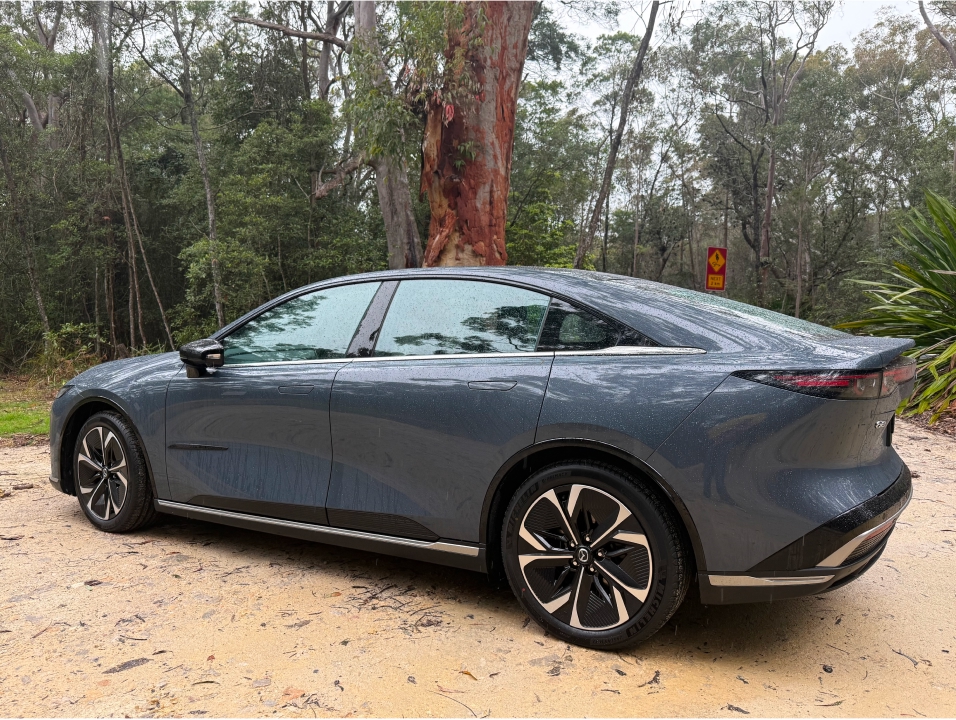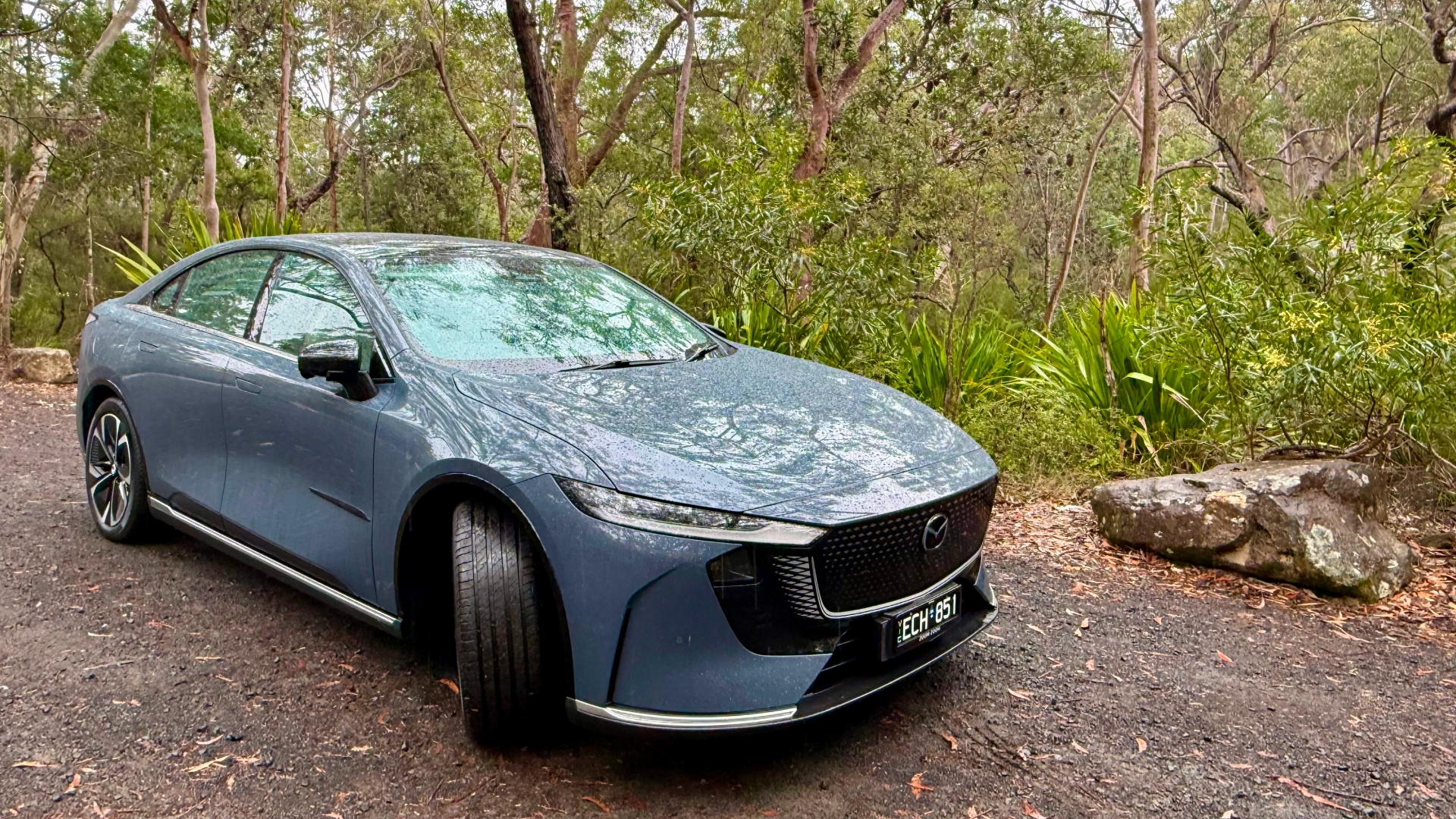
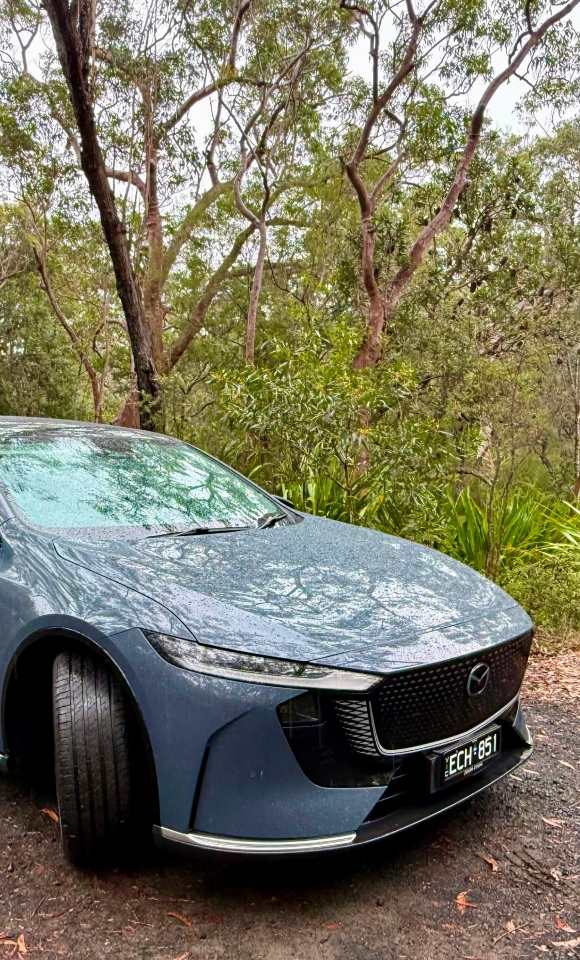
The 6e EV in Sydney’s Royal National Park
I’m in the all-electric 6e GT, arriving at the Royal National Park on Sydney’s southern edge. Established in 1879, it’s Australia’s first national park and the world’s second oldest, after the oldest – the 1872 Yellowstone National Park, USA.
I was here yesterday too, meeting with David Croft from the NSW National Parks and Wildlife Services, head of the rangers across a southern portion of its Greater Sydney Branch. As I return, I’m thinking about our conversation, rich with insight into this park that David simply calls ‘Royal’.
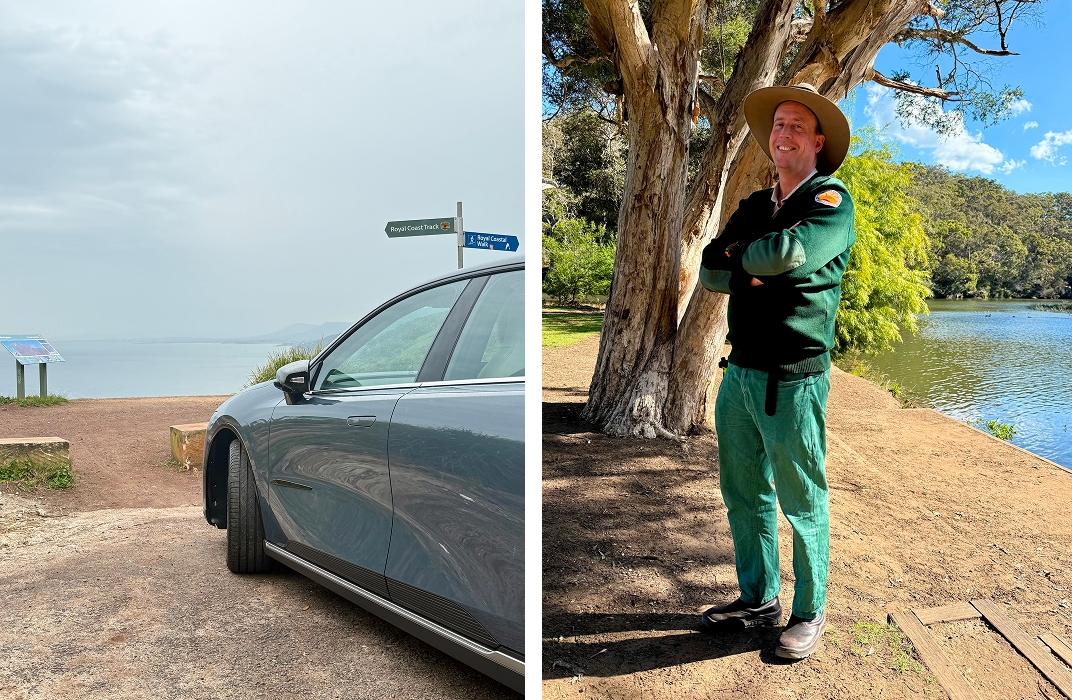
The Mazda 6e at Otford Lookout above the coast, and ranger David Croft beside the Hacking River at Audley
Taking an EV into the Royal National Park
At Royal’s southern tip, I’m pulling out onto Lady Wakehurst Drive after being at Otford Lookout. What a view from there!
And what a car! The 6e is the first mainstream all-electric Mazda to reach Australia. It was released earlier this year, and its excellence was swiftly recognised when it won the 2026 World Car Design of the Year.
There are no EV chargers in this park, or not yet – David indicated this as one aim for the future. And while there are chargers in the surrounding suburbs, you probably won’t need to find them.
Royal spans around 150 square kilometres, and the longest drive across it – the one I do today, from the park’s south to its northwest – is around 35 kilometres. That is a large park, but the range of the 6e’s 78 kilowatt-hour LFP battery when fully charged is a generous 560 kilometres.
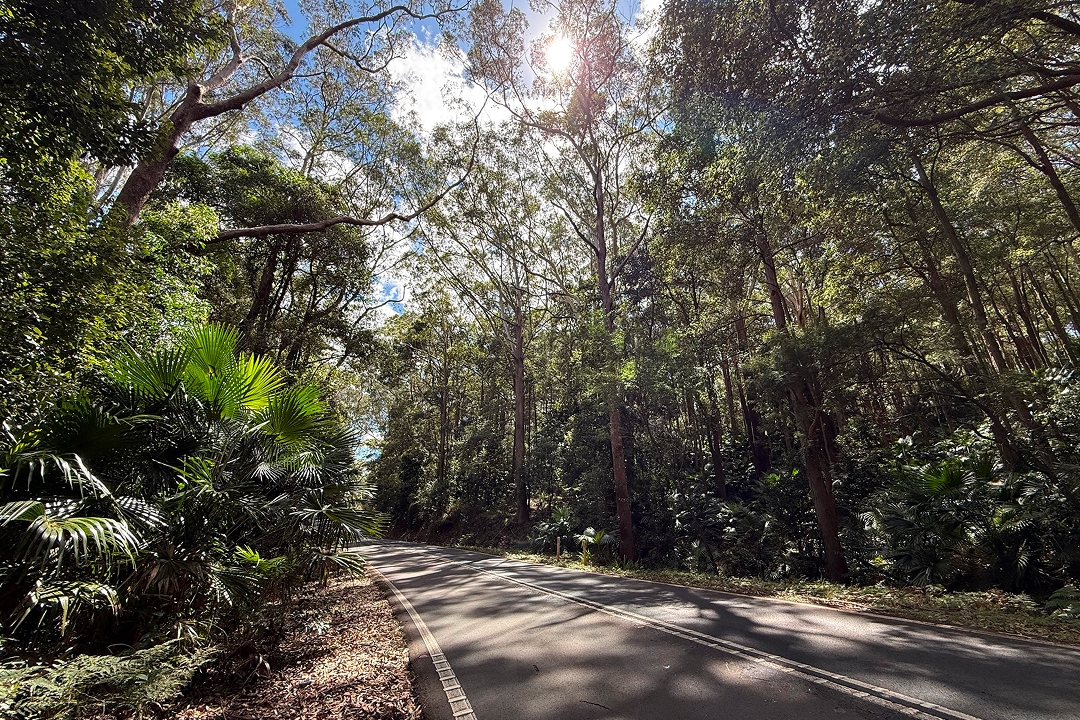
On Lady Wakehurst Drive in rainforest. The palms are the cabbage tree palms, Livistona australis, iconic to the NSW South Coast
It’s a cool day with light rain, and I’m beginning an ascent in the 6e through rainforest when a road sign indicates kilometres of winding road ahead. That makes me smile; I enjoy a winding road like no other.
And it’s perfect to further try the feel of acceleration and braking in this EV, compared to a conventional car. These days in the Royal are my first ever driving an all-electric car.
And? I’m getting excellent control and smoothness in and out of curves, while the rear-wheel handling feels precise. Transitioning to an EV is proving easy, just requiring an initial mental leap for the different locations of certain controls.
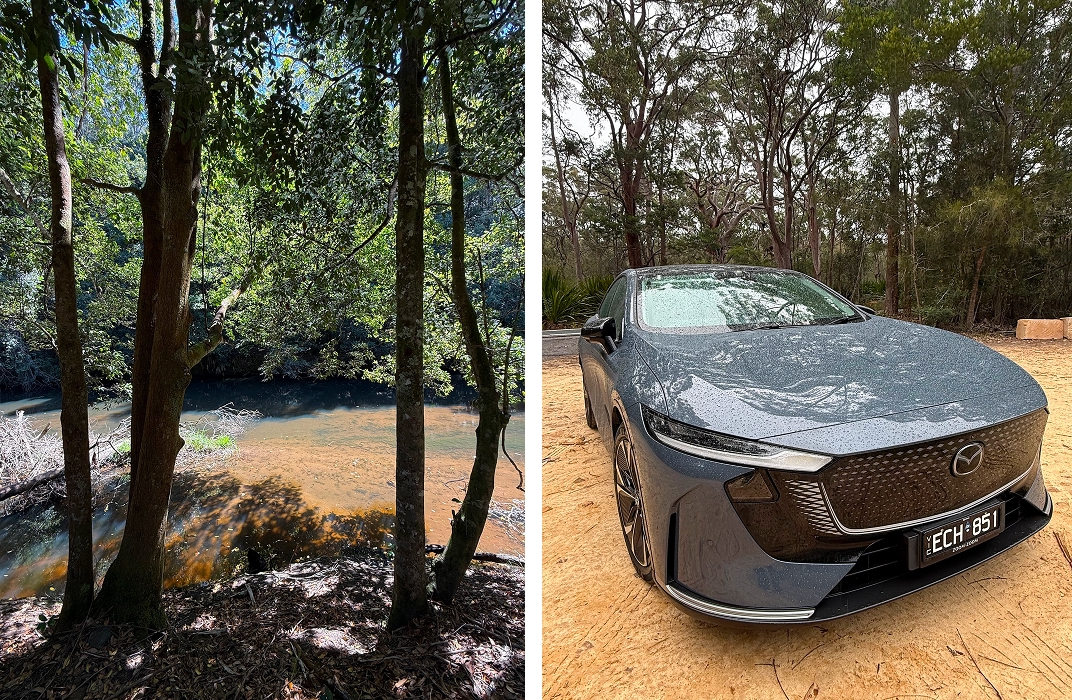
The Hacking River near the upper causeway, and the Mazda 6e in Polymetal Grey parked on
McKell Avenue
It’s an exciting drive, and not just because of the 6e. It’s also the setting, atmospheric and dramatic. Sunlight slants through gaps in the high forest canopy. Wet plants gleam. The head lights are auto-on, illuminating the way through patches of mist… There’s a terrific sense of arrival in climbing up into Royal through this stunning scenery.
For the fullest sense of immersion in this amazing place, I’ve got the panoramic sunroof open again today. Who says that a sunroof is just for blue-sky days?
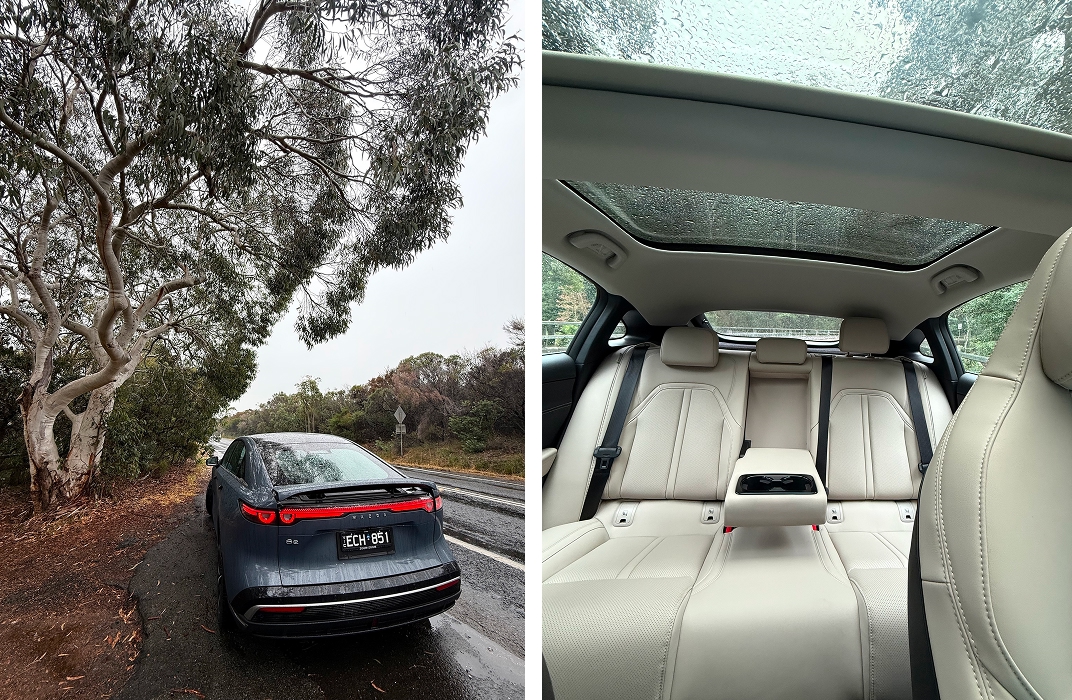
On Bertram Stevens Drive
What makes Royal National Park unique
Yesterday was a blue-sky day, unusually warm for late winter, and I’m glad to be having two days that starkly contrast in weather. It feels like experiencing two different moods of Royal.
This park’s a dynamic place. Over repeat visits, your experience will feel familiar but never quite the same, be that for different weather, seasonal change in the flora and fauna, new or upgraded facilities, or other factors. Also, less observable shifts are constantly going on.
Fluctuating fauna populations is one such shift, and one that David and the wider team keep watch for. I recall for instance David saying, ‘I'm starting to see more bandicoots recently. We've done some fox control, and I'd like to think that the increasing number of bandicoots I'm starting to see is a flow on from that.’
Royal is also wonderfully varied. When I ask David what makes it unique, he gives a combination of factors. Two together – its large size and its geography – mean that Royal has a remarkable range of elevations, environments, ecosystems and wildlife.
For an experience offering a terrific sense of this, David highlights the Wallumarra Track. He says, ‘It was designed as an educational resource, so you could walk a single track and see all these different ecosystems.’
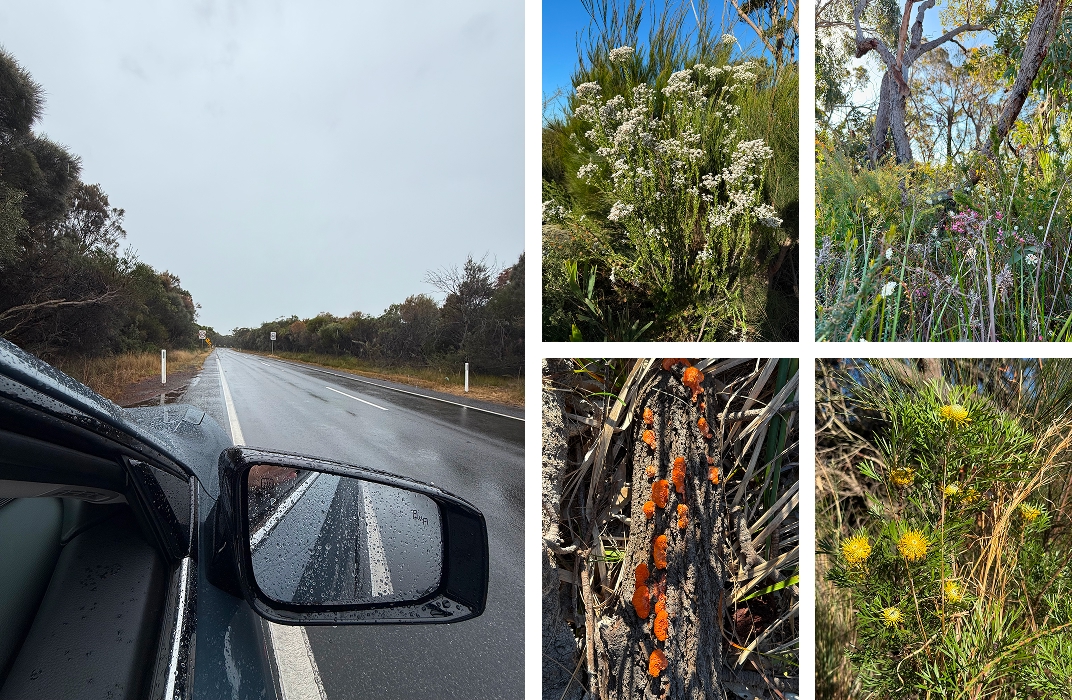
(L) On Bertram Stevens Drive and (R) flora and fungi in this broad vicinity or towards Wattamolla. In yellow bloom is Isopogon anemonifolia, and in white is Conospermum ellipticum
The coast: Garie Beach, Wattamolla and the whale season
Up on Bertram Stevens Drive, I’m approaching the Garie Beach turn off. The altitude is higher here, and the surroundings have opened out. I’m seeing plenty of sky, and sometimes the sea across coastal heathland that, here and there, bursts with colour – late winter flowers.
Garie Beach is a popular surf beach with a weekend kiosk, and what a setting for a surf!
A little further on is the turn off to Wattamolla. Yesterday, I took the short and easy walk from the car park into its extraordinary landscape where waterfall and lagoon and beach juxtapose in a magical way. Other people were there too, some of them swimming. Yes, it’s late winter.
This has long been considered a special place, and first by the people of the Dharawal Nation, whose traditional lands span the park and far beyond. ‘Wattamola’ means ‘place of waters’ in their language.
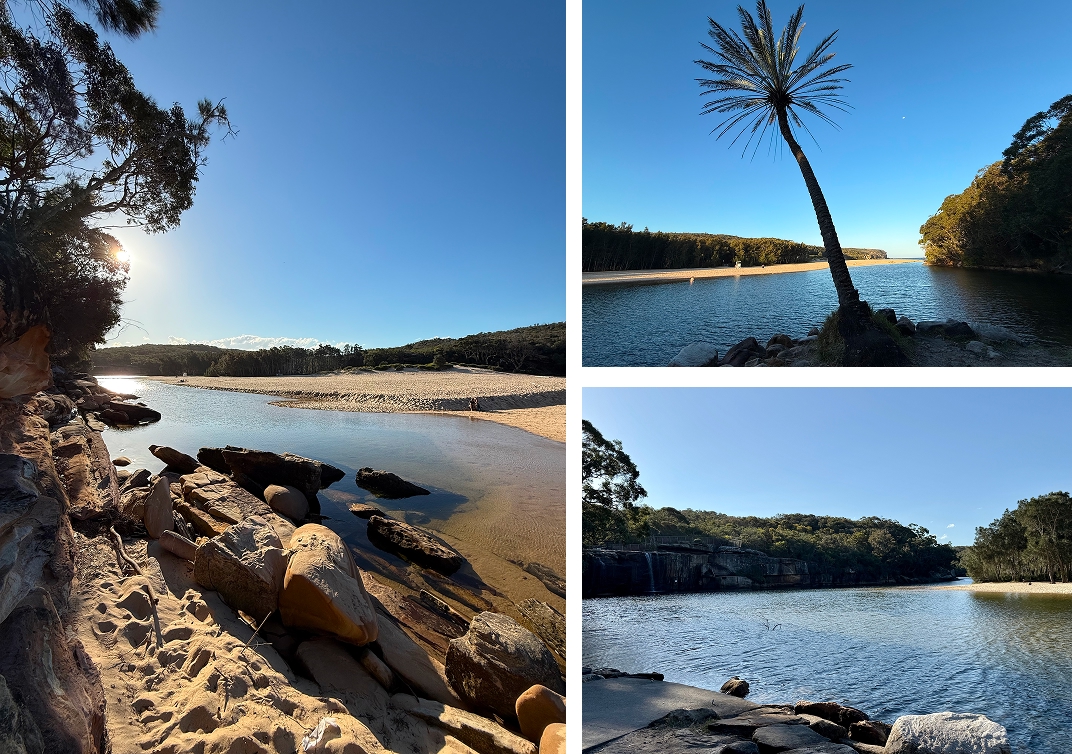
Wattamolla – its beach, lagoon and waterfall
Yesterday, I also met Jessica Fox who manages the team delivering Royal’s programs of tours and more. She urged me to visit Wattamolla, and to take the short walk up from the beach to Providential Head, an elevated lookout offering sweeping views over the sea and along the coast.
Jessica mentioned having voiced self-guided tours for this area, and that her utmost favourite guided tour runs here – Whales and Wildflowers. Plus, she added encouragingly, it’s whale migration time.
You may know from my winter trip on the NSW South Coast in a CX-5, that I’m whale-mad. Well, I didn’t need convincing, and walking up to this head proved providential. I saw whales and the spectacular nature of this coast of sandstone cliffs and beaches.
You can enjoy the coast at length on the Coast Track, extending the entire coastline of Royal, a total 27 kilometres; walk it all, or a section.
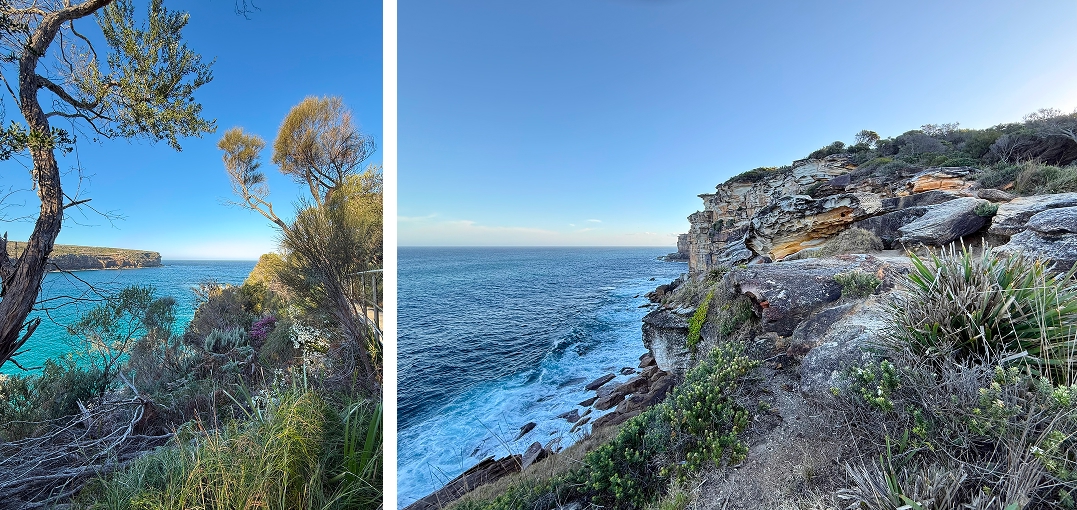
Wattamolla – (L) view approaching Providential Head and (R) view from the head
A stunning seaside exerts a magnetic pull. In David’s words, Wattamolla as well as Garie and Bonnie Vale get ‘super busy in summer’. He flags that, ‘car parking at those places sometimes fills up as early as 8.30–9.00am’.
Royal attracts high visitation, and that’s another of the factors given by David in describing what makes Royal unique. Its closeness to Sydney is one reason for its popularity, while another is its renown as a destination, something that stems right back to its origins.
This park was established in the 1870s as a place for healthy outdoor recreation out of Sydney, more than for nature conservation. That’s not to say that early ideas about conservation didn’t exist in that era, just that only later did they evolve to play the stronger role in park management.
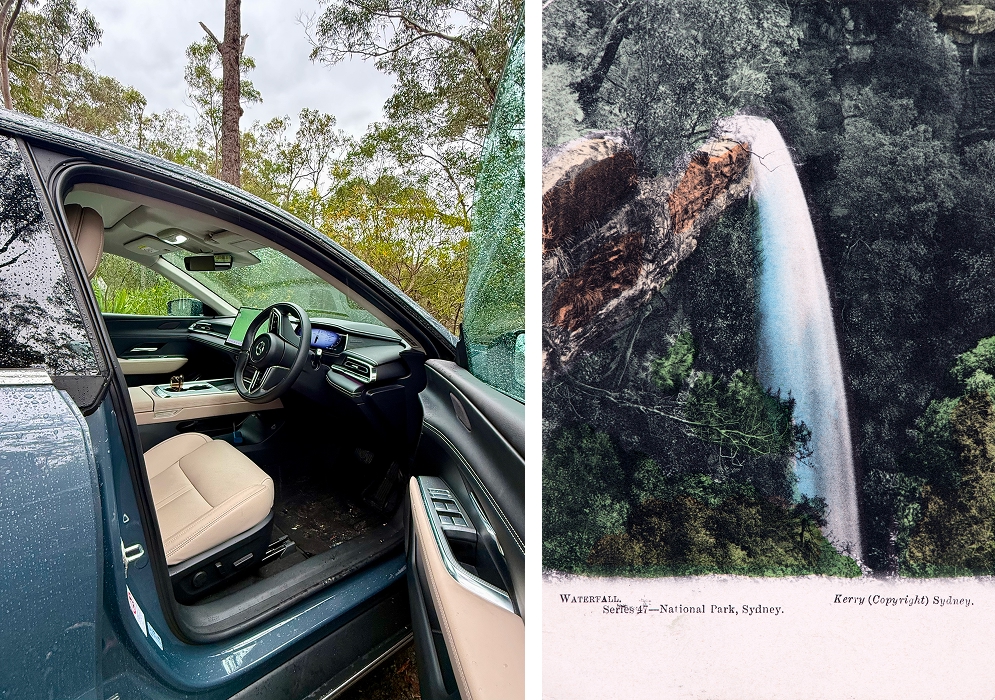
(L) On McKell Avenue near National Falls and (R) a hand-coloured photo-postcard of the lower National Falls by Kerry Co., 1900–1920, Local History, Sutherland Shire Libraries, MF004100, https://localhistory.sutherlandshire.nsw.gov.au/nodes/view/3238
A park for all seasons
David’s insider views on where to go and when are worth remembering. ‘I think the best time to come to the coast is now, around late winter and spring,’ he said. ‘It's a beautiful day out there today, low 20s, you can go for a bushwalk in a T-shirt and not get hot and sweaty. There are whales off the coast… It's a lovely time of year!’
He also recommends the western (i.e. inland) park for any season. But absolutely, he was thinking about summer options as he enthused about ‘walks and picnics in shaded natural areas with beautiful waterfalls and’...
Wild swimming? I asked. He responded, ‘Yes, and we encourage people to take care with all swimming and especially supervise children because it's a wild area and there's no patrol, and don’t swim alone, but there are places like Karloo Pools. It’s popular and a beautiful swim.’
And David’s topmost suggestion? Audley.
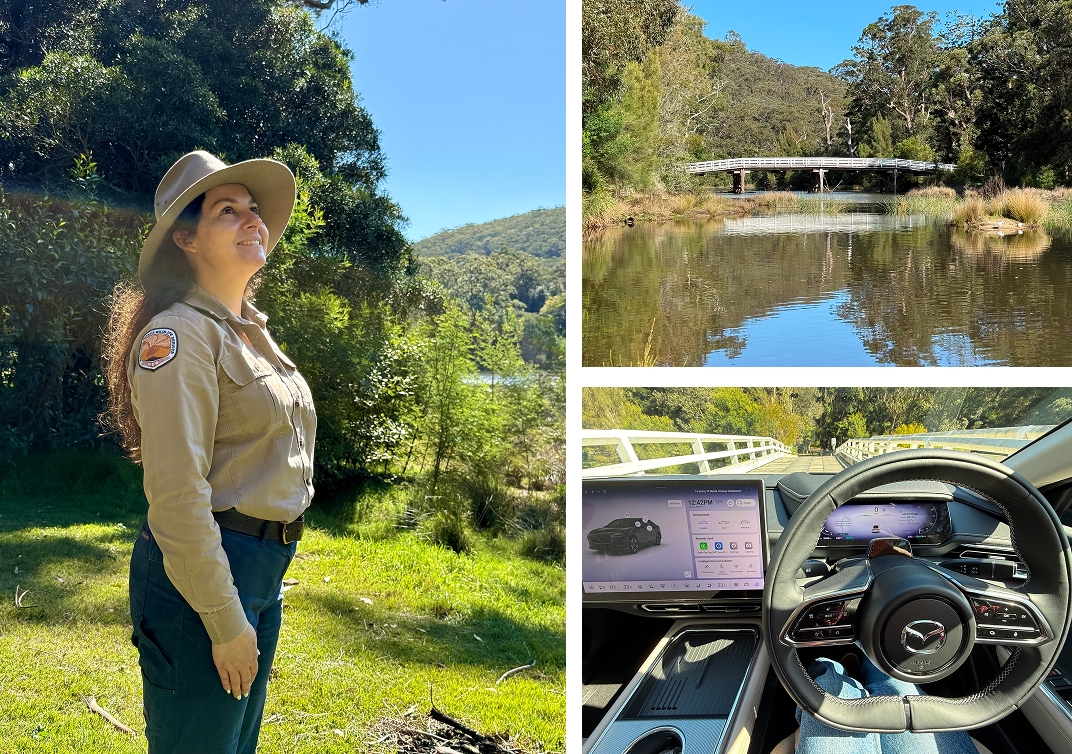
At the Audley precinct with Jessica Fox near the historic Varney’s Bridge. In the 6e, with its 14.6-inch screen and 10.2-inch multi-information meter display
Historic Audley: David's top pick
He says, ‘Audley offers those different experiences at Royal. You can hire a boat, go for a paddle on the river, go to the café… It's an experience at a calmer, more relaxed pace than the coast, which can be a bit frenetic and busy at times.’
I was at Audley yesterday and am driving there again.
Music is playing and sounds sensational. There are fourteen Premium Sony speakers and, sure, I hear the nineteen inch wheels on the road, but with less engine noise than in a conventional car, I’m hearing music more purely.
I pass the turn off to Bundeena Drive, which leads to the northeastern park and, ultimately, to Bundeena (with options for food and drink refreshment) or Maianbar –residential suburbs by the waters of Port Hacking. Access to these suburbs is why the park’s principal roads are thoroughfares – public and open 24/7. Only the park’s car parking and some minor roads are gated nightly.
And I recall David’s mention that sometimes people like to experience Royal simply by driving through. Without stopping to use car parking or other facilities, there’s no fee.
When a fee is due, it’s per vehicle; walk, bike, paddle, or tram in from the Sydney Tramway Museum, and your visit is free.
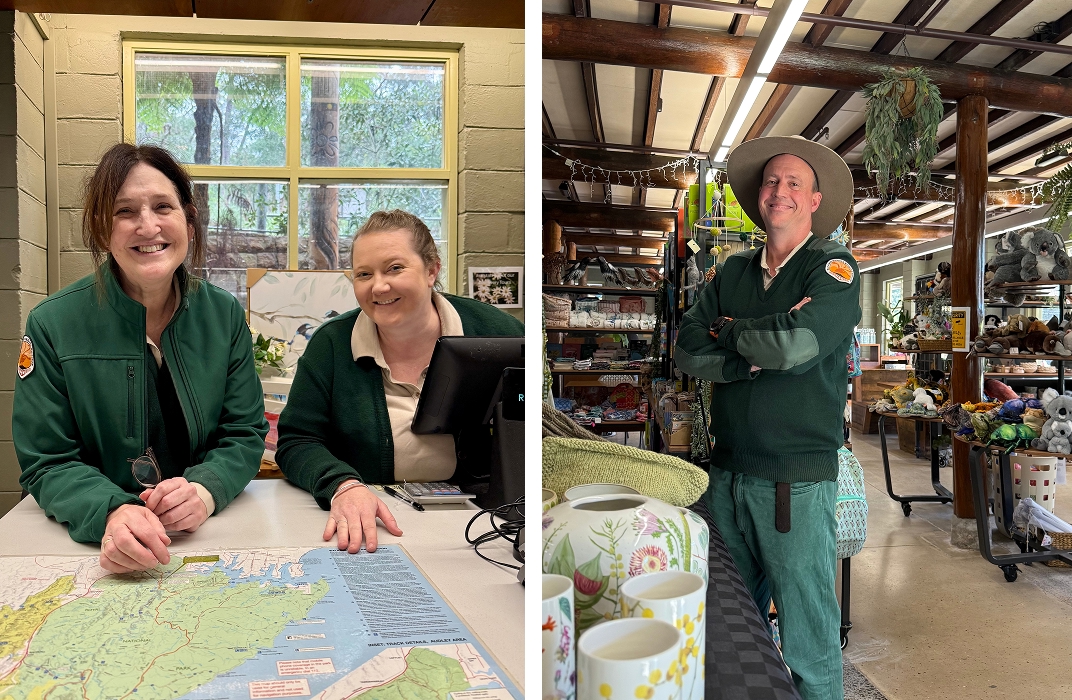
At the Audley Visitor Centre with (L, left to right) Dee Grey and Mandy McCallum, and (R) David Croft
At Audley, there’s a Visitor Centre for information and gifts, where staff from the team led by Dee Gray will help you to plan your visit for how much time you have, and the types of experiences that you want.
Before setting off for Royal, check the website or NSW National Parks App, including for any area closure alerts. As mobile coverage across the park is incomplete, you may wish to make some downloads or pre-book programs.
But that said, you can often join a program just by arriving at the Centre to discuss what’s on that day. And during school holidays, expect more family friendly program options than is usual year-round.
Adjacent to the Centre, is the 1949 Audley Dance Hall with a café across the lower floor. The upper floor is still an open space, and you can hire it for events.
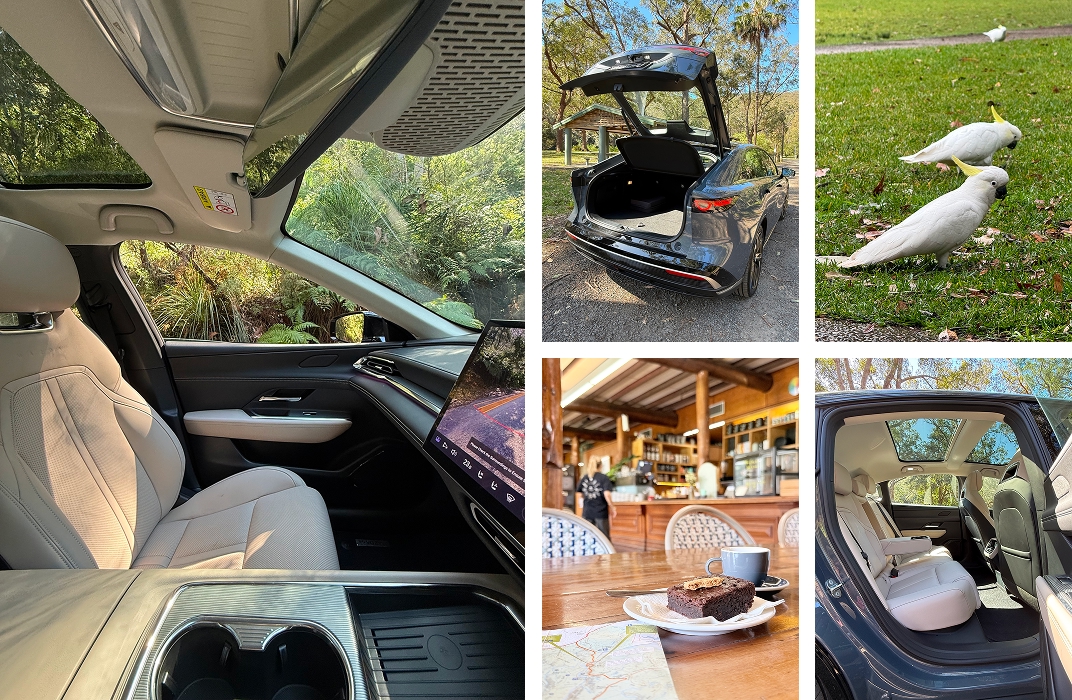
At the Audley precinct near Wattle Forest, sulphur-crested cockatoos, and in the Audley Dance Hall café
After the Centre, I’m at the café where I lunched yesterday. Today, it’s coffee and cake as I study a map… Audley has plenty of picnic areas, and there’s room for picnic gear galore in the 6e’s boot – 337 litres with all the seats up and the boot filled to the tray, up to a whopping 1,074 litres with the back seats down and filled to the roof.
I run my eyes along the riverside Lady Carrington Drive, deciding to do this classic walk this summer. David said, ‘It’s usually shady and cool, even on the hottest days. You’ve got this beautiful canopy above you, and you’re watching lyrebirds running around.’ It’s also easy and beloved by cyclists; it was a road, one of the park’s first, and there are sandstone remnants of that history to see.
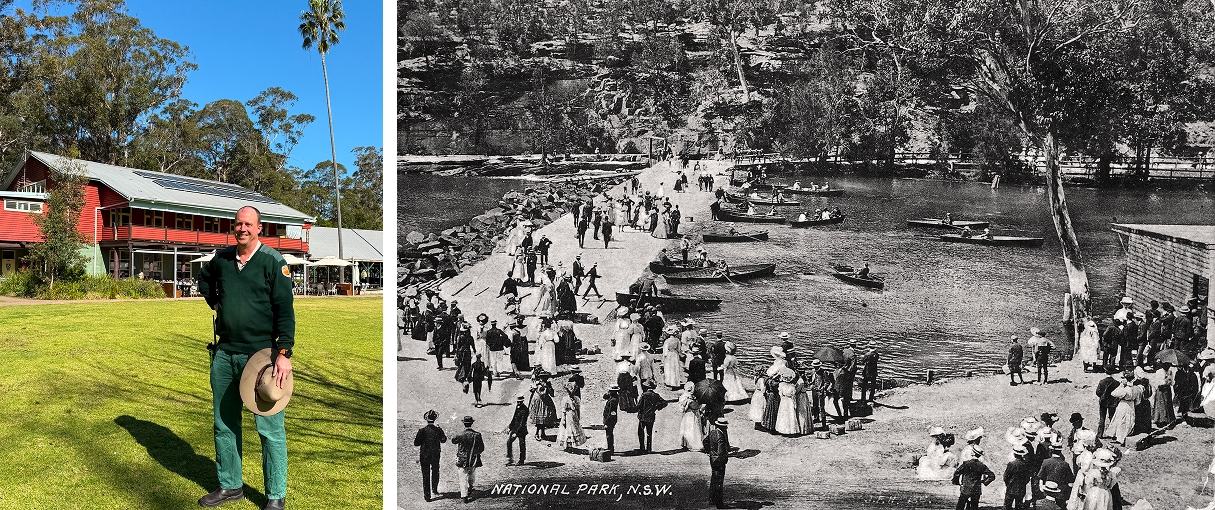
(L) David Croft outside the historic Audley Dance Hall and adjoining Visitor Centre, and (R) Photograph at Audley from near the former boatshed, c.1900–1920, Local History, Sutherland Shire Libraries, MF003200, https://localhistory.sutherlandshire.nsw.gov.au/nodes/view/2407
Audley is where Royal’s history as a park is most visible. And while much of what once was here is gone, including an orchard, enclosures of exotic animals, and a guesthouse that became extensive and renowned for honeymoons – features from times when national parks were different to now – it still feels evidently historic.
Photographs on interpretive signage here and there in the park, and online, help you to picture how it was. And David said, ‘People would come with their parasols and in good fancy clothes, which I can't imagine bush walking in today, or boating in, but people used to do it. Royal was very much the outdoor recreation destination for Sydney.’
Those words are on my mind as I stroll out of the café and across a wide lawn, sans parasol. I’m heading for the Audley Boatshed by the Hacking River, where people have been hiring boats since 1893, though this current, newly restored shed ‘only’ dates from 1938.
Choose a rowboat, a kayak or – how much fun? – a duck or swan pedal boat, and you can stay close or head upriver, or into Kangaroo Creek. For David, this creek is a top favourite paddle, ‘just an amazing natural space’.
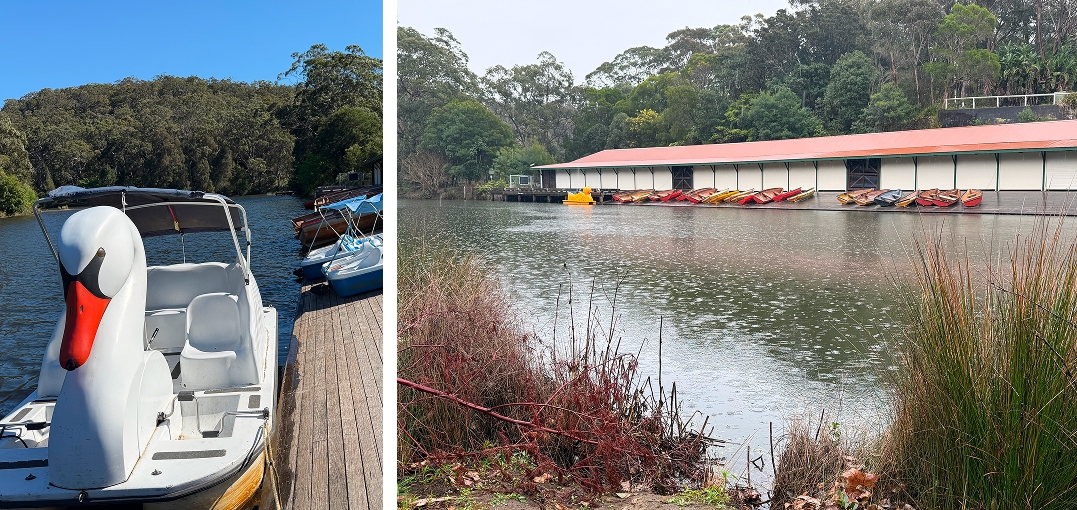
The historic Audley Boatshed on the Hacking River
The platypus are back in the Hacking River
You might see a platypus. There’s a small population of this iconic and famously shy species here, after a rewilding program with University of NSW researchers in their Platypus Conservation Initiative. Seventeen adult platypuses were released into the Audley area of the Hacking River over 2023–2026, and some have since bred.
‘Watching the researchers, seeing their response after they caught a juvenile and put a scanner over it, confirming that it had no microchip, meaning it was bred here… They were ecstatic!’ As David said this, it was clear that he too is ecstatic.
As he talked about this work, his love of wildlife came across with relief and jubilation at success after years of careful work. He concluded, ‘It's always a risk to reintroduce animals, but we've done a lot of checking of the parameters beforehand to be sure it was suitable, in terms of habitat with water quality, all sorts of things. And fox control too, to give these platypuses the best chance of success.’
Another rewilding was achieved with the nearby Symbio Wildlife Park in 2025. Southern stuttering frogs were freed in the park’s south.
Will there be a next? Another species? I asked.
And David’s response was cryptic. We’ll all have to wait and see.
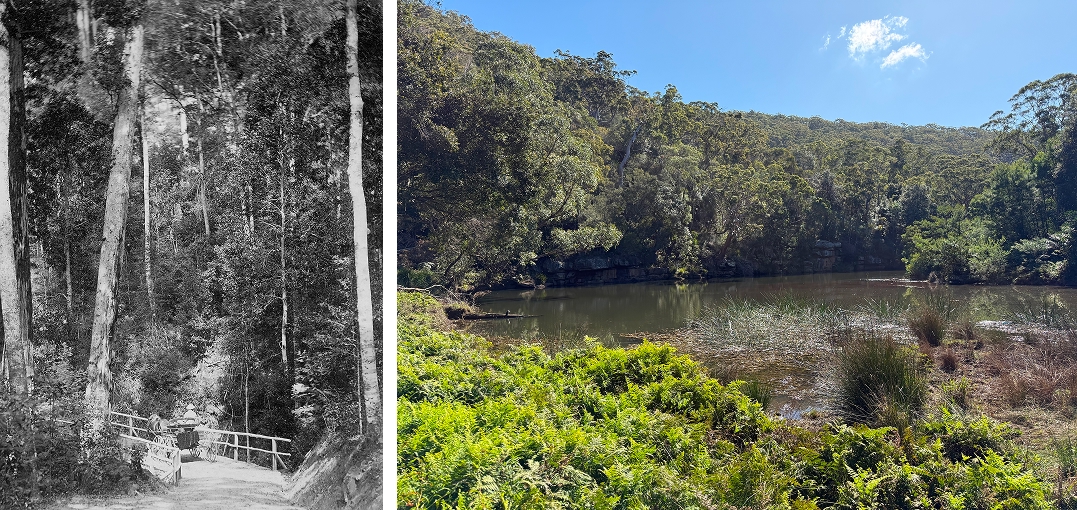
(L) Photograph of Lady Carrington Drive, 1888, Local History, Sutherland Shire Libraries, MF003858, https://localhistory.sutherlandshire.nsw.gov.au/nodes/view/3004 and (R) the Hacking River near Wattle Forest in the Audley precinct
The 6e at dusk, and the pull to stay overnight
Approaching the 6e, I admire its sleek coupe-style form with rear spoiler. It’s signature Kodo design, seeming full of life – dynamic, even when parked, even when driven at speeds nowhere near what its 190 kilowatts of maximum power and 290 Newton-metres of maximum torque can deliver.
I’m of course keeping to the speed limits and watchful for animals, smallest to biggest (feral deer), something especially important at dawn and dusk...
‘What do you want to do?’ The 6e asks.
By now, I’m driving and have (inadvertently) touched the wheel microphone button; the 6e is a communicative car, offering voice (and gesture) control for various functions.
I don’t say what I’d been thinking: I want to stay.
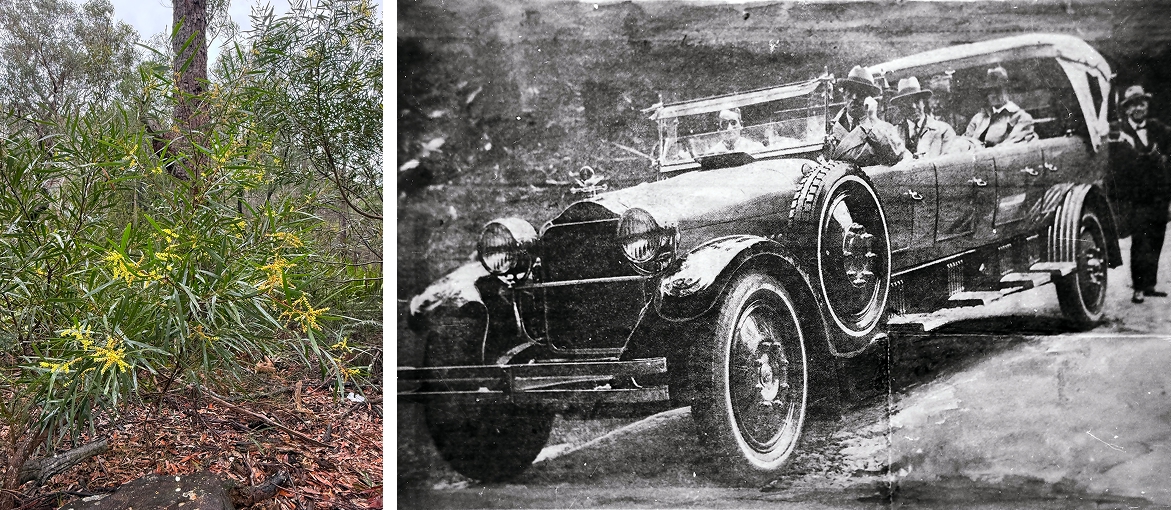
(L) Blooming wattle, Acacia longifolia and (R) tourist party in a 1923 charabanc, December 1924, Local History, Sutherland Shire Libraries, MF004388, https://localhistory.sutherlandshire.nsw.gov.au/nodes/view/3523
I want to stay overnight, to be in Royal over the twilight hours and night. I’m enticed by David’s mention of the potential to spot Royal’s wonderful nocturnal wildlife, the powerful owl, ringtail possum, sugar gliders and more.
He says, ‘If you stay and go for a walk with a torch, carefully and quietly looking around, you may start to see some cool things.’ More, Jessica mentioned guided night tours with torchlight which run at some times of year.
To stay, there are camping grounds or historic cottages.
I’m approaching Reid’s Flat and passing the cottage there, one of the park’s three historic cottages for rent. Hill Top and Weemalah Cottage are the others.
Picnicking at Reid’s Flat, I admire the scenery at this bend of the Hacking River. What colours! And I appreciate something else, and not for the first time; Mazda’s distinctive Polymetal Grey Metallic paint doesn’t so much as blend into natural settings as look right at home.
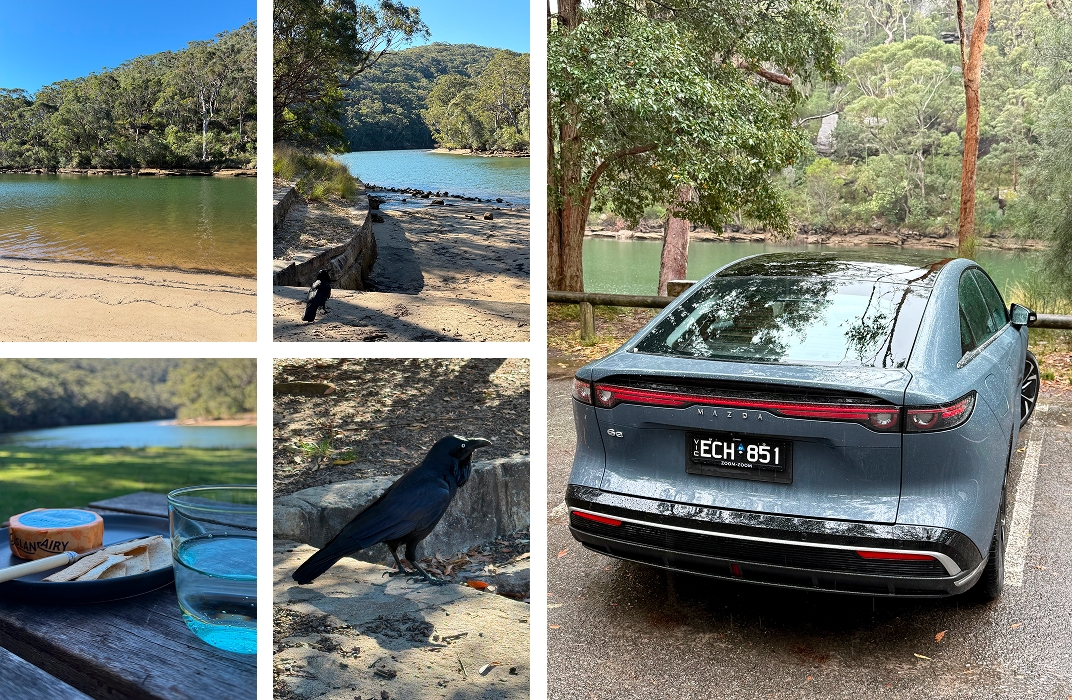
At Reid’s Flat on the Hacking River in the Audley precinct with an Australian raven
As I’m getting back into the 6e, the seat auto-returns to my position. It’s just one of the personal preferences that this car can remember. You can even customise your own driving mode, though I haven’t tried to.
I don’t yet know the extent of what this award-winning car can do.
Meanwhile, no one entirely knows the dynamic array of wildlife across Royal. David said contributions to further knowledge of what’s currently where helps, for instance in informing planning for fire trails and hazard reduction burns, a big part of the rangers’ varied work, and something they’ve been consulting with the Dharawal community about.
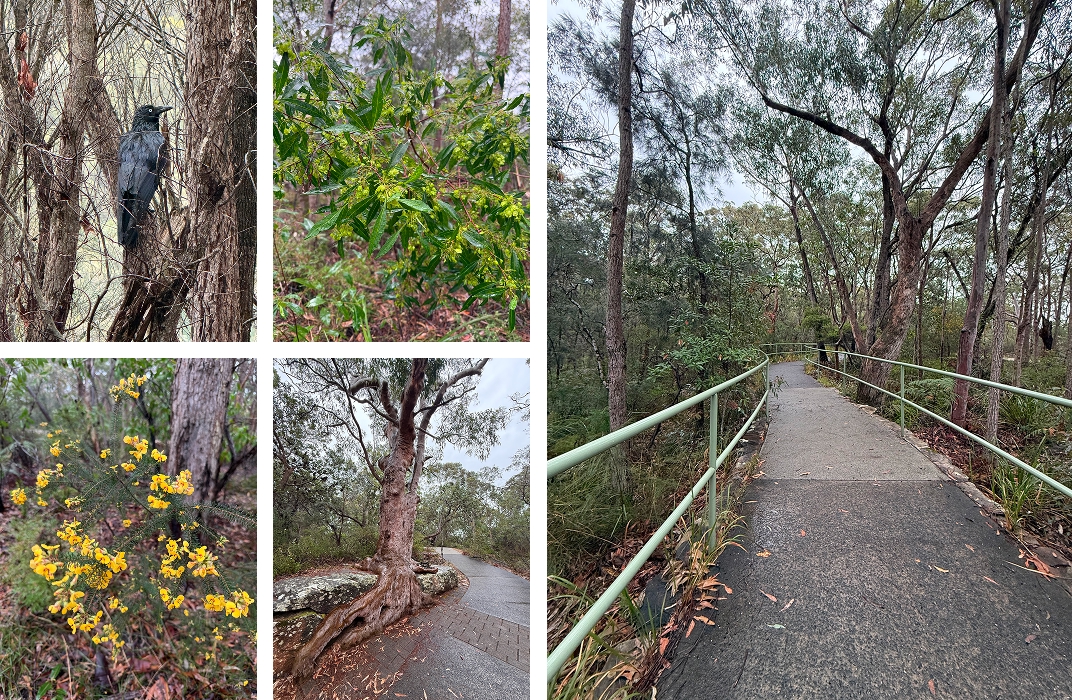
The Bungoona Path through dry sclerophyll forest with wildflowers of Dodonaea triquetra in green, and Dillwynia retorta in yellow, and an Australian raven briefly distracted from gazing across the valley
How visitors can help protect Royal's wildlife
He mentions the global citizen science App iNaturalist which allows visitors to transform their wildlife spotting into data that’s shared and valuable to science and conservation.
You can also get talking with the Visitor Centre staff. David tells me a story of international tourists saying they’d seen a koala, unaware of how ‘huge and exciting’ the news would be to staff; koalas are rare in the park and endangered in NSW.
David’s favourite animal – the wombat – is another local rarity.
And the southern greater glider? I ask.
David’s face fill with joy then, at the idea of this other NSW-endangered marvel being surely spotted. It’s been seldom in the park seen since the 1994 bushfires.
He points me towards a (2022–2023) environmental scorecard for insight across Royal’s ecology.
And we talk about how entering Royal (and other bushland) with clean shoes, clothes and other gear reduces the spread of weeds and pathogens. It’s a less obvious way to help wildlife than some others, like don’t feed animals or pick parts of plants or litter, but it’s significant and now more than ever; it’s part of how everyone can help with H5 Bird Flu in Australia.
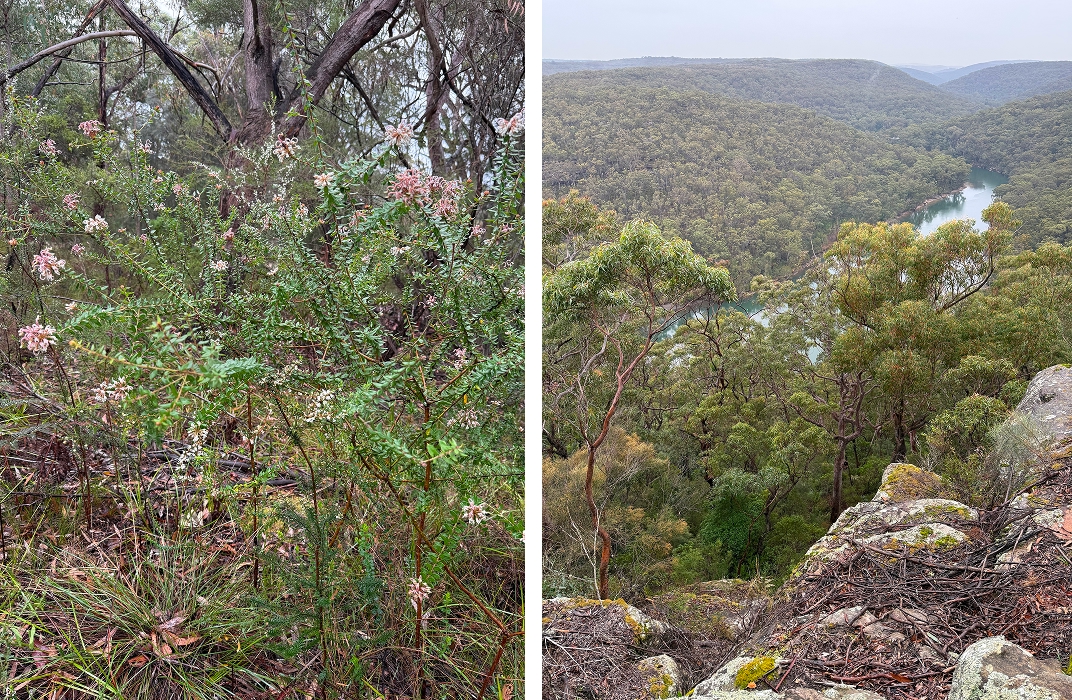
View from the Bungoona Lookout and Grevillea buxifolia in flower nearby
The view from Bungoona Lookout
I pull up at the Farnell Avenue car park, near the historic train station where the vintage tram stops. I’m here for the Bungoona Lookout, and the path to reach it is short and easy, designed for wheelchairs and prams.
It’s lightly raining. Wet leaves shine. Wildflowers bloom near the path. I step onto the ridge-edge platform at path’s end to see a panoramic view. And what a view! Majestic.
Yellow tailed black cockatoos call out as they fly up from the Hacking River valley below. They’re close – the sound is loud, exciting, and it’s the ‘soundtrack’ to me feeling that I’ve suddenly better grasped Royal…
It’s largeness – its dramatic geography – its rich cultural heritage – and the so many individual lives of fauna and flora within it, all supported by the work of David and his colleagues in this place, so dynamic, that will be the more so as climate change continues.
They’ll make leaps in thought and action at points, adopting new approaches for new times.
And I exit via Farnell Rd, glad to have driven this new and exceptional EV into Royal.