Mazda 787B: 35 Years Since Le Mans Win
What Goes Around Comes Around. And in First Place.
When the rotary took on the world and won
Sleep is always hard to come by in endurance racing. If it isn’t the adrenaline coursing through your veins or the constant overstimulation of your senses from the lights, noise and general commotion, the artificial stimulants ingested – whether it be caffeine, sugar or your energy drink of choice – will almost certainly ensure any attempts at shut-eye are met with fierce resistance.
Those who attended the 1991 24 Hours of Le Mans faced another obstacle to sleep. Typically, should you find somewhere to rest, the constant hum of racing cars acts as a kind of white noise to actually aid relaxation, a sort of petrolheads’ version of falling rain, but in 1991 the thrum of the Sauber-Mercedes V8, growl of the Jaguar V12 and drone of the Porsche flat-six was punctuated at regular intervals by the banshee wail of the Mazda quad-rotor.
Regardless of whether it was spectators camped deep in the forest or team members perched on the pit wall, there was no need to use vehicle trackers to identify when the Mazdas were approaching, as the feral scream of the 787B’s unique engine would provide ample warning.
The 1991 Le Mans 24 Hours was an all-or-nothing effort by Mazda to win one of the world’s most prestigious races with its beloved rotary engine [Mazda rotary engine surpasses two million units], for in 1992 new regulations were being introduced that would mandate piston propulsion. The regulations were meant to be in place already, but a lack of manufacturer interest had allowed the previous-generation Group C prototypes a stay of execution. After almost a decade of trying, Mazda had one shot, one opportunity to get it done.
Mazda's Early Le Mans Journey
Mazda’s history at Le Mans started in 1970, when its 12A rotary engine was installed in a Chevron B16. The 12A appeared again in the Sigma MC73 in 1973 and 1974, the latter being the first of an incredible 29 race starts by Mazda factory driver and racing legend Yojiro Terada, while a privateer RX-3 ran in 1975.
The brand’s first official appearance was in 1979 with an RX-7 [Triple Gem: Mazda RX-7 royalty turn out] prepared by Mazda Auto Tokyo, one of Tokyo’s largest Mazda dealerships and run by Takayoshi Ohashi with assistance from European Mazda distributors.
Despite success in America’s IMSA GTU class, including a class victory at Daytona, at Le Mans the RX-7 was included in the catch-all IMSA GTX class alongside the vastly more powerful and specialised Ferrari 512BB-LM and Porsche 935/77. As the slowest qualifer in each class was excluded, the RX-7 was not permitted to start, despite being far from the slowest vehicle overall.
Another attempt a year later netted a 21st overall finish, then in 1981 the larger 13B twin-rotor made its debut in the modified RX-7 253i with the team now called Mazdaspeed [Rotary dials back the years to the glory days of Mazdaspeed]. Work began in earnest for Mazda’s first prototype effort ahead of the introduction of new regulations in 1983, but further revisions to the RX-7 – now called the 254i – led to Mazda recording its best result today in 1982 with 14th overall.
As a remarkable aside, after one was destroyed in a crash the 254i was thought to no longer exist, but the one remaining car was discovered in Okayama in 2019 after 35 years in hibernation and has since been restored.
Mazda’s prototype journey began in 1983 and initially outright victory was not the intention. The 717C was built for the newly introduced Group C Junior category, which it duly won on its first attempt, Yojiro Terada earning his first trophy alongside Yoshimi Katayama and Takashi Yorino.
Strange as it may seem in a motor race, one of the pivotal factors in the 717C’s success was its fuel economy. At the time, Le Mans restricted cars to just 25 fuel stops throughout the race; for the outright cars with their 100-litre tanks, this meant a maximum of 2600 litres were allowed, while Group C Junior cars were limited to 55-litre tanks for a maximum of 1430 litres. As such, efficiency was very nearly as important as outright speed.
Throughout the 1980s Mazdaspeed grew in line with the company’s ambitions. In 1986 Mazda stepped up to the main Group C category to battle the Porsche juggernaut, the new Jaguar works team and fellow Japanese manufacturers Nissan and Toyota.
The 757 debuted a more powerful triple-rotor engine that provided a top speed of 310km/h and while poor reliability ended Mazda’s hopes in 1986, a return in 1987 realised seventh outright, the best placing ever recorded by a Japanese manufacturer.
It was a result matched in 1989 by the now-quad-rotor 767B and a fine effort – the updated ‘B’ car was a full 14 seconds quicker in qualifying than the year prior – but there was still a 21-lap gap to the winning Sauber-Mercedes at race end. And time was running out.
Building the Rotary-Powered 787
By this stage FISA’s plans to force all manufacturers to use F1-mimicking 3.5-litre piston engines were well-known, so 1990 was – at the time – Mazda's final chance. It introduced an all-new car, the 787, which was a huge improvement over its predecessor.
Nigel Stroud was once again in the charge of the car’s design, as he had been since the 767, and he focused on a low frontal area rather than peak downforce. The construction of the monocoque switched from aluminium honeycomb to carbonfibre, created by Advanced Composite Technology in the UK, with a rear spaceframe supporting the engine and rear suspension, which was double-wishbone with rocker-actuated Bilstein dampers.
The engine remained a quad-rotor, but so extensive were the changes that it earned a new designation, the R26B. Veteran Belgian racing driver Pierre Dieudonné joined the Mazda team in 1984, which gave him the clout to answer “another 100bhp (75kW)” when asked what it would take for the team to win Le Mans.
As an almost 17 per cent increase, the task was thought impossible, especially as fuel consumption could not worsen as a result. The engineering team, led by Yoshinori Honiden, worked around the clock (the project had to completed in addition to regular road-car engineering duties), with more than 1000 engineering suggestions being refined to 80 improvements.
Ceramic apex seals improved durability, three spark plugs per chamber ensured the fuel mixture was burned more efficiently and a variable-intake system allowed for a wider spread of power. The impossible had been achieved: the 787 lined up for the 1990 Le Mans 24 Hours with 515kW and 570Nm.
Six-time Le Mans winner Jacky Ickx was drafted in as a consultant and two 787s were entered, one with a trio of young F1 hotshots in Johnny Herbert, Volker Wiedler and Bertrand Gachot, the other with the more experienced Stefan Johansson, David Kennedy and Dieudonné. The older 767B was also entered with the all-Japanese crew of Terada, Katayama and Horino.
The race was a disaster. While the 787 was much quicker, qualifying six seconds faster than the 767B had the previous year, myriad reliability problems saw both cars expire by the 14th hour. The sole finisher was the older 767B in 20th, 55 laps down on the winner. It appeared the dream was over.
How the Mazda 787B Won Le Mans
Having read this far, you know that 1991 would be designated as one final “transition” year before the introduction of the new 3.5-litre regulations. Mazda had one more chance and it wasn’t going to waste it.
The car was overhauled once more to become the 787B. A 25mm wheelbase stretch was accompanied by revised suspension geometry to allow the fitment of wider wheels (18 x 12.0-inch front, 18 x 14.75-inch rear) with massive Dunlop slicks measuring 300mm and 355mm wide front and rear respectively.
Carbon brakes were installed, one of the first applications of the technology, and the R26B received a continuously variable intake system that not only boosted torque to a maximum of 608Nm, but 95 per cent of this peak was available from 6000-9000rpm.
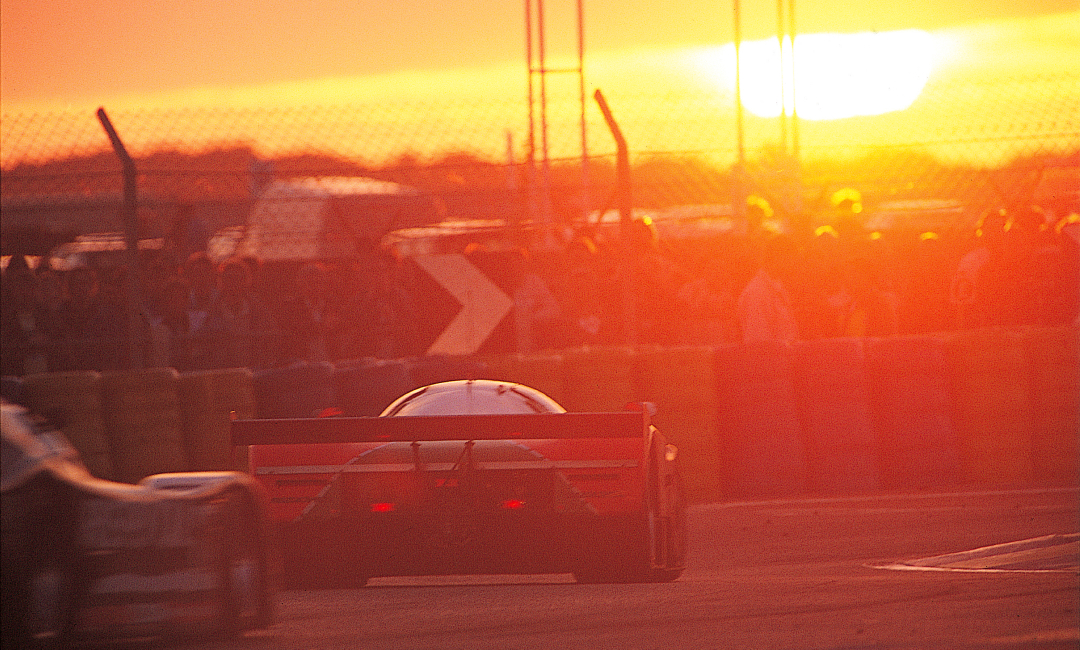
Having worked with them during Dakar, Ickx recommended Mazda partner with French motor racing specialists ORECA, continuing the long tradition of Franco-Japanese collaboration. But it was team manager Ohashi who pulled a masterstroke. To reduce their competitiveness, FISA increased the minimum weight of the older Group C cars to 1000kg, but Ohashi requested – and was granted – an exemption for the rotary-powered 787B and it stayed at 845kg.
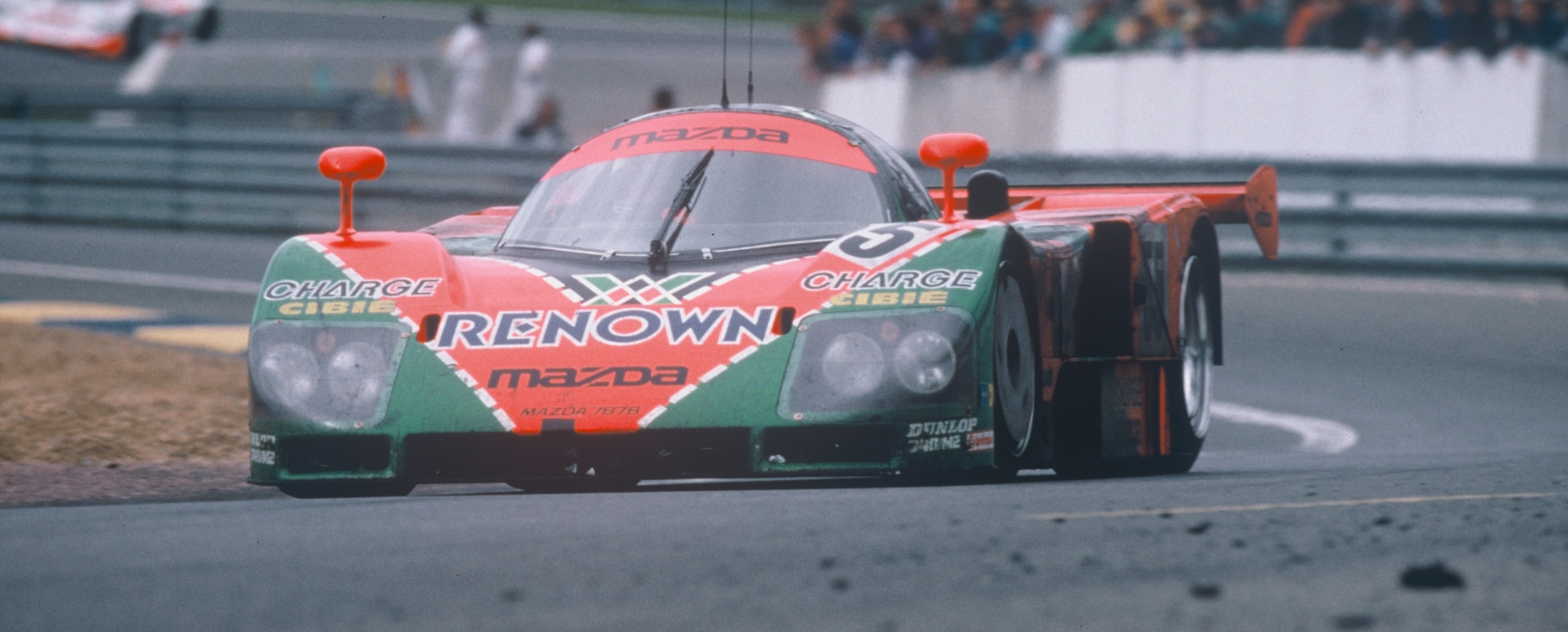
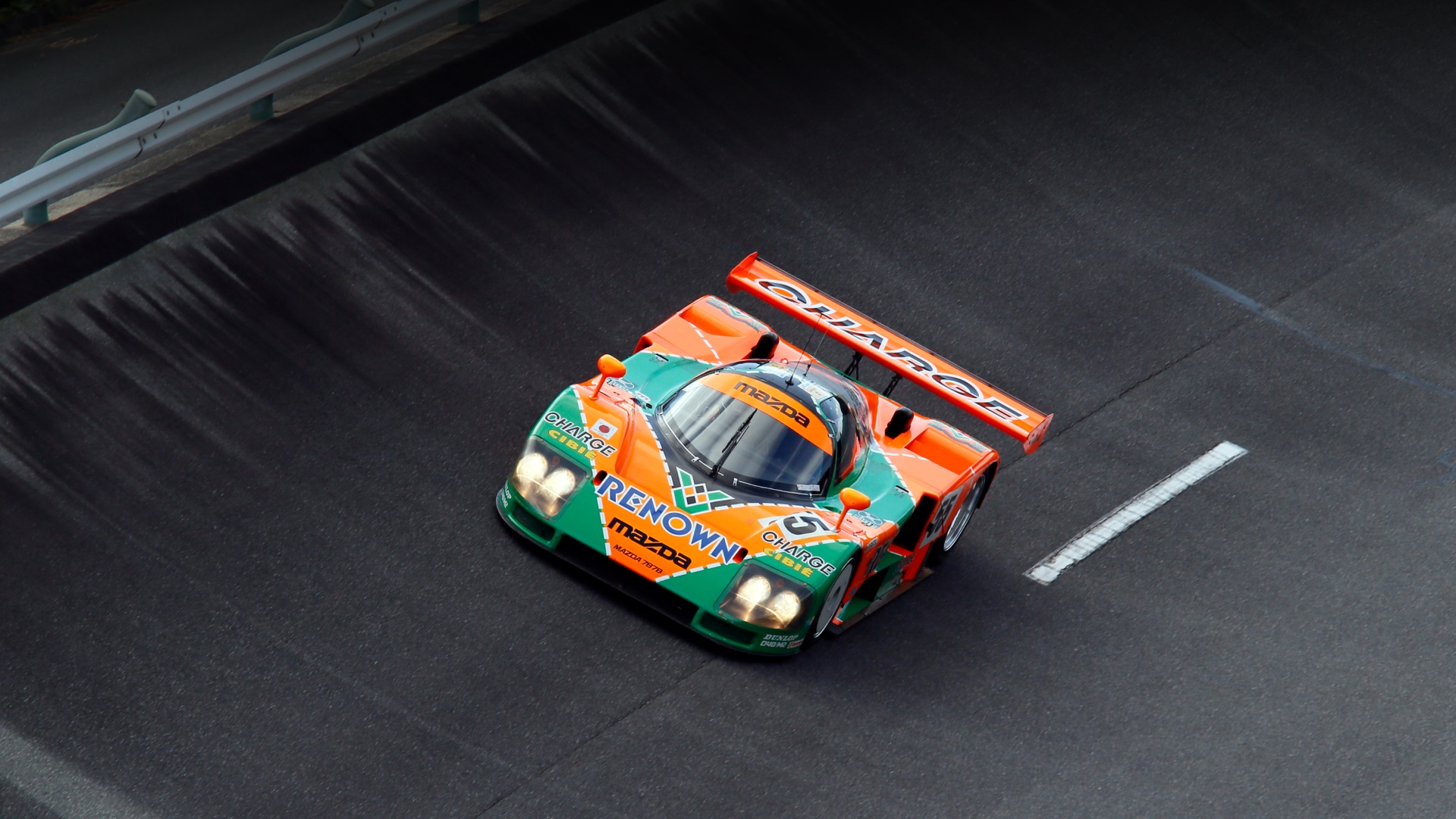
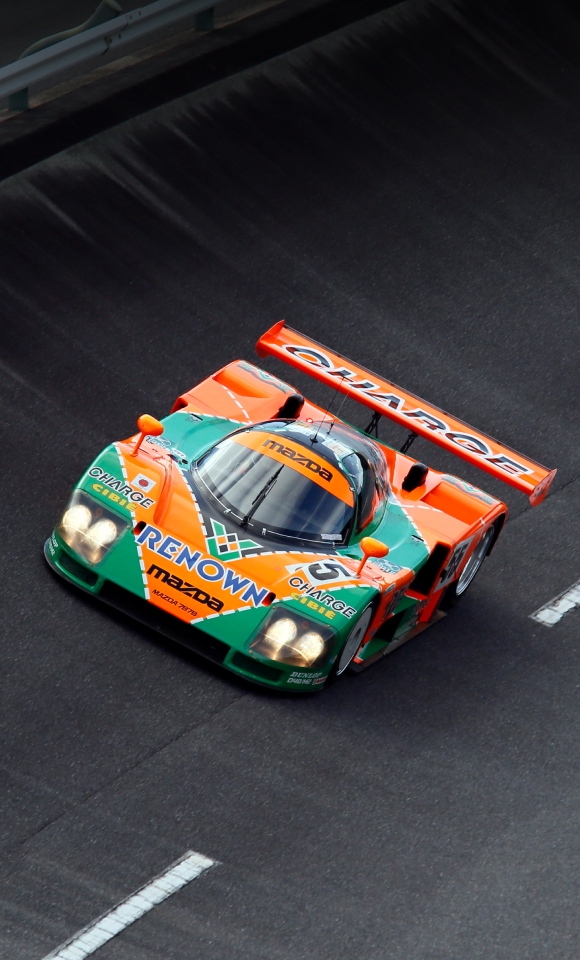
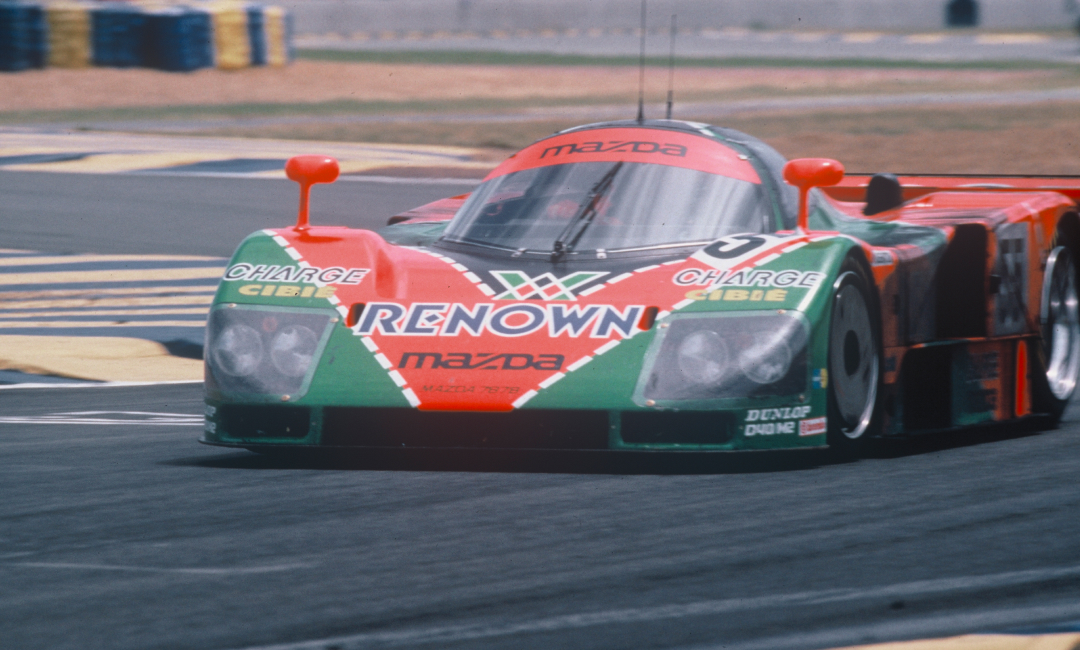
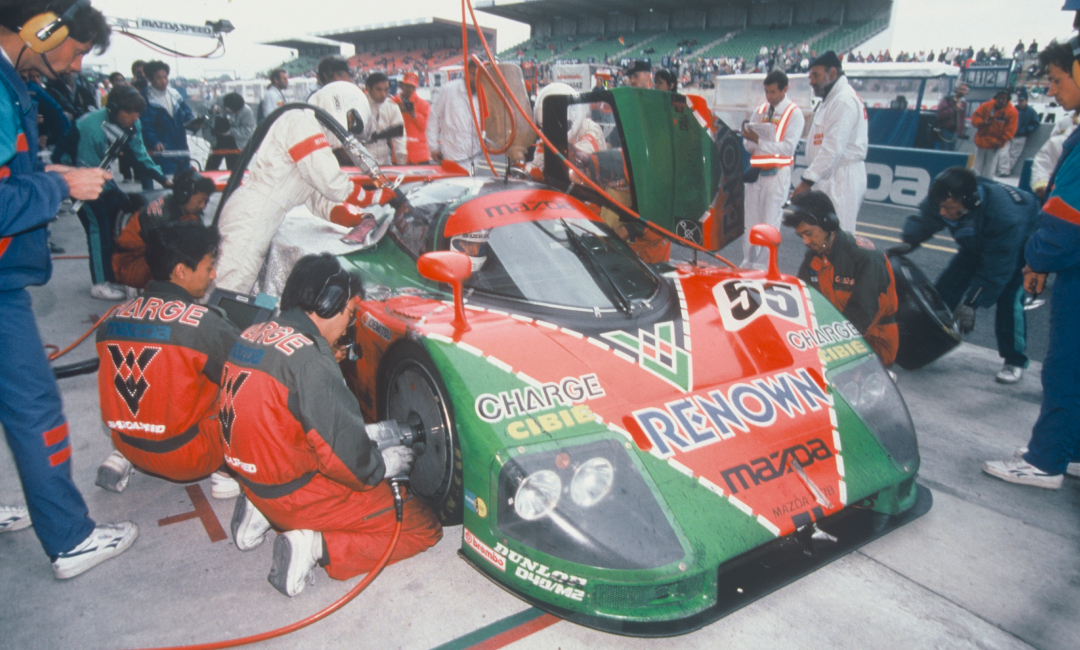
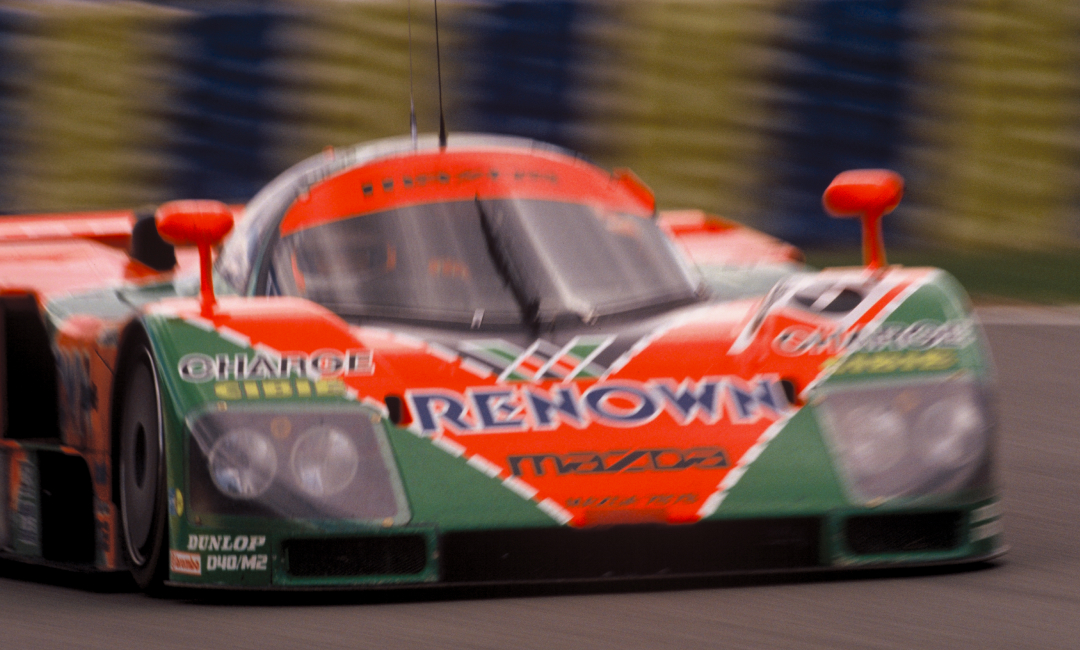
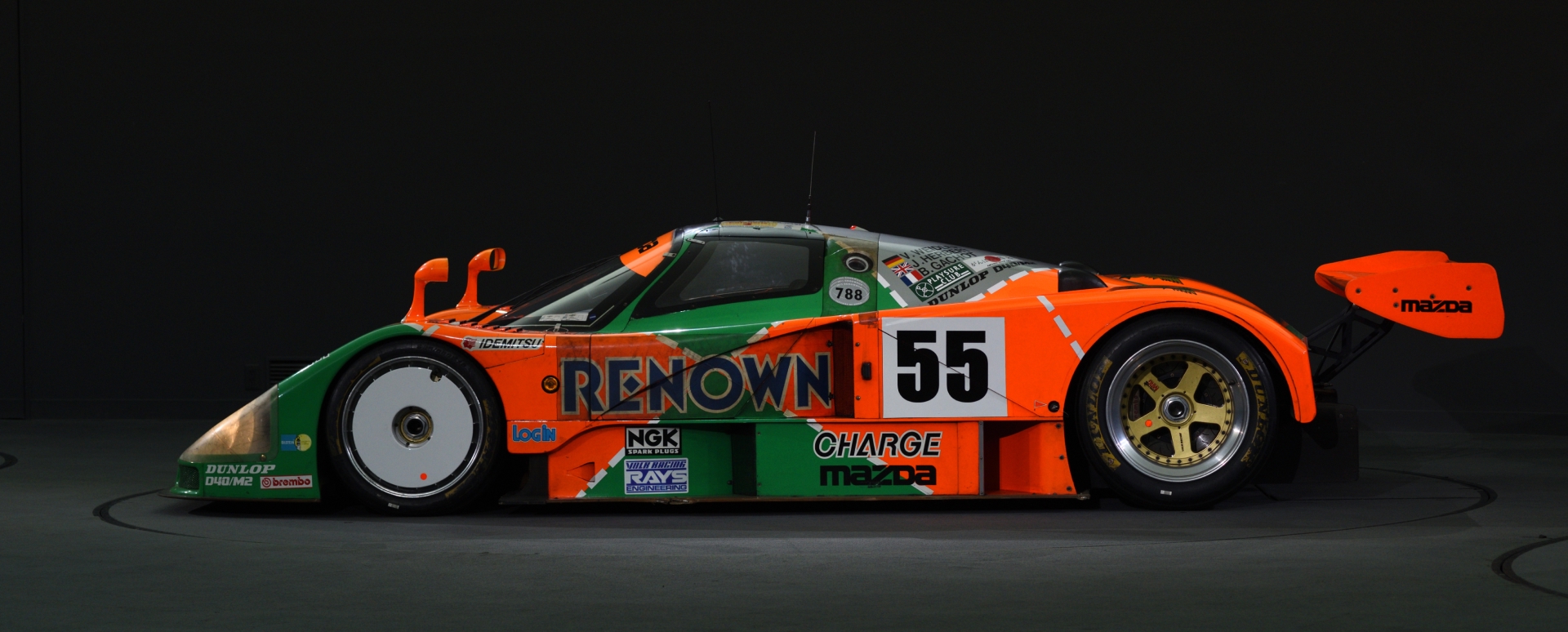
Car 55 would be painted in the vivid orange-and-green of Japanese clothing brand Renown and piloted by Herbert, Weidler and Gachot, while the 18 driven by Johansson, Kennedy and Maurizio Sandro Sala and the older 787 of Terada, Yorino and Dieudonné would be in Mazda’s blue-and-white corporate colours.
The competition was extraordinarily fierce. New-generation cars were entered by Peugeot, Mercedes-Benz and Jaguar, along with multiple examples of the older Sauber-Mercedes C11, Jaguar XJR-12 and Porsche 962, all of which were previous winners. The 787B lapped five seconds faster than its predecessor in qualifying, but the leading 55 car could only manage 12th, 12 seconds slower than the pole-sitting Sauber-Mercedes.
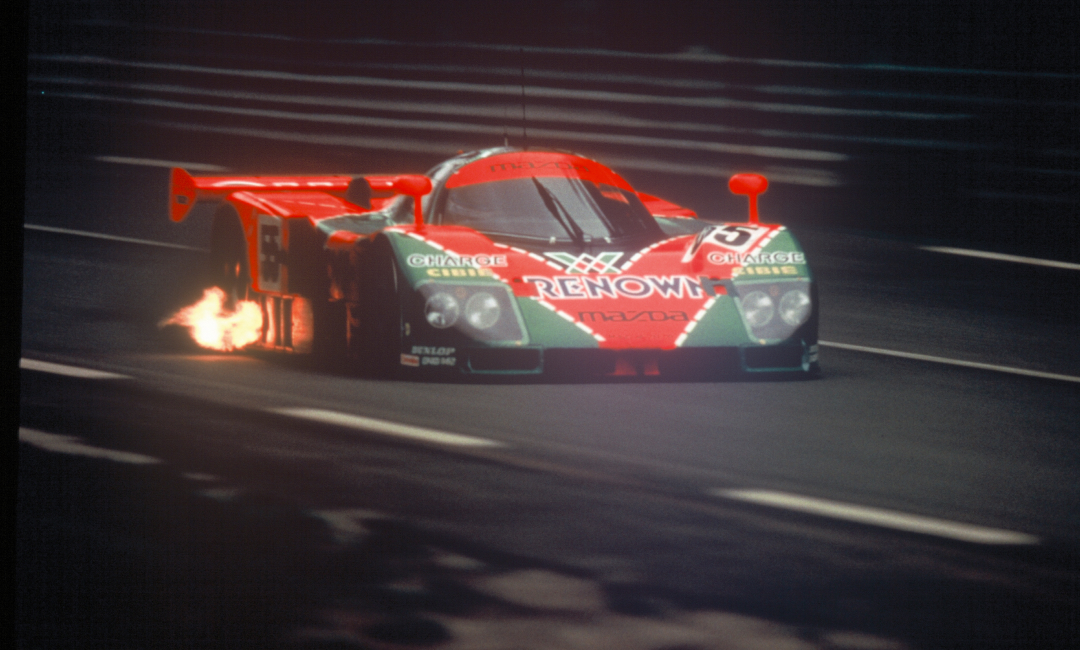
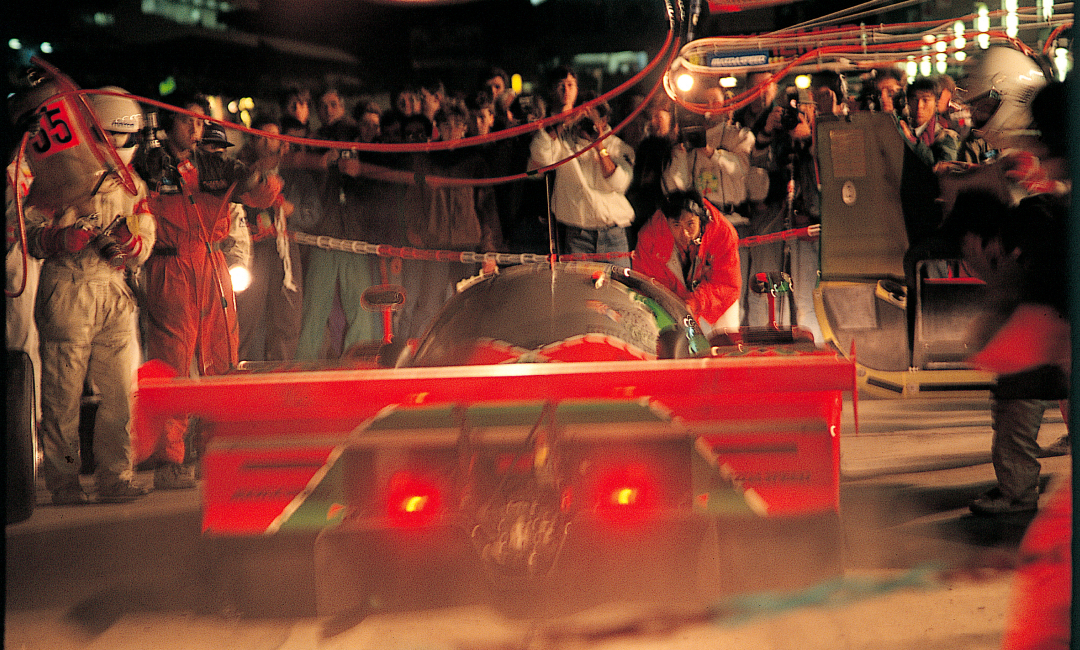
It might sound strange to describe a 515kW/845kg missile as a tortoise, but the Mazda team had a plan. Once again, cars were limited to a maximum of 2550 litres for the race and by adhering to an 8500rpm rev limit and using no more than seven litres of fuel per lap, the Mazda crews could stretch each tank longer than its rivals and spend less time in the pits.
The 787B’s other big advantage was its usability. “What was so special about the 787B? I think it was the ease with which it drove,” remembers Herbert. “And that was mainly down to the rotary engine itself. Very, very smooth. Not very torquey, had a very long, flat power band and that enabled you as a driver to really feel that power, ease it on without any problems, not being able to spin up the wheels, not damaging the tyre and then having a problem throughout the stint you were on.”
Put simply, the engine was relatively fuel efficient, the weight and handling allowed the drivers to corner extremely quickly without stressing the tyres and the reliability was faultless. By the halfway point the leading 787B – car number 55 – was up to third and battling with the second-placed Jaguar, with the leading Sauber-Mercedes three laps in front.
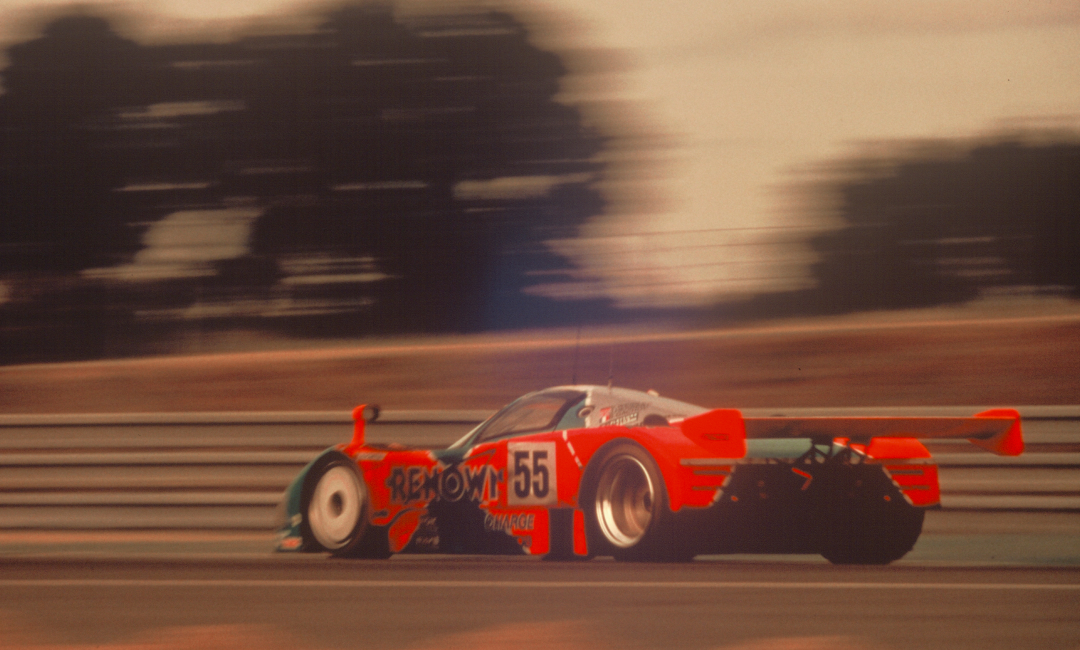
Come the dawn the Mazda had climbed to second and its efficiency was allowing it to build a buffer over the Jaguar, but the Germans looked out of reach. However, a failed alternator bracket allowed the water pump belt to come off and with fewer than three hours to go, the front running Sauber-Mercedes was forced to pit with an overheating engine, ceding the lead to Herbert in the 55 787B.
To prevent the risks associated with another driver change, Herbert was asked to triple-stint to the finish. Despite having struggled to sleep and eat during the week thanks to a combination of nerves and mild food poisoning – he sustained himself on packet noodles – Herbert displayed the incredible determination that allowed him to recover from a near-career-ending crash in 1988 to take the chequered flag, only to collapse from exhaustion and severe dehydration after being pulled from the car.
As a result, only Weidler and Gachot attended the podium, as Herbert was in the medical facility. The 787B was in better shape, as it had only required one oil top-up, a headlight bulb and a scheduled brake change during the race. Upon its return to Japan, the R26B engine was stripped down and found to be down just two per cent on peak power after almost 5000km of flat-out racing, the engineers confident it could’ve completed another 24 hours.
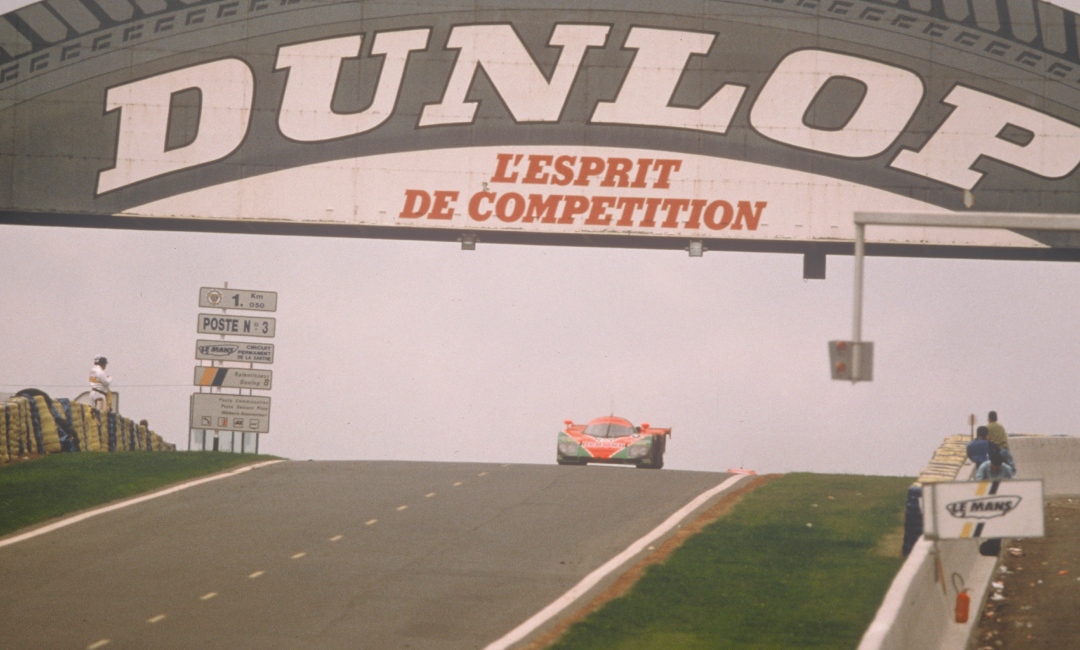
The Lasting Legacy of the Mazda 787B
For the Mazdaspeed team it was the fairytale ending and a fitting reward for more than a decade of hard graft, during which the organisation had grown from four people in 1979 to more than 120 in 1991.
The winning car – 787B-002 – was immediately mothballed and displayed in Mazda’s museum [Explore ten hidden gems in Hiroshima's Mazda Museum], before being immortalised in digital form as one of the stars of the Gran Turismo video game series.
For the 20th anniversary of its win, the car was restored and returned to Le Mans, where spectators were once again treated to the scream of the quad-rotor during demonstration laps. After two decades, Johnny Herbert not only turned back the clock behind the wheel of the 787B, but at long last got to stand on the top step of the podium. [Mazda 787b To Demonstrate At 24 Hours Of Le Mans Centenary Anniversary]
To this day the 787B is the only rotary-powered [discover the 2025 Mazda Vision X-Coupe concept integrating a two-rotor rotary turbo engine] car to win Le Mans – an achievement that may well stand forever – and it would be 17 years before another Japanese manufacturer would duplicate Mazda’s success. The winning machine is occasionally called upon for demonstration runs at events like the Goodwood Festival of Speed, but spends most of its sleeping in the Mazda museum. It’s earned the rest.