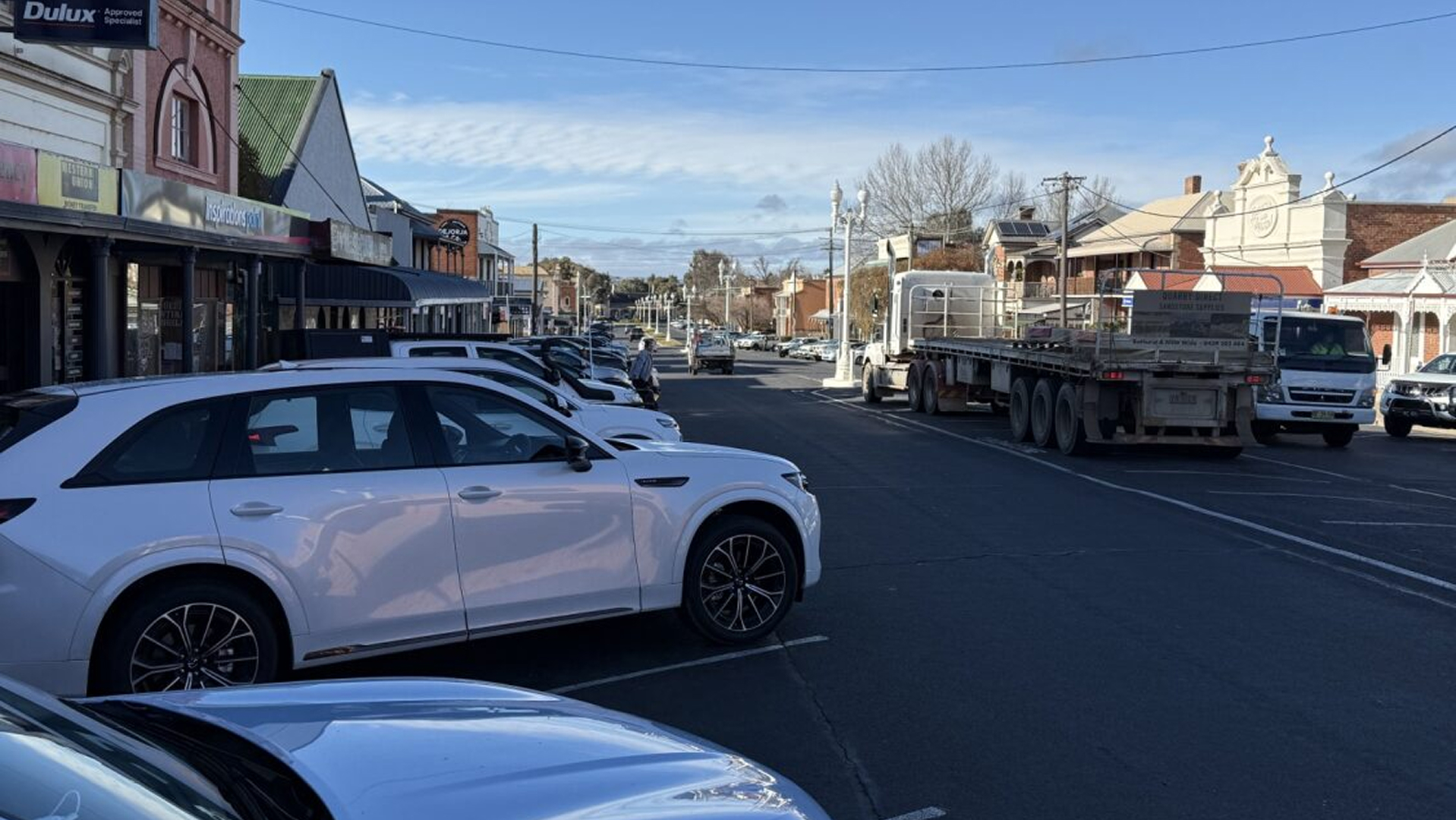
Mazda CX-70
Road trip to Bathurst: motorsport and more
Jane Johnston
It’s mid-winter when I take a Mazda CX-70 Azami from Sydney, west over the Blue Mountains to Bathurst. It’s an easy, three-hour drive in the warm, luxurious comfort of the high-end SUV, Nappa leather seat and wheel heated to perfection and once there, I want to get out into the cold – Bathurst is an historic and culturally rich city.
The questions then become how to don a coat and scarf at pitstop but not breakneck speed, and how to choose from all that Bathurst offers.
Motorsport is an exciting part of Australia’s history and its culture now. So much so, that for decades, Bathurst has been widely known as the city where Mt Panorama is. For sure, I’ll drive that iconic racetrack and visit the National Motor Racing Museum.
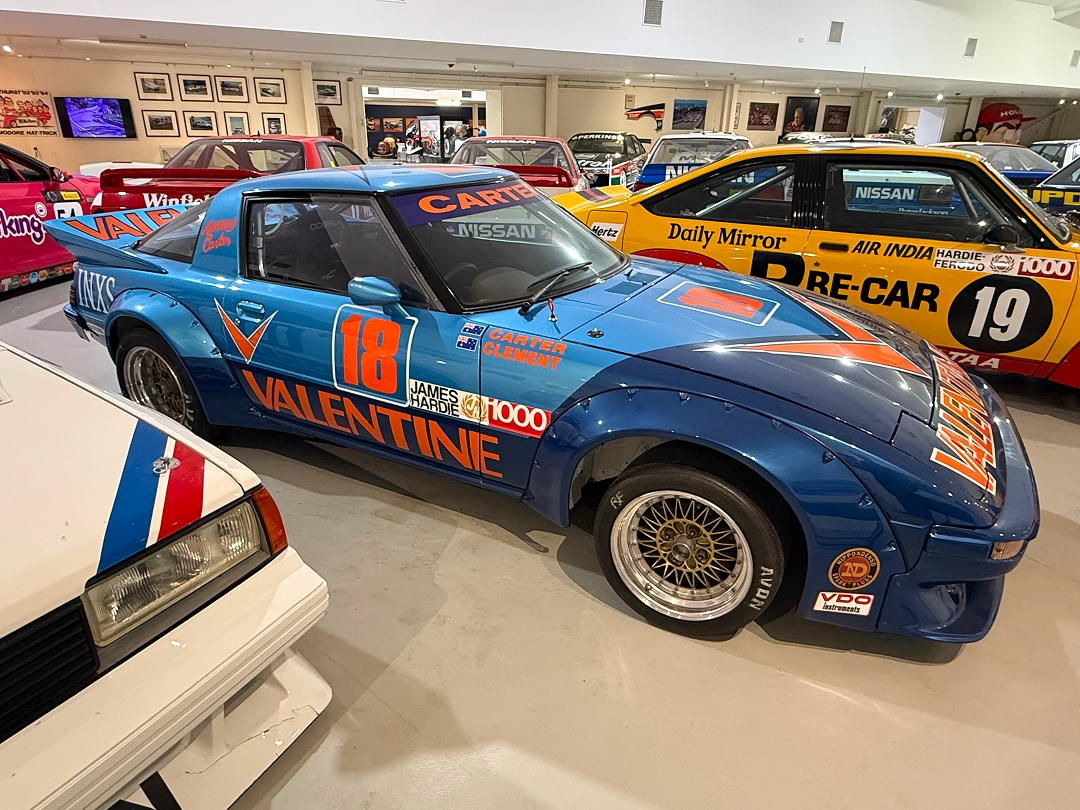
National Motor Racing Museum, Museums Bathurst. The RX-7 (centre) with race history including the 1983 James Hardie 1000. Restored to as was for that race
But Bathurst offers much more than motorsport, and I’ll visit places of interest for history, art and geology, and bring the CX-70 to a halt at some destinations for food and beverage that have got people talking.
Bathurst is also a superb base from which to drive to the nearby villages of Rockley, Millthorpe and others. This trip, Hill End is my destination for a day. A gold rush began in the 1850s over an area north of Bathurst, and Hill End’s rush peaked intensely in the early 1870s.
Hill End’s gold rush history is fascinating and so is its art history – its evocative post-rush streetscapes and landscapes have inspired artists since Donald Friend and Russell Drysdale first made Hill End renowned for art, in the late 1940s.
Today, Hill End is home to some hundred people, including the remarkably high number of around twenty artists, and it’s wholly listed (since 1967) as an Historic Site by the NSW National Parks and Wildlife Service. I find out what it’s like to visit, meeting people as I go, but that’s a whole other story for later.
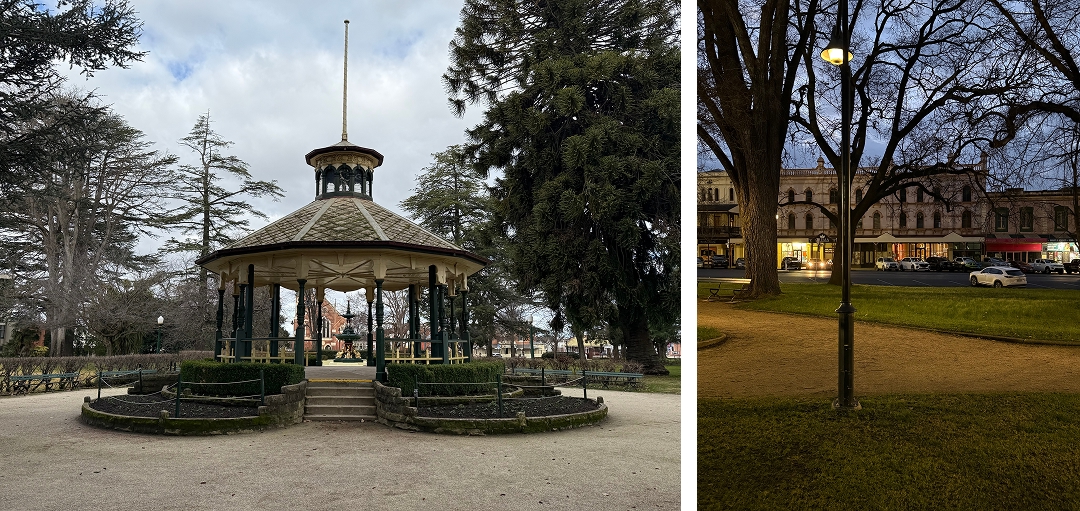
In Machattie Park, with a street view of the CX-70 parked nearby
Drive into Bathurst, and you’ll see history all around you. So much built heritage has been retained, especially in the wide streets at its heart.
Bathurst was proclaimed by Governor Macquarie in 1815. Bathurst was Australia’s first inland European settlement, established on the lands of the Wiradjuri people.
Remnants from Bathurst’s first decades exist and include ‘Old Government Cottage’, now a small museum. But the later nineteenth century buildings really grab my attention, with sizes and design panache expressing confidence. Bathurst was rising to prosperity then, thanks to the nearby gold rush and the 1876 coming of the Great Western Railway from Sydney.
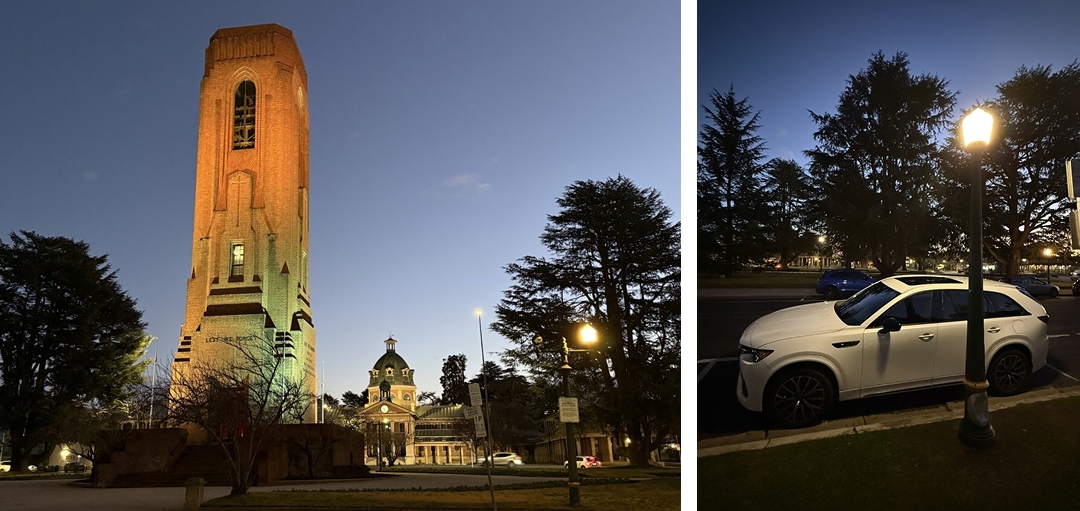
Views of the War Memorial Carillon, the Bathurst Courthouse and the CX-70 parked nearby
You can find maps with historical information at the Visitor Information Centre, and the app Bathurst Step Beyond offers further insight and photographic glimpses back into history.
Map in hand or not, the massive Neoclassical 1880 Bathurst Courthouse is hard to miss, especially at night when lit up. It’s by the then NSW Colonial Architect, James Johnstone Barnet, and accommodates the Bathurst District Historical Society Museum in a side-wing.
The adjacent Machattie Park is a beloved public space to stroll in. It first opened in 1890, and some of the great enthusiasms of those times, ferneries and decorative cast iron included, are on show across the historic features in this National Trust listed garden.
The War Memorial Carillon is nearby and by luck (as I had it) or preplanning (see the Carillon website), you can hear its 37 bronze bells being played. Gorgeous.
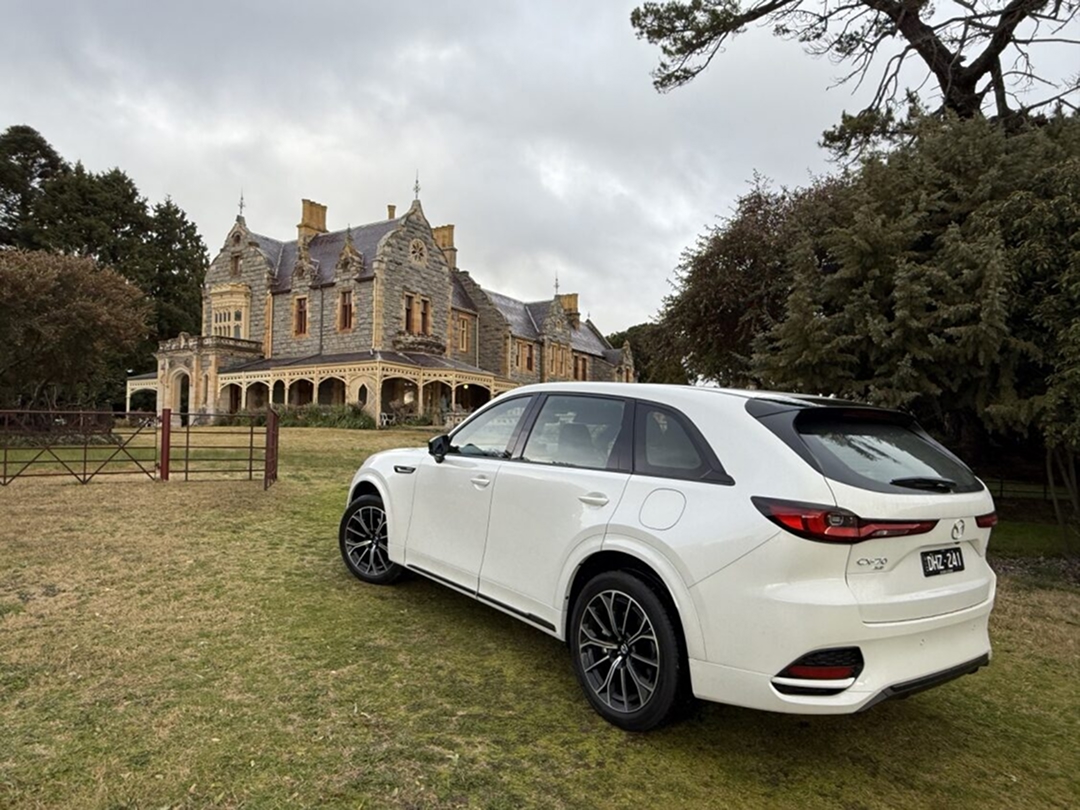
At Abercrombie House
I drive up to Abercrombie House on the city edge and am wowed. Blocks of local granite and Hawkesbury sandstone form this state heritage-listed home of 52 rooms. Immense, certainly, and stylish.
It was built in the 1870s as the home of James Horne Stewart and his family. The important Australian architects George Allen Mansfield and Matthew Sadlier both worked on the design, adapted from a published plan for a Scottish baronial mansion by the famed American architect Calvert Vaux.
The country garden grounds and inside full of antique furnishings can be explored self-guided, or on a booked event – high tea, anyone? Or Christmas in July?
It’s now home to the Morgan family, and when I meet Christopher Morgan outside on an icy afternoon, he welcomes me in to talk history by a crackling fire. Perfect.
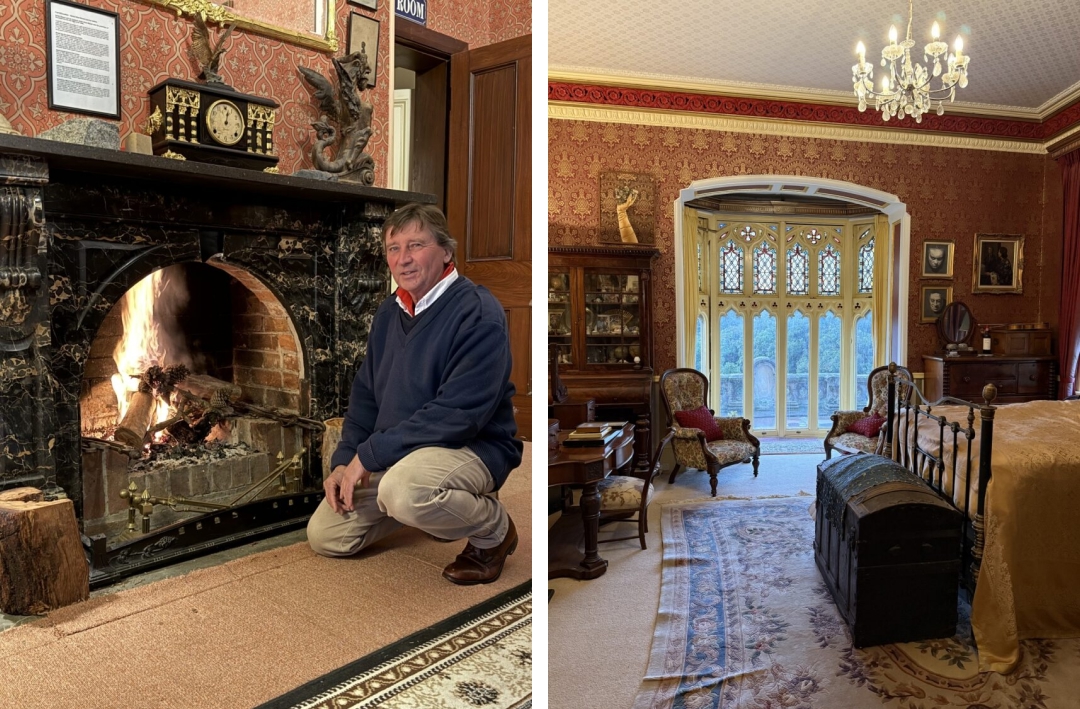
At Abercrombie House with Christopher Morgan
First, this mansion was the busy focal point of a vast Stewart property – some 30 square kilometres when at its maximum extent – apportioned to tenant sheep farmers who were Scottish emigrees. Then, in the 1920s, the house was emptied and closed. Bar some fairly brief interludes, it remained abandoned until 1968.
The Morgans drove into Bathurst that year – an English couple from Sydney with two young sons, one being Christopher, who were looking to buy a cottage and bought the Stewart’s mansion instead – a colossal ‘renovator’s dream’ that they recognised as a national historical treasure.
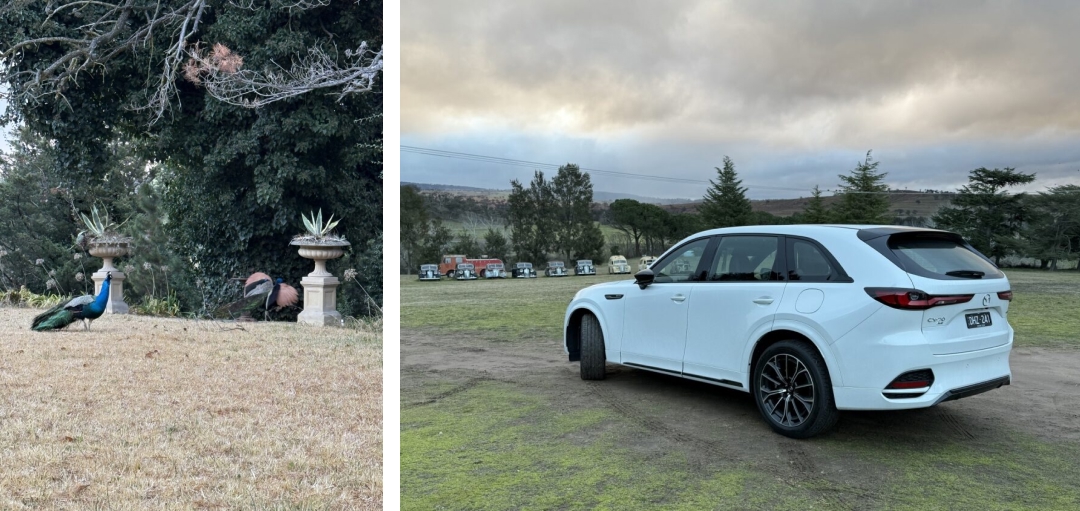
At Abercrombie House. In the line-up of vintage vehicles, the cars are A125 Austin Sheerlines
This radical change of real estate plans happened after a chance conversation with a local motor enthusiast that started as about the Morgan’s car: an Austin A125 Sheerline, a large and quite rare 1940s–50s car.
There’s much more to this serendipitous story and the wider history of this house, and it’s best heard direct from the Morgans, who have welcomed visitors here since 1969.
The Morgans also continue to work on the house. Christopher is currently converting the basement level into a museum-style display area to present the house history and expects to open it later this year.
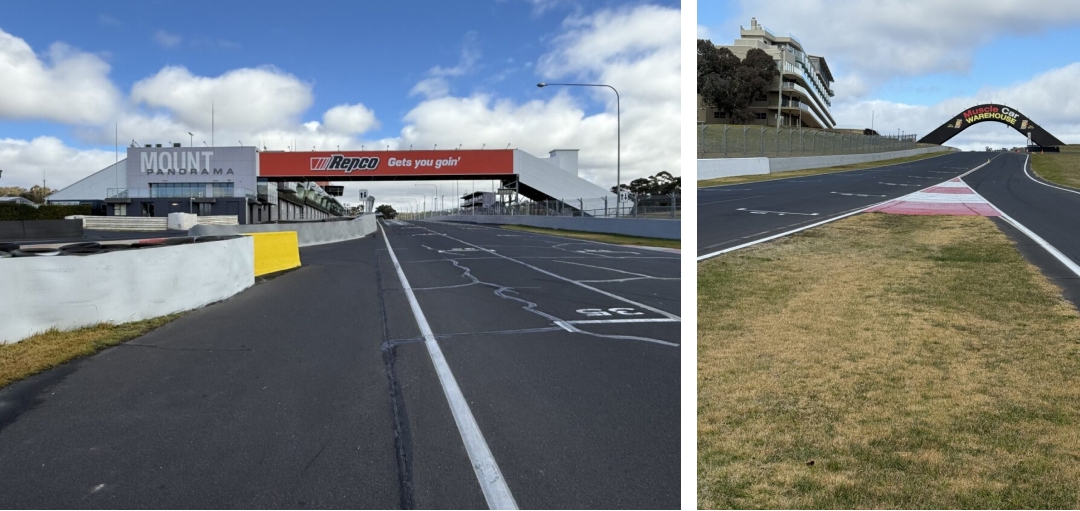
Mt Panorama track views. Left: Pit Straight, the start and finish. Right: Near Murray’s Corner, looking along Conrod Straight
In Bathurst’s modern history, nothing has a bigger profile than motor racing on Mount Panorama and you can drive this iconic racetrack – it’s a looping public road whenever there is no event scheduled.
The CX-70 and I go around once, and again. One lap doesn’t feel enough, not when drivers in the Bathurst 1000 tear through 161.
It is a thrill to experience, but at the 60 km/h limit, is not exactly a pacy, challenging drive. The CX-70 doesn’t get a chance to demonstrate anything near the full 187 kW power of its in-line 6-cylinder diesel engine, or to really showcase its prowess in braking and AWD handling. I’m half expecting a message of disappointment to appear on its active driving display.
As for me: I end up awed by the skills of the drivers racing here at phenomenal speeds. Recent tops of around 300 km/h are recorded along the main Conrod Straight.
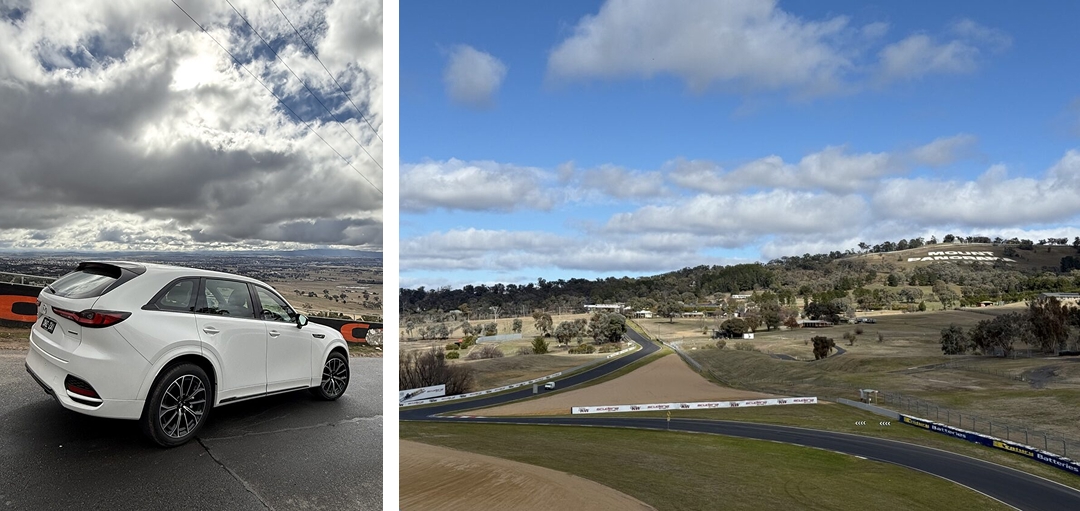
Left: In the parking at the Mt Panorama track top, near where you can find a scenic boardwalk. Right: View from the trackside Rydges Mt Panorama, along Conrod Straight with the doglegged The Chase and towards the track top
I’m also awed by the truly panoramic views from the track top. The basalt-capped Mount Panorama, called Wahluu in the Wiradjuri language, really does rise high from the vast Bathurst Plain.
Indeed, the track was built in the 1930s as a ‘scenic road’ via a Great Depression federal job creation scheme, in a form that would also suit motor racing. Bathurst already had motor racing groups by then.
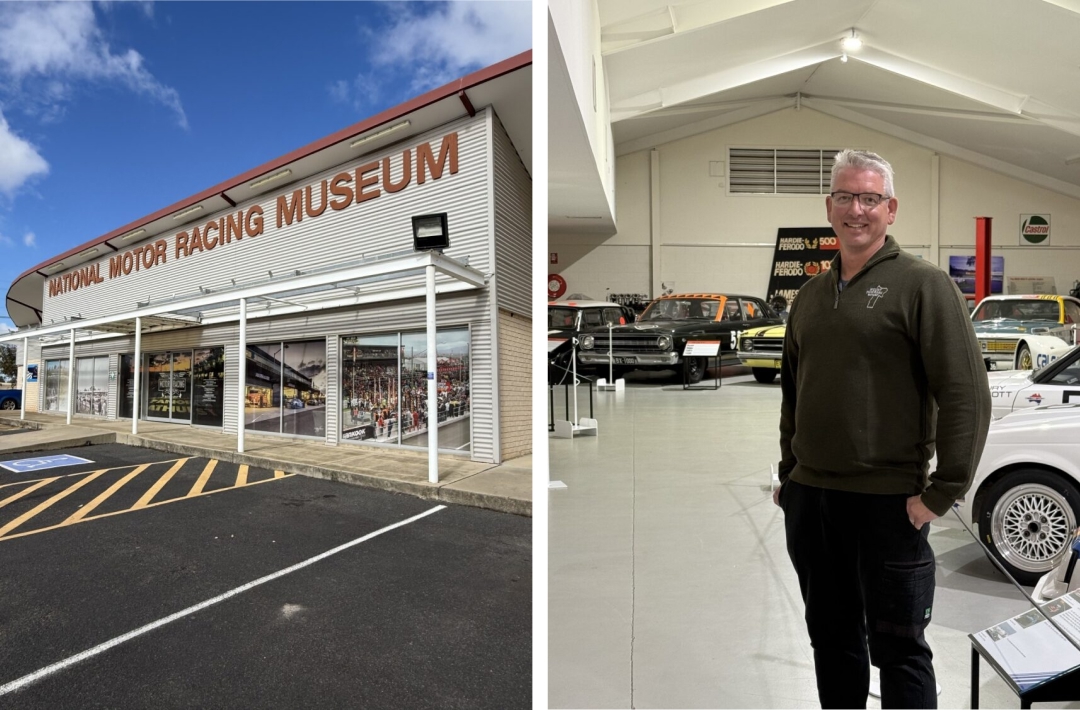
At the National Motor Racing Museum, Museums Bathurst, with Brad Owen
I turn off the track and pull straight in at the National Motor Racing Museum to meet Brad Owen, Museum Co-ordinator, a self-described motorhead who is also an expert in Australian motorsports.
The main attraction is the vehicles, and here you’ll see some of the most exciting two, three and four wheelers to have ever raced in Australia. There is a constantly changing array of over one hundred vehicles of various makes, models and eras, many with bodies covered in exuberant sponsorship graphics. Spectacular? Yes. Fascinating? Absolutely, especially once you find out their stories.
And what I found out in conversation with Brad warrants an entire other story to read.
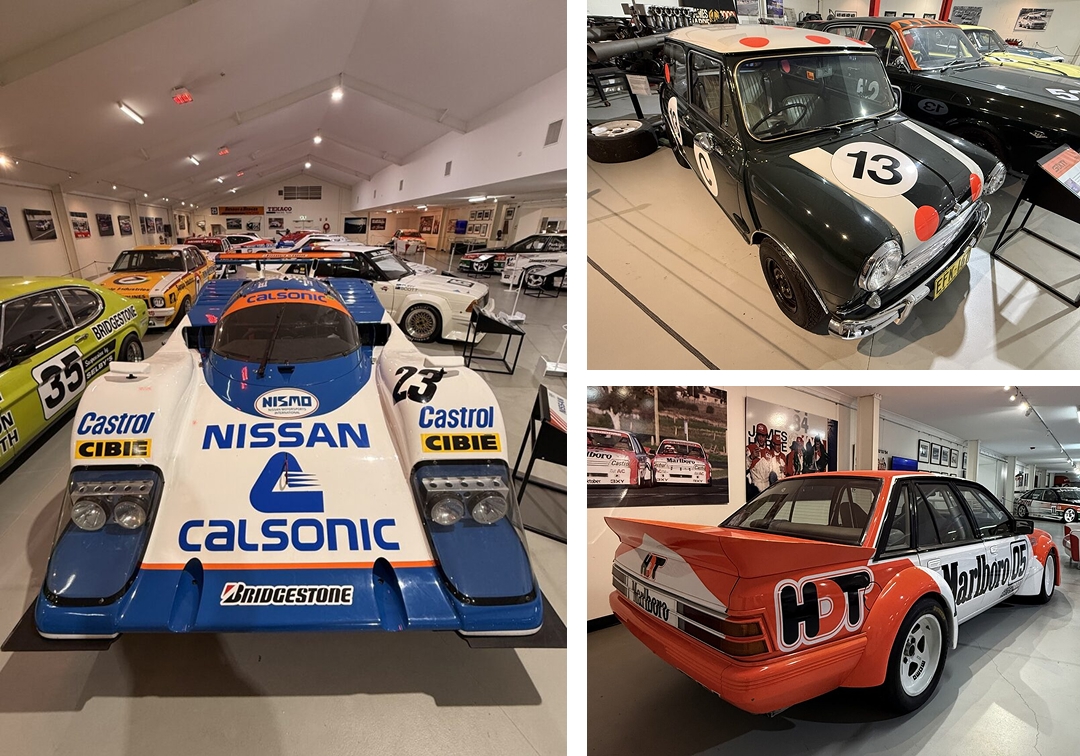
At the National Motor Racing Museum, Museums Bathurst. Left: 1988 Nissan R88C sportscar in foreground. Top Right: Hour Mini Cooper S; (replica) 1966 Gallaher 500, win, Rauno Aaltonen & Bob Holden; livery restored to that race. Bottom right: 1984 Holden VK Commodore; as is after its last race, 1984 James Hardie 1000, win, Peter Brock & Larry Perkins
Keep an eye on the Museum’s Facebook page, which says what’s new in the vehicles and upcoming events. For example, fancy a ride around Mt Panorama in one of the Museum’s historic cars?
The Museum is open year-round, but if you go when the big motor races happen at Mount Panorama, you’ll find it tremendously abuzz with fellow visitors. The next of those big races are coming up on 9-12 October 2025 for the REPCO Bathurst 1000 and 13-15 February 2026 for the Meguiar’s Bathurst 12 Hour.
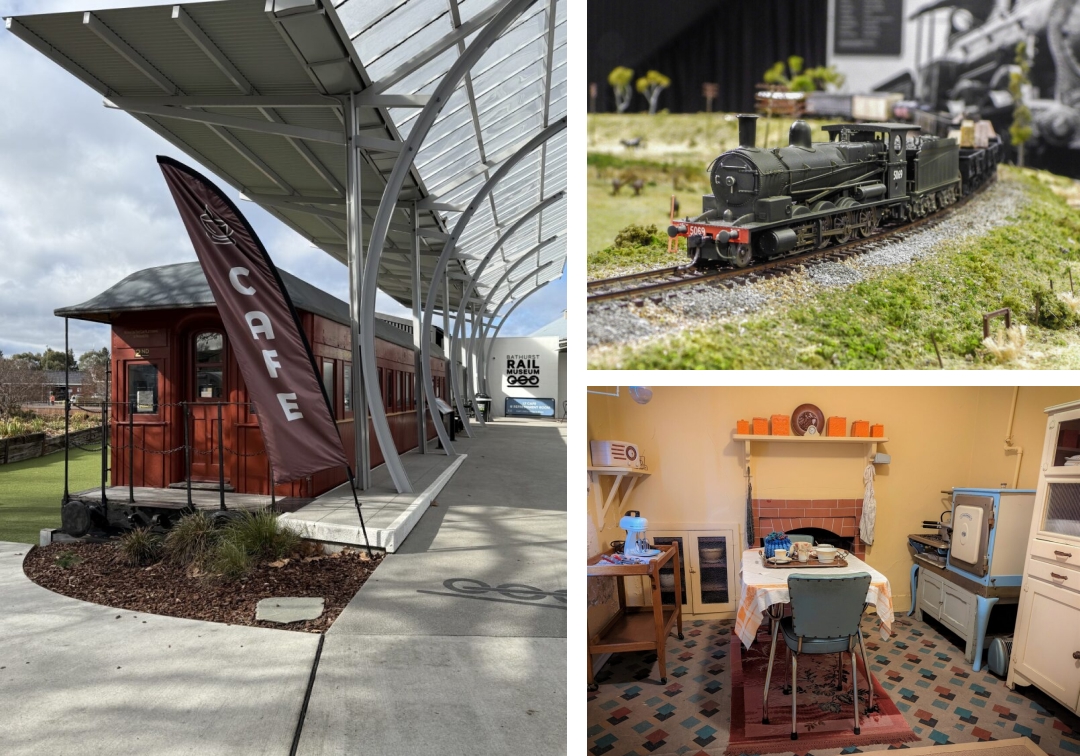
Right: Views of the model railway at the Bathurst Rail Museum and the Chifley Home, images courtesy of Museums Bathurst. Left: outside the Bathurst Rail Museum, with the carriage as café seating
This racing museum is part of the wider Museums Bathurst, a combination of four very different museums run by the Bathurst Regional Council.
I do want to see the Bathurst Rail Museum, which tells the story of the Great Western Railway coming to Bathurst, plus more besides, and has an extraordinary draw card – an extensive (tennis-court size) model railway, where the trains run between detailed scale models of seven local stations as they once were in the 1950s-60s.
And there’s the Chifley Home, a house museum that presents the home and belongings of Ben Chifley and his wife, Elizabeth, as it was in the 1940s. Ben Chifley was a Labor politician and Australia’s Prime Minister (1945-1949) and this house is an alluring time capsule.
I’m also drawn by another house museum, Miss Traill’s House, a National Trust site, but time is limited. Next time, is my decision for all three sites.
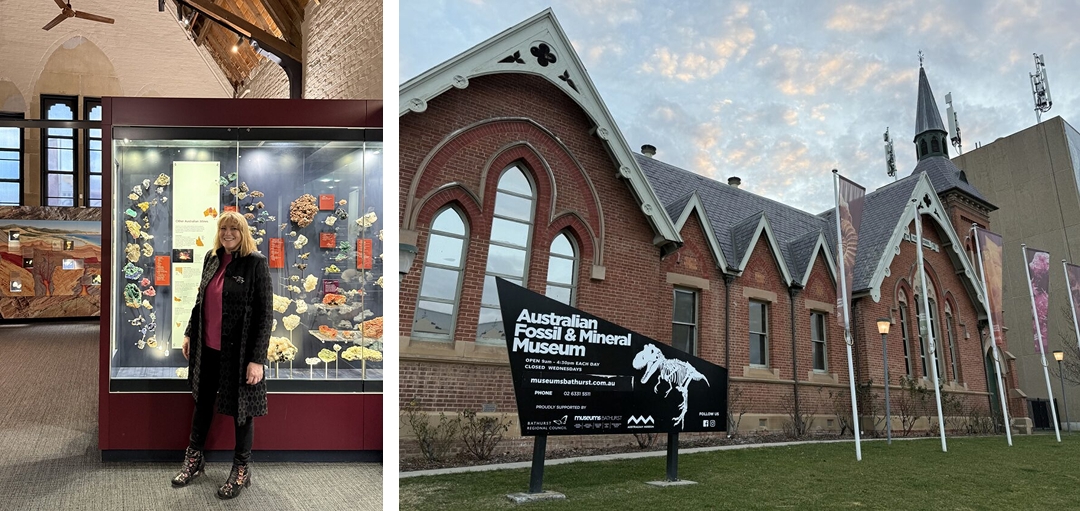
At the Australian Fossil & Mineral Museum, Museums Bathurst, with Penny Packham
The Australian Fossil and Mineral Museum is my second Museums Bathurst visit this trip. The Museum Co-ordinator, Penny Packham, shows me around the temporary exhibition space currently set up to spark thought and conversation about how critical minerals are used.
And then we see what this museum is most famous for: the Sommerville Collection of minerals and fossils, held in joint custodianship with the Australian Museum, and amassed over a lifetime by Warren Sommerville AM.
How do you sum this collection up? Spectacular. Diverse. International in scope. Inclusive of rarities. World-class, with specimens of an astonishing quality more often found in museums in metropolitan centres. And enormous – around 5000 specimens in total, with some in storage.
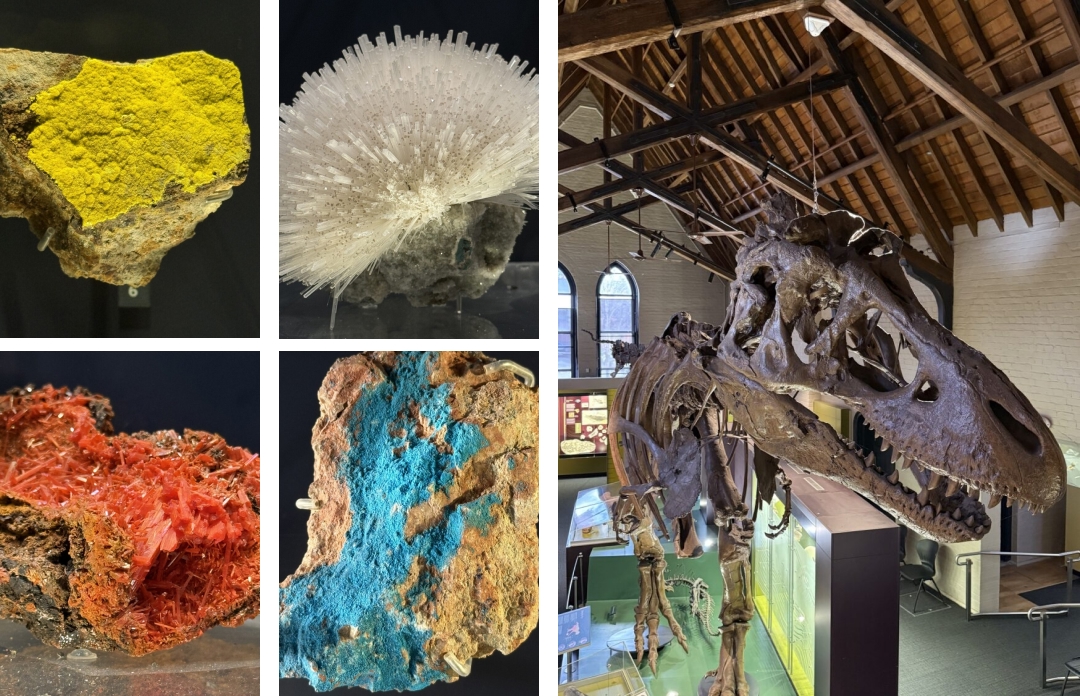
At the Australian Fossil & Mineral Museum, Museums Bathurst. Top left: Vanuralite (a uranium mineral) from Franceville, Gabon. Middle top: Scolecite from Pandula Hill Quarry, Nasik. Bottom left: Crocoite from Dundas, TAS. Middle bottom: Lavendulan, Anorak Region, Iran. Right: fossil gallery with Tryannosaurus rex skeleton
Penny draws my attention to various specimens, including the needly red crocoite from Dundas, TAS. There’s no other place in the world where crocoite crystals are known to grow so big. Penny says that as Warren bought and traded specimens on the international market, rarities such as these, obtained via his contacts in Dundas, really helped him to acquire such an amazing collection.
To re-assure parents with young children: yes, there are dinosaurs on display, two in fact. The largest is a Tyrannosaurus rex, its head high in the soaring ceiling space of the Museum’s 1876 building, designed by George Allen Mansfield and originally the Bathurst Public School.
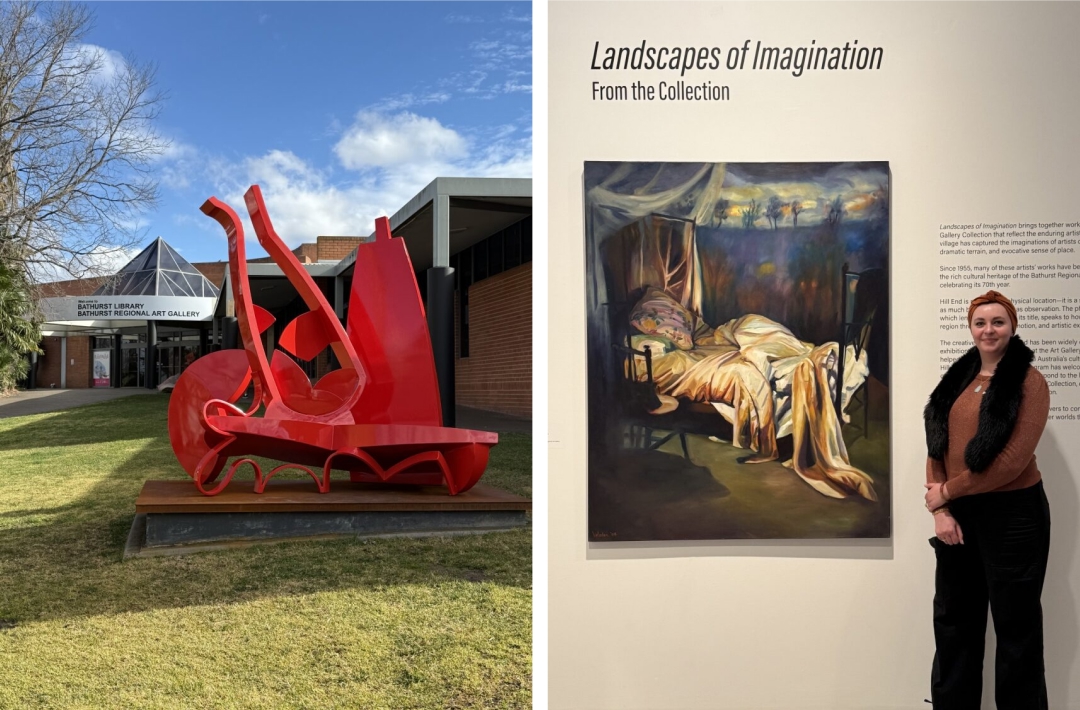
At the Bathurst Regional Art Gallery with Camille Gillyboeuf. Right: Landscapes of Imagination: From the Collection exhibition, 2025; Rosemary Valadon, Jean Bellette’s Bed, 2004, oil paint on canvas
Now, for art…
There are other places to see art around Bathurst, including the monthly Bathurst Arts Trail to studios, but the Bathurst Regional Art Gallery (BRAG) run by the Council is the city’s prime art destination.
BRAG presents temporary exhibitions. One of the two current exhibitions is drawn from its significant collection and, as luck has it, this is Landscapes of Imagination: From the Collection which solely shows art about Hill End and closes 9 November 2025.
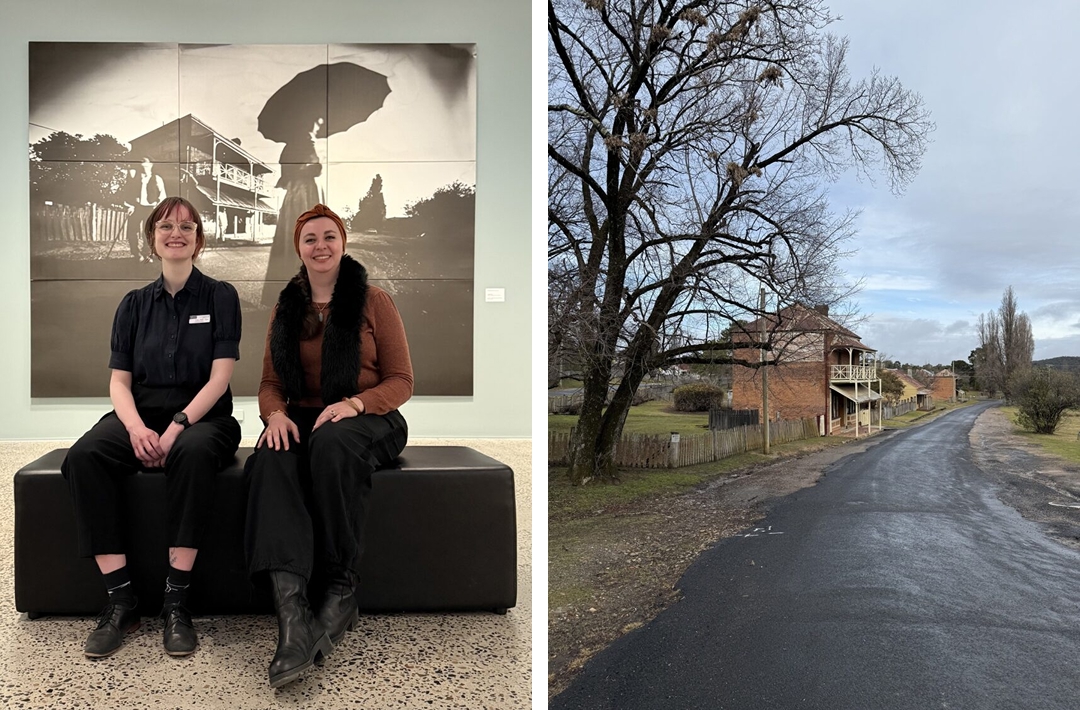
Left: At the Bathurst Regional Art Gallery with Camille Gillyboeuf and Calina MacGinley Jamieson, Landscapes of Imagination: From the Collection exhibition, 2025; Tamara Dean and Dean Sewell, Untitled, 2005, pinhole photograph on canvas. Right: Street view, Hill End
Camille Gillyboeuf and Calina MacGinley Jamieson have curated this exhibition, with Calina assisting Camille. They take me through it, talking about the works and the creation of the exhibition, with one challenge being to select only these art works from a much larger range of Hill End-relevant works in BRAG’s collection.
The result? A wonderful, intriguing range of widely varying imaginative responses to Hill End, 41 works by 20 artists, placed to make an evocative combination over three exhibition rooms.
You see painting, drawing, printmaking, photography, sculpture, illustrated writing, a film animation, and a medium infrequently seen in contemporary art – a tapestry that was realised by the Australian Tapestry Workshop on a design by Luke Sciberras, one of the best known of the artists who now live in Hill End.
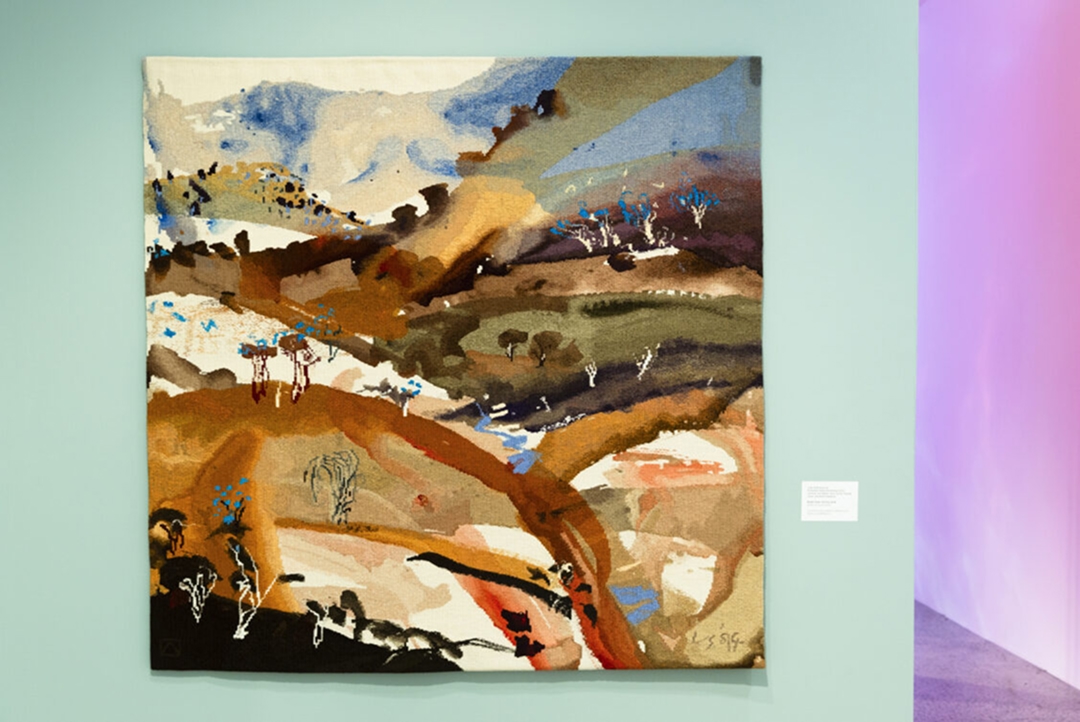
At the Bathurst Regional Art Gallery (BRAG). Landscapes of Imagination: From the Collection exhibition, 2025; Luke Sciberras with the Australian Tapestry Workshop, The Bridle Track, 2019, cotton and wool. Image by Silversalt Photography, provided courtesy of BRAG
Some works were created during BRAG’s Hill End Artists in Residence Program (Hill End AiR), and that’s no surprise once you know that 350 residencies have resulted from this program, running 1999–2021 and in hiatus since. The recipients gained the invaluable opportunity to stay and work in one of the two cottages in Hill End that are a significant part of Australian art history.
Before my trip, Camille encouraged me to experience the exhibition to see the artists’ perspectives, and then go to see Hill End for myself. And I’m glad to drive up to Hill End the next day, with the artworks still fresh in my memory.
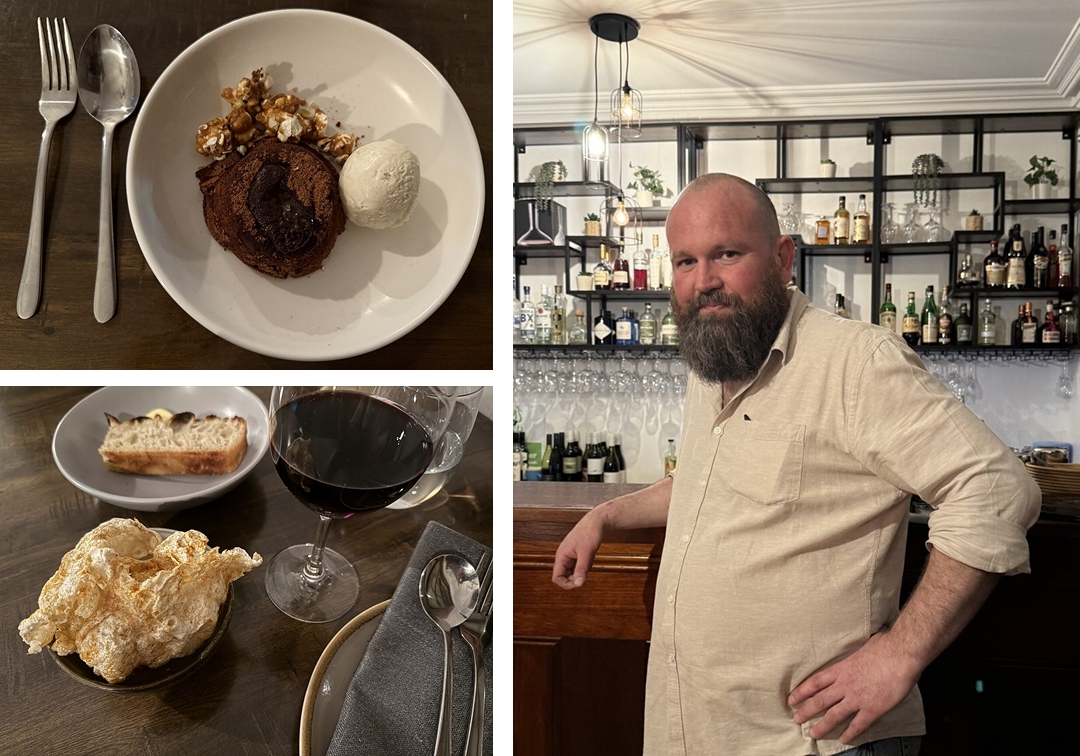
At Bootleg Dining with John Mannion
The city of Orange may be further down the road in establishing a profile as a food and beverage destination in this region, but Bathurst is catching up in this regard. Look in your rear vision mirror, Orange! Those who are closing the distance include the famed chef Matt Moran, who now owns The Rockley Pub in Rockley.
And I visit some of the other places that have got people enthusiastically recommending. One is upstairs in a heritage building in central Bathurst: Bootleg Dining. John and Kim Mannion who have worked in fine dining in Australia, Paris and Galway and that experience clearly shows at Bootleg.
John heads a kitchen focused on local produce and seasonal dishes, and Kim heads the front of house. I find attentive and welcoming service, memorably fine food and wine, and a comfortable and stylish small restaurant space with John also out front with the diners.
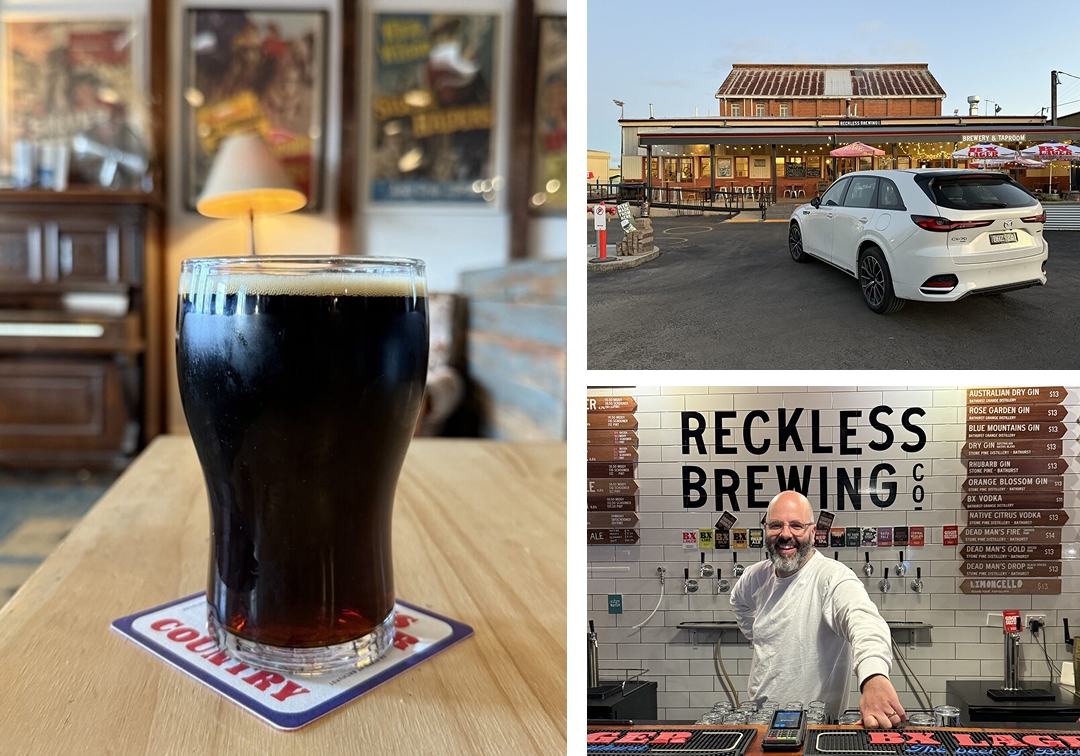
At Reckless Brewing with Jarrod Moore
Near the railway line there are several sights to see for industrial heritage aficionados, and one is a haven for craft beer lovers – Reckless Brewing Co. in the heritage-listed Crago Flour Mill building.
Grace Fowler gained her first experience and love of brewing in the craft beer scene of inner West Sydney. Now, Grace as the head brewer, and her partner, Jarrod Moore, and friend Alice Wilson, own a business with award-winning beers sold widely across Australia, and a popular venue.
I meet Jarrod at this venue and enjoy a beer from their range, offered alongside other drinks and food in a large, laid-back setting to relax and play in – table tennis, anyone? Or table soccer?
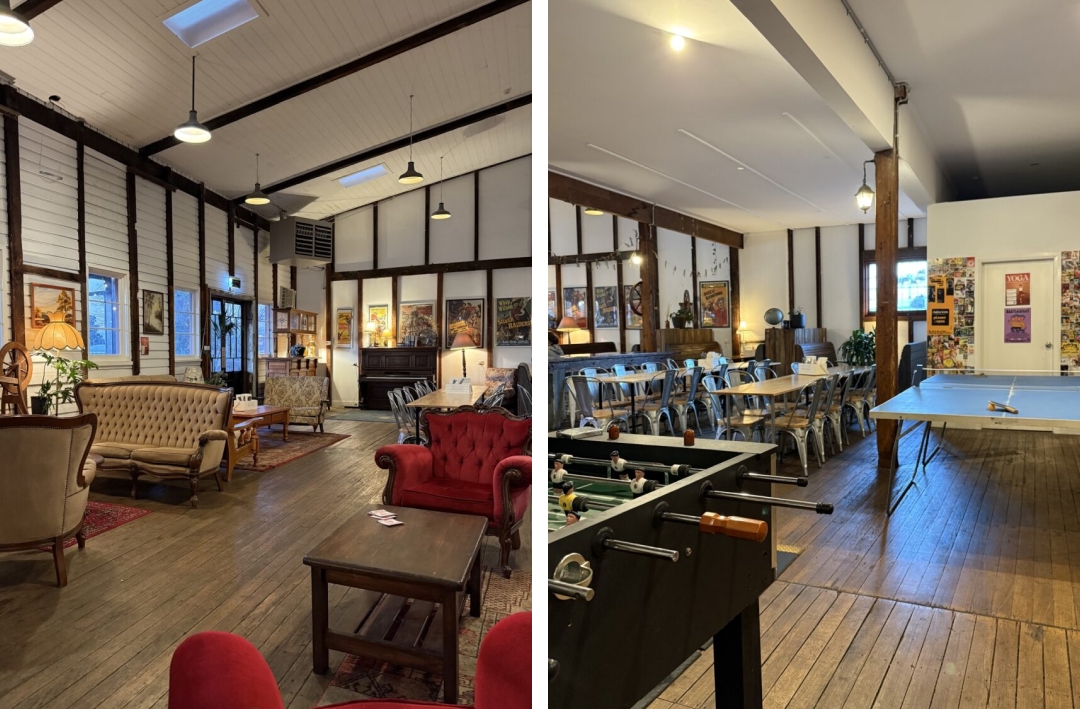
At Reckless Brewing
There are vineyards in the Bathurst area too, but whisky and winter have been indelibly paired in my mind since Abercrombie House – the effect of talking about Scots by a fire before heading out into icy cold air, I suspect.
Turning the CX-70 towards home, I head for The Grange Distillery, just out of Bathurst. Toby Jones is the distiller and a farmer as well – he took on his parents’ sheep farm and then diversified into spirits.
This state heritage listed farm is part of the land granted early (1820s) to John West, who named his farm The Grange. There are significant historical elements still in place here, and the old and new of the Jones’s farm make a picturesque setting for the distillery.
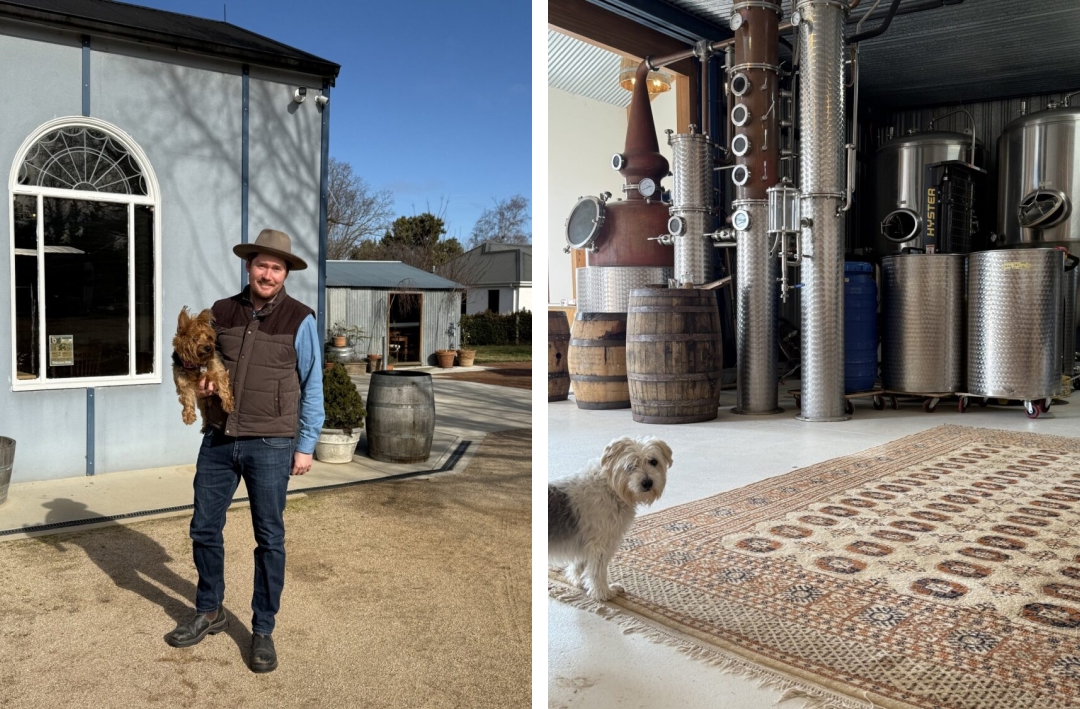
At The Grange Distillery with Nick Jones
It’s family run, and I talk with Toby’s wife, Sue, and son, Nick, and enjoy tasting gins and whiskeys beside the gleaming stills with which Toby is making award-winning spirits.
I select a bottle of whisky as a trip memento that’s uniquely from here, when the water and the heritage variety of barley for the whiskeys (and the juniper and other botanicals for the gins) are sourced from the property.
It’s not hard to fit this one bottle into the absolute oodles of space around my luggage in the CX-70’s capacious boot – 598 litres just at its smallest, seats up, luggage tray closed.
I unwrap myself from my coat and scarf a last time, and step into the CX-70 fast. Pitstop speed and smoothness achieved.
Music sent to the CX-70’s 12 fine BOSE speakers…
Warm, luxury comforts set…
Panoramic sunroof unopened…
I drive away, already planning a sunroof appropriate timing for my next visit to Bathurst, a place for motorsport and much more.
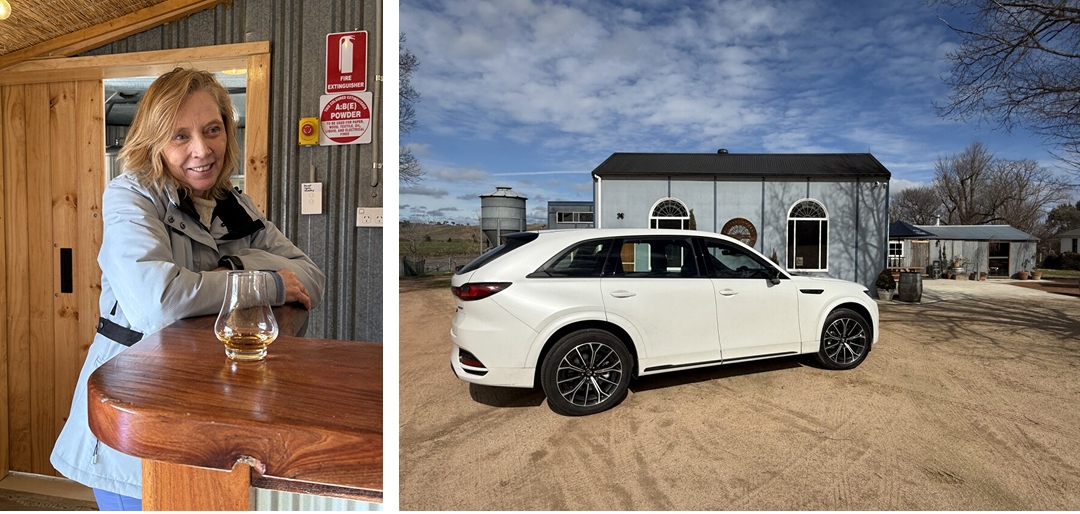
At The Grange Distillery with Sue Jones